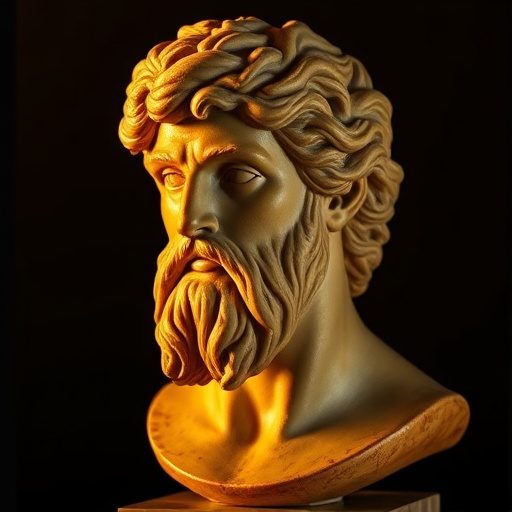
Pythagoras — "It is not possible to conceal a base mind by a fair face."
It is not possible to conceal a base mind by a fair face.
It is not possible to conceal a base mind by a fair face.
Click any product to generate a realistic preview. Up to 3 at a time.
* Initial load can take up to 90 seconds — revising the preview in another color is nearly instant.
"Lust weakens both body and mind."
"Do not put your hand to anything without thinking."
"In no way neglect the health of your body; But give it drink and food in due measure, and also the exercise of which it has need."
"There is geometry in the humming of the strings. There is music in the spacing of the spheres."
"The soul of man is immortal and that it changes into other kinds of animals."
Greek philosopher and mathematician whose school in Croton combined geometry (the Pythagorean theorem), number-mysticism, and a religious-vegetarian way of life. Closely associated with Thales of Miletus (earlier pre-Socratic and the first philosopher). For an intellectual contrast, see Heraclitus, pre-Socratic Greek philosopher of flux — Heraclitus called Pythagoras 'the chief of swindlers' — among the founding insults of the philosophical-rivalry tradition. Their 'all is flux' vs 'all is number' poles still organize the philosophy of mathematics today (Platonist vs anti-realist).
Found in 1 providers: grok
1 source checked
A person's physical attractiveness cannot hide the ugliness of their inner character. No matter how beautiful or well-groomed someone appears on the outside, a cruel, petty, or corrupt mind will eventually reveal itself through words, actions, and expressions. True character shows through, making outward appearance a poor disguise for moral deficiencies. Beauty is surface; character is substance.
Pythagoras led a philosophical brotherhood demanding rigorous self-examination, silence, and moral purification alongside mathematical study. His school required years of probation to test initiates' character, not their appearances or intellect alone. He taught that the soul's harmony mattered more than external form, believing inner virtue and outer reality were intertwined, echoing his conviction that numbers and ethics both revealed hidden truths beneath surface appearances.
In 6th-century BCE Greek society, physical beauty was culturally prized, linked to divine favor and civic virtue through the ideal of kalokagathia—beauty and goodness fused. Aristocratic appearance often signaled status and presumed moral worth. Pythagoras, founding his community in Croton, pushed back against this superficial equation, emphasizing purification of soul over body. His era wrestled with distinguishing genuine virtue from aristocratic performance, making such warnings about deceptive exteriors philosophically urgent.
AI-generated insights based on extensive research and information for context. Factual errors? Email [email protected].
Your cart is empty