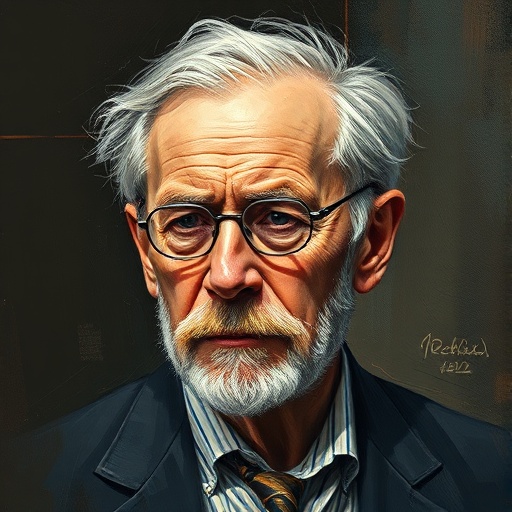
Erwin Schrodinger — "The only possible interpretation of quantum theory is that there are no particle…"
The only possible interpretation of quantum theory is that there are no particles.
The only possible interpretation of quantum theory is that there are no particles.
Click any product to generate a realistic preview. Up to 3 at a time.
* Initial load can take up to 90 seconds — revising the preview in another color is nearly instant.
"We are thus faced with the following dilemma: either the cells of the organism contain a highly efficient 'memory' for all the details of previous events, or they are, in some mysterious way, able to …"
"A theoretical science, like any other human activity, is entirely a matter of taste."
"The human mind is not capable of grasping the universe. We are like a little child entering a huge library. The walls are covered to the ceilings with books in many different tongues. The child knows …"
"The only real valuable thing is intuition."
"The task is not so much to see what no one has yet seen; but to think what nobody has yet thought, about that which everybody sees."
Austrian physicist who shared the 1933 Nobel for the wave equation that bears his name and the famous cat thought-experiment. Closely associated with Werner Heisenberg (matrix-mechanics rival who reached the same physics by different math) and Albert Einstein (his pen-pal on quantum interpretation). For an intellectual contrast, see Niels Bohr, Danish physicist and architect of the Copenhagen interpretation — Schrödinger's cat thought-experiment was specifically designed to ridicule Bohr's 'observer-dependent reality' reading of quantum mechanics — Schrödinger thought the Copenhagen interpretation was absurd; the cat was meant as reductio ad absurdum.
Attributed, reflecting his wave-only interpretation of quantum mechanics.
Date: Circa 1920s
EducationalFound in 1 providers: grok
1 source checked
Quantum physics reveals that the fundamental building blocks of reality are not tiny solid objects but continuous waves of probability. What we call particles are merely localized disturbances in underlying fields — abstractions we invented for convenience. The universe at its core is wave-like and smeared, not made of discrete billiard-ball objects bouncing around in empty space.
Schrödinger formulated wave mechanics in 1926, mathematically describing quantum systems as continuous wave functions rather than discrete particles. His famous wave equation remains foundational physics. His thought experiment with the cat satirized the Copenhagen interpretation's probabilistic collapse of quantum states, reflecting his deep discomfort with treating particles as fundamental — he believed waves were the truer physical reality.
The 1920s–30s saw fierce debate between competing quantum interpretations. Heisenberg's matrix mechanics and Bohr's Copenhagen interpretation treated particles as fundamental, with wave behavior as probabilistic abstraction. Schrödinger opposed this, siding with de Broglie's wave-centric view. Einstein shared similar unease. The era's physics community was fracturing over whether quantum mechanics described reality or merely predicted measurement outcomes.
AI-generated insights based on extensive research and information for context. Factual errors? Email [email protected].
Your cart is empty