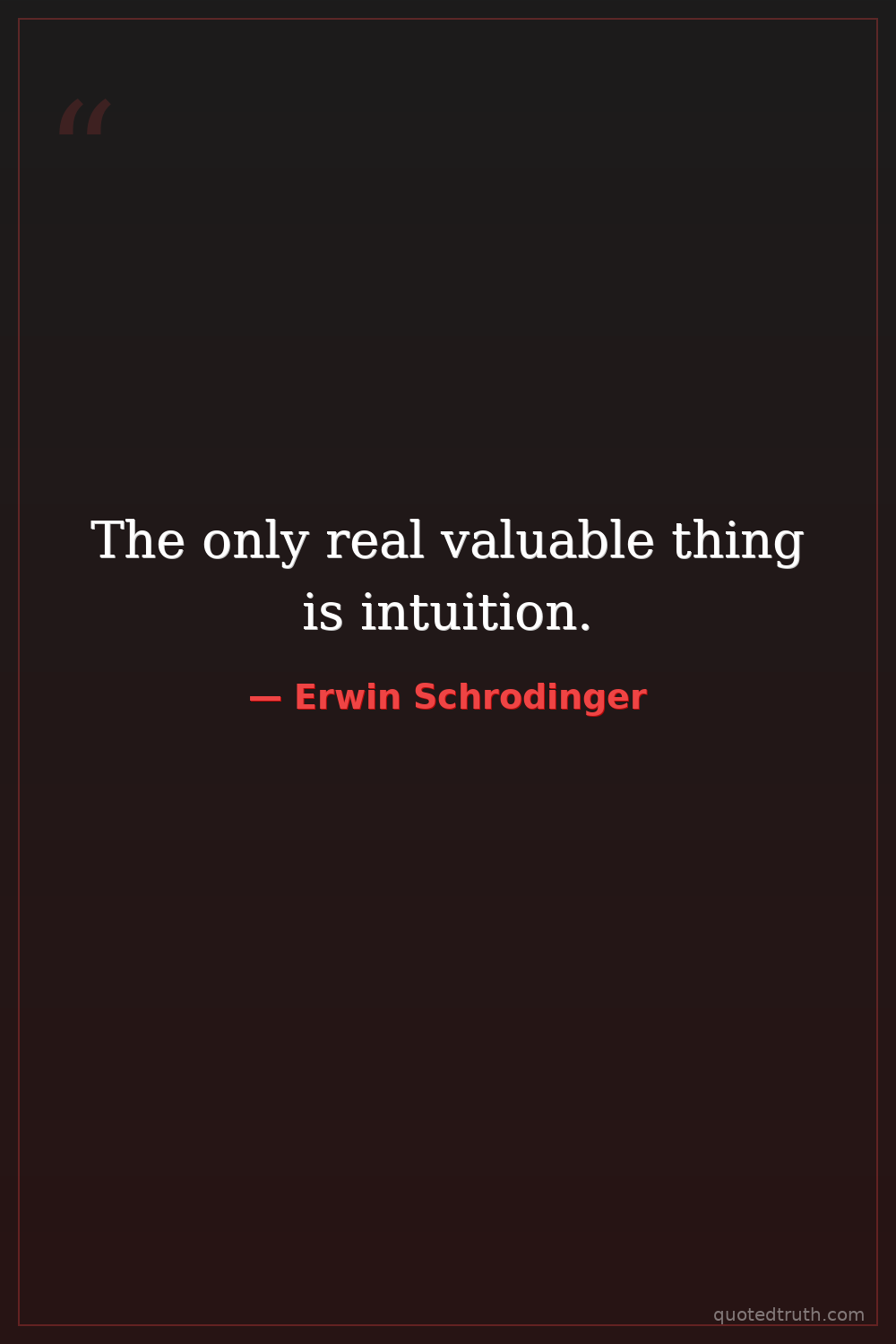
Erwin Schrodinger — "The only real valuable thing is intuition."
The only real valuable thing is intuition.
The only real valuable thing is intuition.
Click any product to generate a realistic preview. Up to 3 at a time.
* Initial load can take up to 90 seconds — revising the preview in another color is nearly instant.
"We do not belong to this material world that science constructs for us. We are not in it; we are outside. We are only spectators. The reason why we believe that we are in it, that we belong to the pic…"
"The true path to knowledge is to question everything."
"Quantum mechanics is a wonderful theory. But it is not the last word."
"The only constant in life is change."
"My solution was not motivated by the desire to reduce the number of independent constants in nature, but rather by the desire to avoid the infinite self-energy of the electron."
Austrian physicist who shared the 1933 Nobel for the wave equation that bears his name and the famous cat thought-experiment. Closely associated with Werner Heisenberg (matrix-mechanics rival who reached the same physics by different math) and Albert Einstein (his pen-pal on quantum interpretation). For an intellectual contrast, see Niels Bohr, Danish physicist and architect of the Copenhagen interpretation — Schrödinger's cat thought-experiment was specifically designed to ridicule Bohr's 'observer-dependent reality' reading of quantum mechanics — Schrödinger thought the Copenhagen interpretation was absurd; the cat was meant as reductio ad absurdum.
Found in 1 providers: grok
1 source checked
Intuition — the direct, pre-analytical sense that something is true — is more foundational than data, logic, or formal method. Structured reasoning always builds on top of an initial flash of recognition that cannot itself be reasoned into existence. Real breakthroughs begin with an almost physical certainty that something is right, and the mathematics or evidence arrives afterward to confirm what intuition already grasped.
Schrödinger developed his wave equation during a late-1925 ski holiday in Arosa — an intuitive leap treating electrons as matter waves, not point particles, before a rigorous derivation existed. His career consistently trusted cross-domain intuition: 'What is Life?' (1944) connected quantum physics to genetics decades before DNA's structure was known, directly inspiring Crick and Watson. For him, the equation always followed the vision.
Schrödinger worked during the 1920s quantum revolution, when Newtonian physics was collapsing under phenomena — electron diffraction, atomic spectra — that defied classical intuition entirely. Physicists had to construct frameworks for a reality no human could directly observe or visualize. When sensory experience and prior logic both fail simultaneously, raw intuition becomes the only navigational tool. The entire quantum project was, in this sense, a sustained collective act of trusting it.
AI-generated insights based on extensive research and information for context. Factual errors? Email [email protected].
Your cart is empty