Erwin Schrodinger — "The task is not so much to see what no one has yet seen; but to think what nobod…"
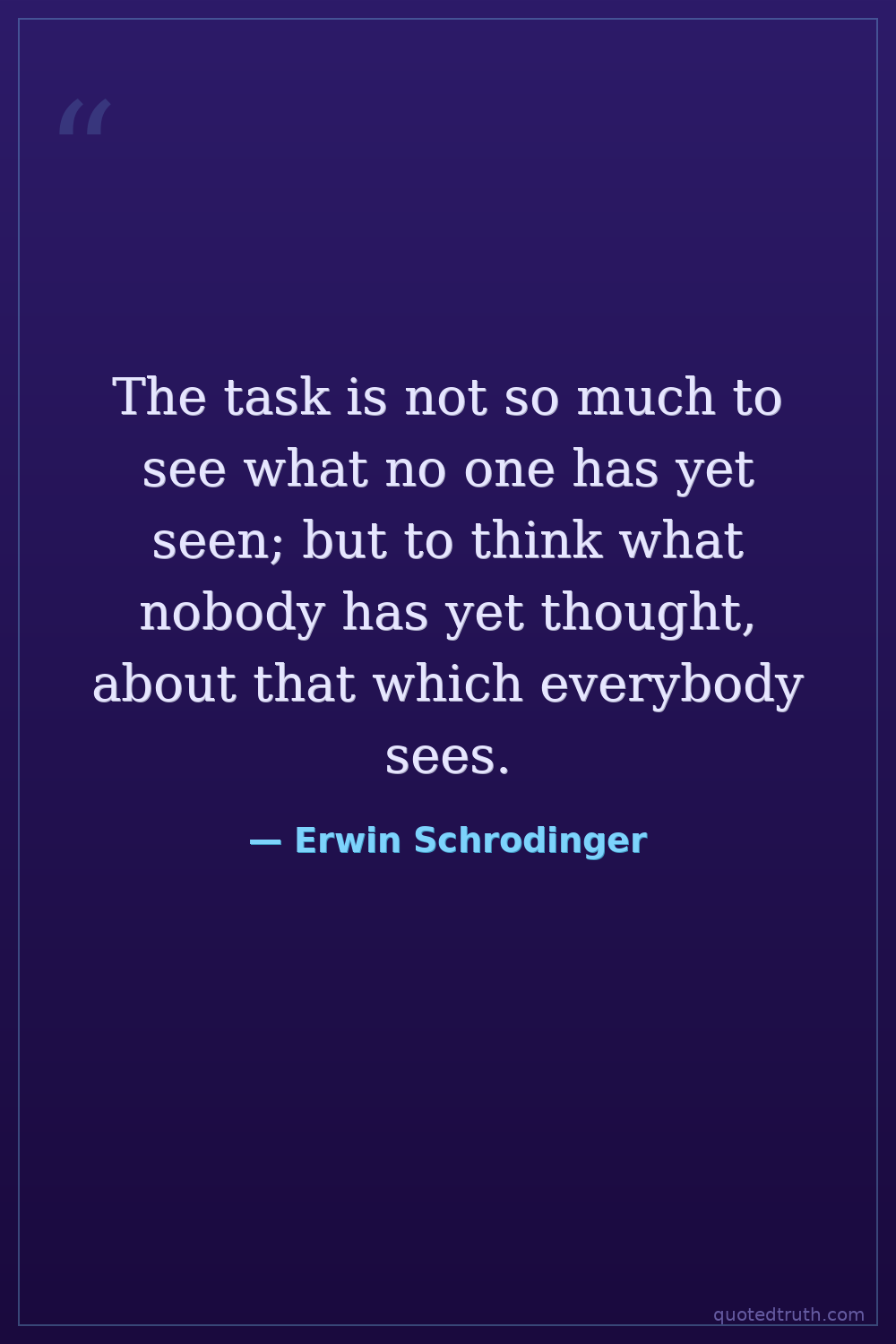
The task is not so much to see what no one has yet seen; but to think what nobody has yet thought, about that which everybody sees.
The task is not so much to see what no one has yet seen; but to think what nobody has yet thought, about that which everybody sees.
Click any product to generate a realistic preview. Up to 3 at a time.
* Initial load can take up to 90 seconds — revising the preview in another color is nearly instant.
"The reason why our sentient, percipient and thinking ego is met nowhere within our scientific world picture can easily be indicated in seven words: because it is itself that world picture."
"The world is a puzzle, and we are here to solve it."
"The world is full of wonders, and it is our task to explore them."
"The idea that consciousness is a phenomenon of the brain is an illusion. Consciousness is a fundamental property of the universe, and the brain is merely an antenna that tunes into it."
"The greatest American art form is the comic strip."
Austrian physicist who shared the 1933 Nobel for the wave equation that bears his name and the famous cat thought-experiment. Closely associated with Werner Heisenberg (matrix-mechanics rival who reached the same physics by different math) and Albert Einstein (his pen-pal on quantum interpretation). For an intellectual contrast, see Niels Bohr, Danish physicist and architect of the Copenhagen interpretation — Schrödinger's cat thought-experiment was specifically designed to ridicule Bohr's 'observer-dependent reality' reading of quantum mechanics — Schrödinger thought the Copenhagen interpretation was absurd; the cat was meant as reductio ad absurdum.
Found in 1 providers: grok
1 source checked
True discovery isn't about observing something hidden or exotic — it's about rethinking what's already in plain sight. Anyone can look at the same phenomenon, but the rare thinker reframes it entirely, finding meaning others missed. Insight comes not from privileged access to new data, but from the courage and originality to interpret familiar reality in ways no one has dared before.
Schrödinger spent his career doing exactly this — quantum mechanics didn't require new astronomical instruments or exotic materials. Electrons, atoms, light: phenomena physicists already studied. His 1926 wave equation reframed existing observations through radical new mathematics. His famous cat paradox reexamined everyday logic about states of being. He consistently took familiar problems and rebuilt their conceptual foundations from scratch.
Early 20th-century physics was experiencing a crisis of interpretation. Classical Newtonian mechanics had explained the visible world for centuries, yet the same familiar phenomena — light, electrons, atomic spectra — defied those frameworks at small scales. Schrödinger's era demanded not new telescopes but new thinking. The quantum revolution succeeded precisely because theorists reimagined what everyone already observed rather than seeking undiscovered territory.
AI-generated insights based on extensive research and information for context. Factual errors? Email [email protected].
Your cart is empty