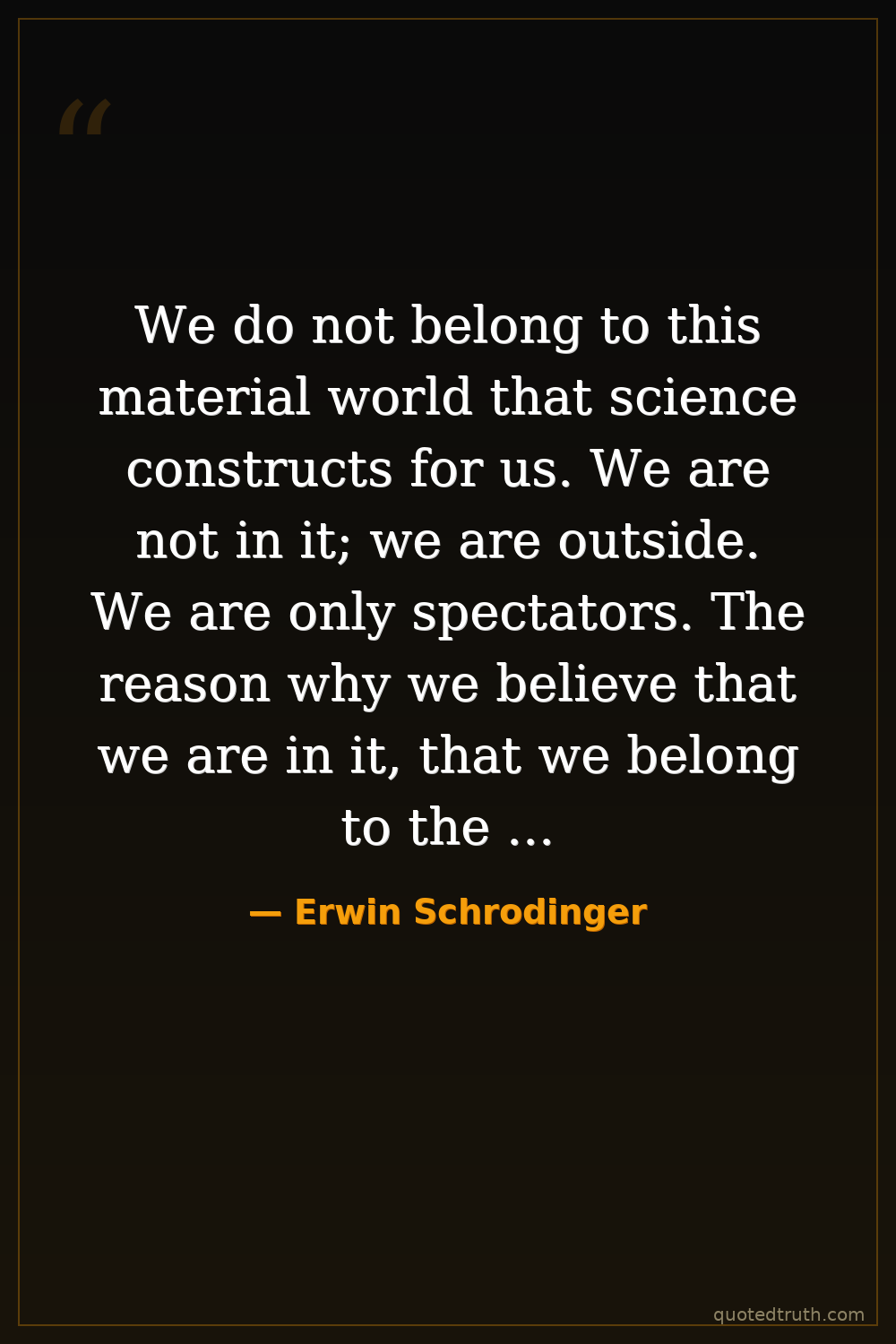
Erwin Schrodinger — "We do not belong to this material world that science constructs for us. We are n…"

We do not belong to this material world that science constructs for us. We are not in it; we are outside. We are only spectators. The reason why we believe that we are in it, that we belong to the picture, is that our bodies are in the picture. Our bodies belong to it. Not only my own body, but those of my friends, also of my dog and cat and horse, and of all the other people and animals. And this is my only means of communicating with them.
Erwin Schrodinger — Erwin Schrodinger Modern · Wave mechanics

Get This Quote & Author's Image Illustrated On:

Click any product to generate a realistic preview. Up to 3 at a time.
* Initial load can take up to 90 seconds — revising the preview in another color is nearly instant.

Kitchen

Apparel

Other

About Erwin Schrodinger (1887-1961)

Austrian physicist who shared the 1933 Nobel for the wave equation that bears his name and the famous cat thought-experiment. Closely associated with Werner Heisenberg (matrix-mechanics rival who reached the same physics by different math) and Albert Einstein (his pen-pal on quantum interpretation). For an intellectual contrast, see Niels Bohr, Danish physicist and architect of the Copenhagen interpretation — Schrödinger's cat thought-experiment was specifically designed to ridicule Bohr's 'observer-dependent reality' reading of quantum mechanics — Schrödinger thought the Copenhagen interpretation was absurd; the cat was meant as reductio ad absurdum.

Details

From 'Nature and the Greeks', expressing a radical separation of consciousness from the material world.

Date: 1954

Shocking

Verification

Unverifiable

Found in 1 providers: gemini

1 source checked

Understanding this quote

What it means

Reality as described by physics is not where consciousness actually lives. Our minds observe the physical world from outside it, like an audience watching a play. We mistakenly think we are inside this world only because our bodies are physical objects within it. Bodies are the interface, the only channel through which one mind can reach another mind, whether human or animal. Subject and object are fundamentally separate.

Relevance to Erwin Schrodinger

Schrodinger, who formulated wave mechanics in 1926 and won the 1933 Nobel Prize, spent his later years grappling with consciousness and Vedanta philosophy. His 1944 book What Is Life? and 1958 Mind and Matter argued the observing mind cannot be located in the physical equations he helped write. A devoted dog and cat owner, he genuinely puzzled over how separate minds connect through mere bodies, an obsession dating from his Vienna upbringing.

The era

Mid-twentieth-century physics had just dismantled classical certainty through quantum mechanics and relativity, forcing scientists to confront the observer's role in measurement. Logical positivism dominated philosophy, insisting only empirical claims had meaning. Against this, Schrodinger and Heisenberg pushed back, drawing on Eastern thought as Europe rebuilt after World War II. Watson and Crick's 1953 DNA discovery raised fresh questions about whether biology reduced mind to molecules, the exact reduction Schrodinger resisted.

AI-generated insights based on extensive research and information for context. Factual errors? Email [email protected].
Your Cart

Your cart is empty