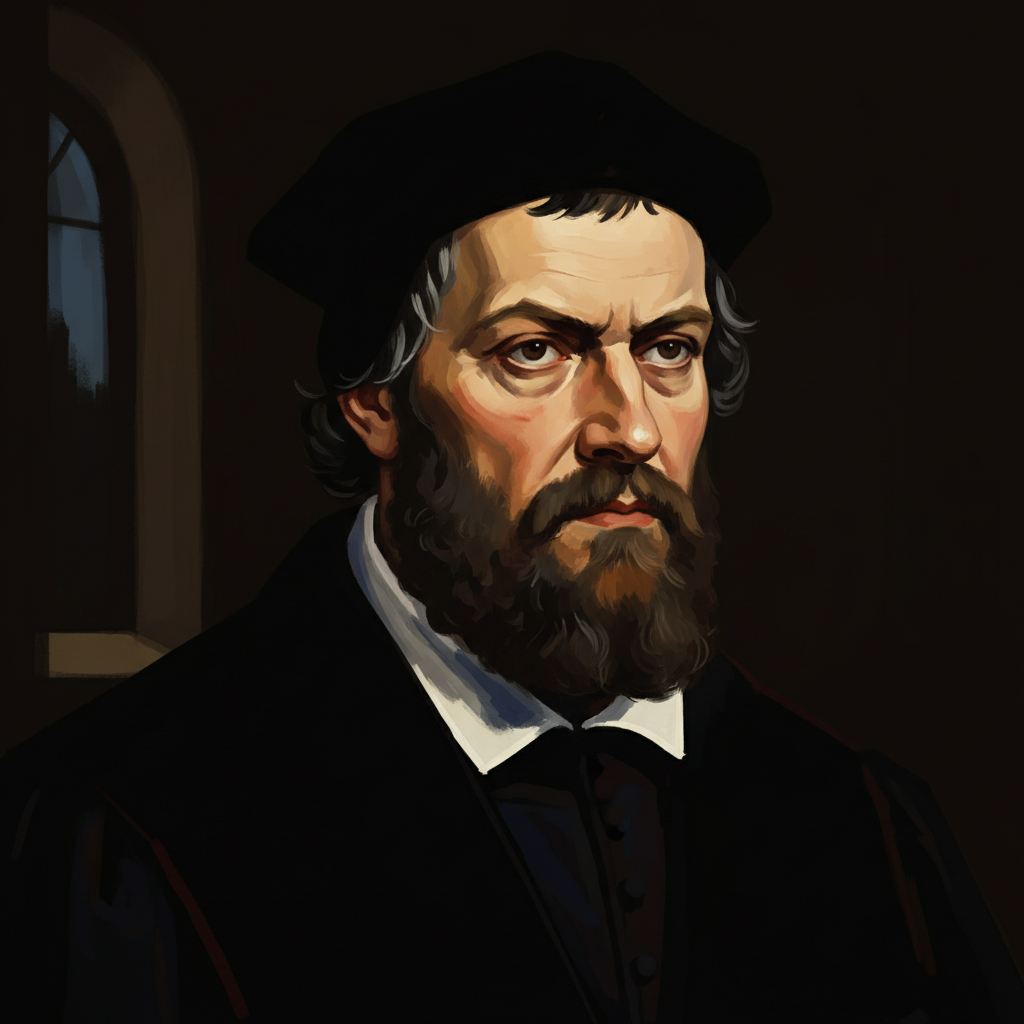
Martin Luther — "The Pope is a mere tormentor of conscience."
The Pope is a mere tormentor of conscience.
The Pope is a mere tormentor of conscience.
Click any product to generate a realistic preview. Up to 3 at a time.
* Initial load can take up to 90 seconds — revising the preview in another color is nearly instant.
"The church is not a pen-house but a mouth-house."
"The greatest gift of God is a pious, cheerful, God-fearing, home-loving wife, to whom you can entrust your property, and your children, and your all."
"I am afraid that the schools will prove the very gates of hell, unless they diligently labor in explaining the Holy Scriptures and engraving them in the heart of the youth."
"If I am to be executed, I would rather be executed by the Pope than by my own people."
"Every man must do two things alone; he must do his own believing and his own dying."
German theologian whose 95 Theses (1517) launched the Protestant Reformation and broke the Catholic Church's monopoly on Western Christianity. Closely associated with Philipp Melanchthon (Lutheran systematizer) and John Calvin (later Reformer who built on Luther's break). For an intellectual contrast, see Pope Leo X, Renaissance pope (1513-1521) — Leo X's indulgence sales triggered Luther's break and Leo excommunicated him in 1521 — Luther's entire Reformation is structured as a direct answer to the indulgence-funded Vatican Leo represented.
Found in 1 providers: gemini
1 source checked
The statement accuses the Pope of inflicting needless psychological and spiritual suffering on believers. Rather than guiding souls toward peace with God, papal authority is pictured as weaponizing guilt, fear, and obligation to control people. The Pope imposes rules, penances, and threats that trap ordinary Christians in anxiety about their salvation. Instead of being a shepherd, he functions as a jailer of the inner life, keeping consciences in chronic torment rather than granting relief.
Luther spent years as an Augustinian monk crushed by scrupulosity, fasting, confessing, and flagellating himself trying to earn God's favor. His breakthrough on justification by faith convinced him the papal system had manufactured that torment. After posting his 95 Theses in 1517 against indulgences, he increasingly cast the Pope as the Antichrist. This line distills his core grievance: Rome sold spiritual peace it had no authority to withhold, profiting from the very anxiety it created in believers.
In early sixteenth-century Europe, the Catholic Church dominated spiritual and civic life. Indulgences, relics, purgatory, mandatory confession, and papal decrees regulated salvation itself. Johann Tetzel's indulgence campaign to fund St. Peter's Basilica was underway when Luther wrote. The printing press let his German pamphlets spread explosively, while German princes chafed under Roman taxation and interference. Calling the Pope a conscience-tormentor was not abstract theology but a direct political and pastoral attack that helped ignite the Reformation.
AI-generated insights based on extensive research and information for context. Factual errors? Email [email protected].
Your cart is empty