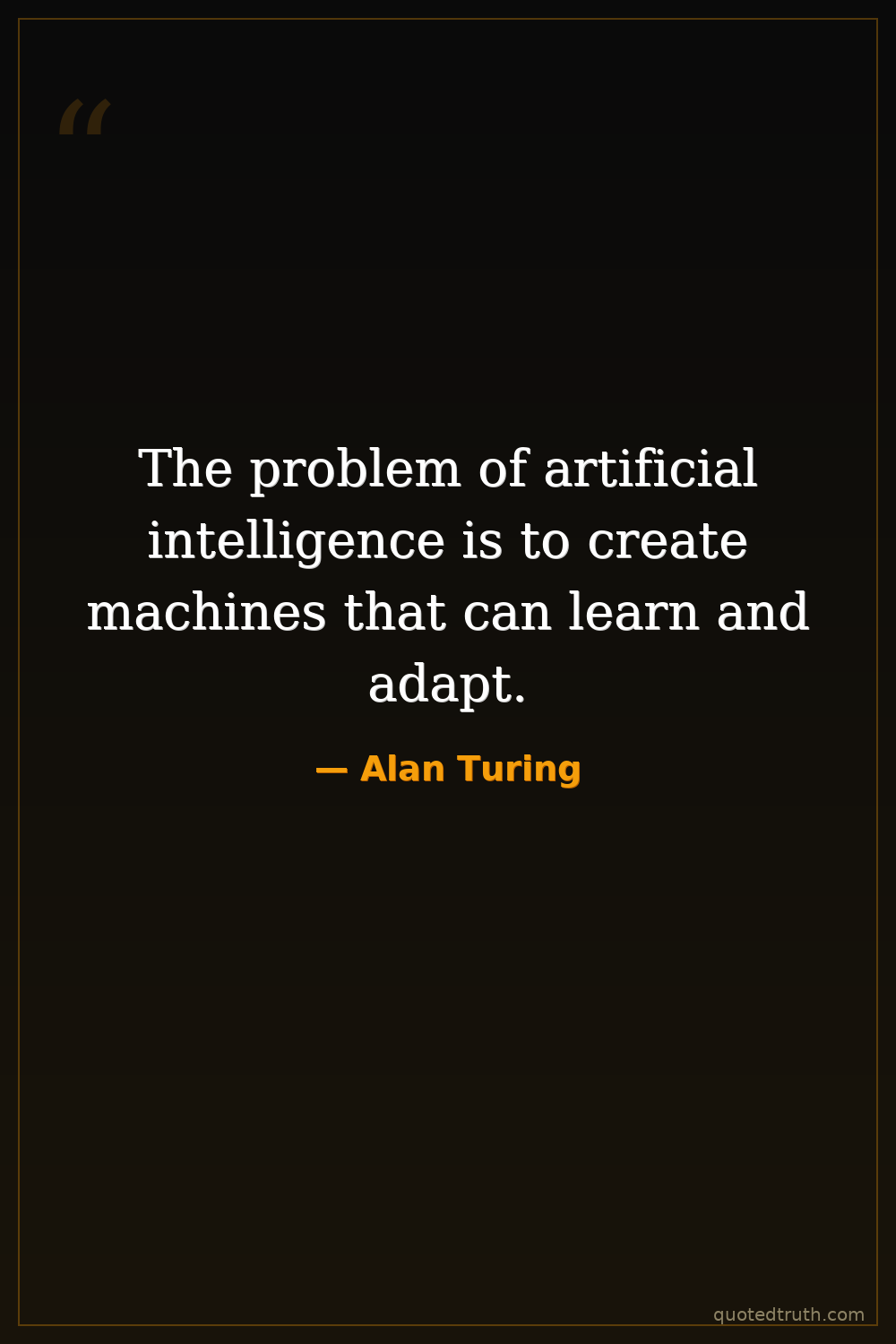
Alan Turing — "The problem of artificial intelligence is to create machines that can learn and …"
The problem of artificial intelligence is to create machines that can learn and adapt.
The problem of artificial intelligence is to create machines that can learn and adapt.
Click any product to generate a realistic preview. Up to 3 at a time.
* Initial load can take up to 90 seconds — revising the preview in another color is nearly instant.
"I am not very impressed with theological arguments whatever they may be used to support. Such arguments have often been found unsatisfactory in the past. In the time of Galileo it was argued that the …"
"We are trying to make a brain."
"Science without religion is lame, religion without science is blind."
"The machine should be able to understand what it is doing."
"The human brain is an electrical machine."
Attributed, general implication from his writings, but exact quote is elusive.
Date: Approx. 1950s
ShockingFound in 1 providers: grok
1 source checked
True artificial intelligence isn't about programming rigid rules into a machine—it's about creating systems that grow from experience and adjust to new situations on their own. A machine that only executes fixed instructions isn't intelligent; intelligence requires the ability to encounter something unfamiliar and figure it out. Adaptability is what separates a thinking system from a sophisticated calculator.
Turing's 1950 paper 'Computing Machinery and Intelligence' asked 'Can machines think?' and proposed the imitation game to test it. His Bletchley Park codebreaking work showed him machines could outpace humans on fixed logic—but he recognized that wasn't enough. His theoretical work on machine learning and child-machine models reflected his conviction that genuine intelligence must grow, not merely execute.
In the late 1940s and early 1950s, the first electronic computers—ENIAC, Colossus—were celebrated but fundamentally static: fast calculators, nothing more. Cold War pressures pushed governments to automate intelligence work. 'Machine learning' didn't exist as a discipline yet. Turing's insistence that adaptability was the defining feature of intelligence was a radical reframe at a moment when most researchers equated computation with intelligence itself.
AI-generated insights based on extensive research and information for context. Factual errors? Email [email protected].
Your cart is empty