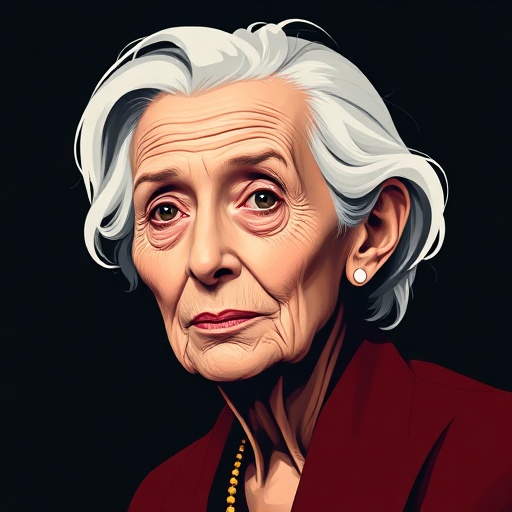
Jane Goodall — "If we don't change our ways, we are heading for disaster."
If we don't change our ways, we are heading for disaster.
If we don't change our ways, we are heading for disaster.
Click any product to generate a realistic preview. Up to 3 at a time.
* Initial load can take up to 90 seconds — revising the preview in another color is nearly instant.
"We are all interconnected. What happens to one part of the world affects us all."
"Every day is a chance to make a difference."
"Only if we understand, will we care. Only if we care, will we help. Only if we help, shall all be saved."
"Every day is a new opportunity to make a positive impact on the world."
"The greatest lesson I learned from the chimpanzees is that we are all connected."
British primatologist who in 1960 began the longest-running wild primate study at Gombe Stream, transforming our understanding of chimpanzees. Closely associated with Dian Fossey (mountain-gorilla researcher) and Birutė Galdikas (orangutan researcher; together with Goodall and Fossey one of Louis Leakey's 'Trimates'). For an intellectual contrast, see Walter Palmer, American dentist who killed Cecil the Lion in Zimbabwe in 2015 — Palmer represents the trophy-hunting tradition Goodall's life's work has been organized against — the colonial-era hunter-naturalist worldview that treated primates and big game as specimens or trophies, which Goodall's Roots & Shoots and Jane Goodall Institute exist specifically to displace.
Found in 1 providers: grok
1 source checked
Unless humanity fundamentally alters how it treats the natural world—through unchecked consumption, habitat destruction, and pollution—civilization faces catastrophic consequences. The quote frames environmental neglect not as abstract risk but as a near-certain outcome of inaction. 'Our ways' implicates collective behavior: industrial farming, fossil fuel dependence, deforestation. The urgency lies in the present tense: disaster is not hypothetical, it is the direction we are already moving unless course is corrected.
Goodall spent over six decades documenting chimpanzee behavior at Gombe Stream in Tanzania, witnessing firsthand how deforestation, poaching, and human encroachment devastated primate populations. This transformed her from scientist into activist. She founded the Jane Goodall Institute in 1977 and launched Roots & Shoots globally. Her life's work is a living demonstration of this warning: she watched forest corridors disappear and chimp numbers collapse as humans failed to change course.
Goodall speaks as a contemporary witness to accelerating ecological breakdown. During her career, global carbon emissions tripled, species extinction rates rose to 1,000 times the natural baseline, and tropical forest cover shrank by nearly 20 percent. The IPCC issued increasingly dire climate reports from 1990 onward, and pandemic scientists warned that habitat destruction enables zoonotic spillover. Her era is precisely when warnings like this shifted from speculation to measurable, documented crisis.
AI-generated insights based on extensive research and information for context. Factual errors? Email [email protected].
Your cart is empty