Laozi — "The sage rules by emptying their minds and filling their bellies, by weakening t…"
The sage rules by emptying their minds and filling their bellies, by weakening their wills and strengthening their bones.
The sage rules by emptying their minds and filling their bellies, by weakening their wills and strengthening their bones.
Click any product to generate a realistic preview. Up to 3 at a time.
* Initial load can take up to 90 seconds — revising the preview in another color is nearly instant.
"The sage is sharp but not cutting, pointed but not piercing, straightforward but not unrestrained, brilliant but not dazzling."
"If a nation is to be great, it must be like a great river, it must flow freely in every direction."
"Do not exalt the talented, so that people will not be contentious. Do not value rare treasures, so that people will not steal. Do not display what is desirable, so that people will not be confused."
"If you do not change direction, you may end up where you are heading."
"Seal the openings, shut the doors, and until your last day you will not be exhausted. Widen the openings, interfere, and until your last day you will not be safe."
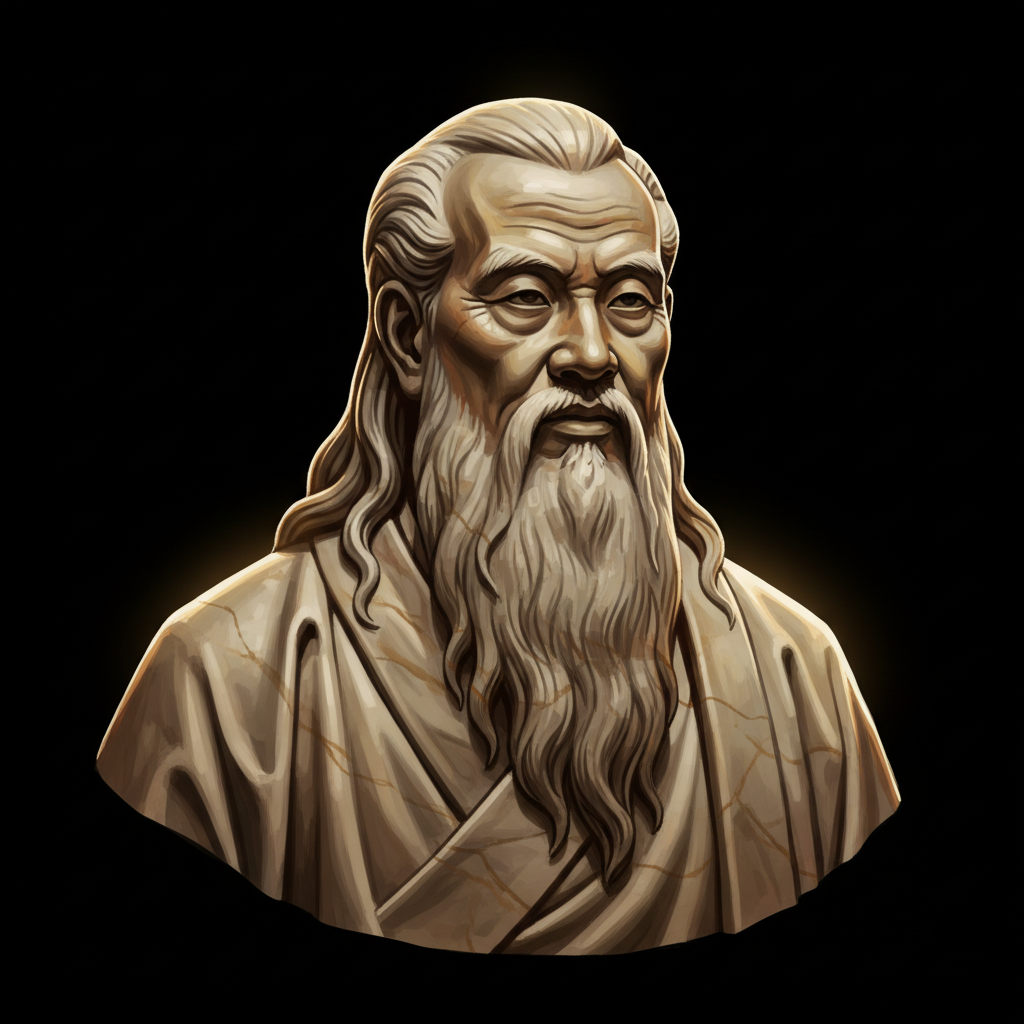
Reputed founder of Taoism and author of the Tao Te Ching, whose wu wei (effortless action) shaped East Asian philosophy. Closely associated with Zhuangzi (later Taoist who extended Laozi's framework). For an intellectual contrast, see Confucius, near-contemporary Chinese sage of social ritual and duty — Confucius systematized social order through ritual and hierarchy; Laozi argued that all such systems were the disease, not the cure — the two founding poles of Chinese moral philosophy.
Found in 1 providers: grok
1 source checked
A wise ruler keeps people free from ambitious thoughts and restless desires while making sure their basic needs are met. Instead of stirring up craving, status competition, or ideological fervor, the sage promotes calm minds, full stomachs, modest goals, and healthy bodies. Contentment and physical well-being matter more than stoking cleverness or ambition. Govern people toward simplicity and sufficiency, not toward striving, and society stabilizes on its own.
Laozi, traditionally an archivist in the Zhou royal court, watched scholars and nobles scheme for influence and grew disillusioned with bookish cleverness. As founder of Taoism, he championed wu wei, non-striving, and a return to natural simplicity. This saying mirrors his core teaching that desire and ambition breed disorder, while humility and physical sufficiency align people with the Tao. His legendary retreat westward, leaving only the Dao De Jing, embodies the same rejection of status.
Laozi lived during the late Zhou dynasty, around the 6th century BCE, as centralized authority crumbled and rival states drifted toward the Warring States era. Competing philosophers, strategists, and ambitious ministers sold ideologies to desperate rulers, fueling taxation, conscription, and war. Confucians pushed ritual and learning; Legalists pushed harsh law. Against that backdrop, urging rulers to quiet ambition, feed the people, and avoid clever schemes was a pointed critique of the restless court culture destabilizing ordinary Chinese life.
AI-generated insights based on extensive research and information for context. Factual errors? Email [email protected].
Your cart is empty