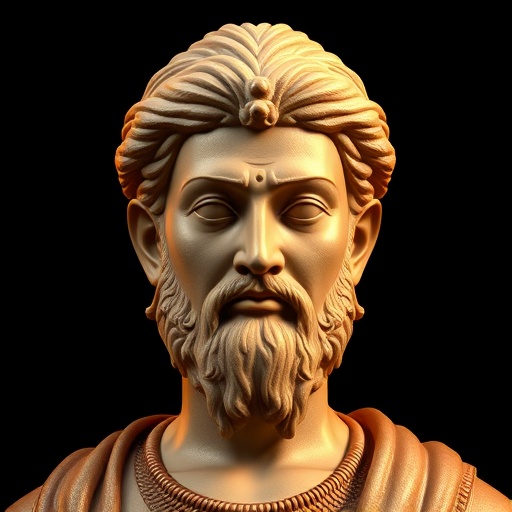
Mahavira — "All living beings desire happiness and despise misery."
All living beings desire happiness and despise misery.
All living beings desire happiness and despise misery.
Click any product to generate a realistic preview. Up to 3 at a time.
* Initial load can take up to 90 seconds — revising the preview in another color is nearly instant.
"One who neglects or disregards the existence of earth, air, fire, water, and vegetation disregards his own existence which is entwined with them."
"Live and allow others to live. Hurt neither yourself nor others."
"The soul is pure and eternal. It is never born, nor does it ever die."
"The true happiness lies in detachment."
"Truth is the very nature of the soul."
24th and last Tirthankara of Jainism, whose teachings of strict ahimsa (non-violence), aparigraha (non-attachment), and karma reshaped ancient Indian religion. Closely associated with The Buddha (near-contemporary moral revolutionary, also reacting against Vedic ritualism). For an intellectual contrast, see Vedic Brahmanical ritual sacrifice, the animal-sacrifice-centered Vedic religion of his era — Mahavira's ahimsa demanded total non-violence, including not eating root vegetables that kill the plant — a maximum-distance ethical move from the Vedic priestly tradition that ritually sacrificed cattle and horses. The two cleanest poles of ancient Indian religious ethics.
Found in 1 providers: grok
1 source checked
Every creature — human or animal — is driven by the same core impulse: pursue wellbeing, escape suffering. This observation levels the field of moral consideration. A worm recoils from pain just as a king does. Recognizing this shared inner life becomes the logical foundation for non-violence: if suffering is universally unwanted, deliberately inflicting it on any being — regardless of species or status — becomes ethically indefensible.
Mahavira was born a Kshatriya prince around 599 BCE but renounced wealth and family at 30, spending 12 years as a wandering ascetic enduring extreme physical hardship. That direct encounter with suffering — hunger, cold, violence from villagers — shaped his core teaching: ahimsa, absolute non-violence toward all living things. He taught that liberation requires halting karma accumulation by refusing to harm any being, however small, because their desire to avoid pain mirrors your own.
Mahavira lived in 6th-century BCE northeastern India during the Shramana movement, a philosophical revolt against Vedic orthodoxy. Brahminical rituals regularly involved mass animal sacrifice, and the caste system justified treating lower-born humans as near-property. Asserting that every living being — cow, slave, or king — equally desires happiness was politically and spiritually radical. It directly undermined the logic of ritual slaughter and caste cruelty by grounding ethics in shared experience rather than birth or divine decree.
AI-generated insights based on extensive research and information for context. Factual errors? Email [email protected].
Your cart is empty