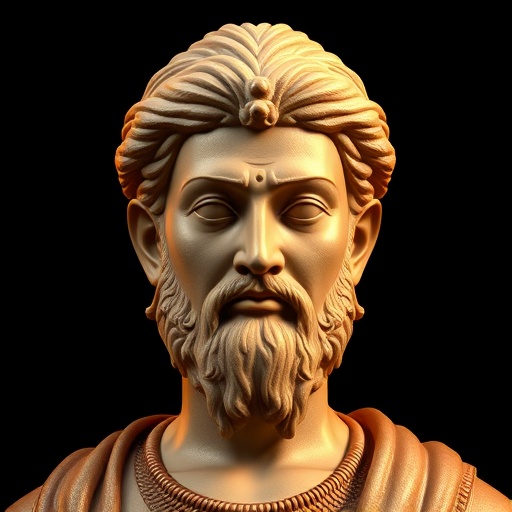
Mahavira — "The soul is the perceiver, the knower, the agent, the enjoyer, and the sufferer."
The soul is the perceiver, the knower, the agent, the enjoyer, and the sufferer.
The soul is the perceiver, the knower, the agent, the enjoyer, and the sufferer.
Click any product to generate a realistic preview. Up to 3 at a time.
* Initial load can take up to 90 seconds — revising the preview in another color is nearly instant.
"The path to liberation is difficult, but it is the only path to true happiness."
"One should not speak ill of others."
"Control of the senses is the highest form of self-control."
"Know thyself, and thou shalt know the universe and God."
"The world is full of suffering. The cause of suffering is attachment. The cessation of suffering is detachment."
24th and last Tirthankara of Jainism, whose teachings of strict ahimsa (non-violence), aparigraha (non-attachment), and karma reshaped ancient Indian religion. Closely associated with The Buddha (near-contemporary moral revolutionary, also reacting against Vedic ritualism). For an intellectual contrast, see Vedic Brahmanical ritual sacrifice, the animal-sacrifice-centered Vedic religion of his era — Mahavira's ahimsa demanded total non-violence, including not eating root vegetables that kill the plant — a maximum-distance ethical move from the Vedic priestly tradition that ritually sacrificed cattle and horses. The two cleanest poles of ancient Indian religious ethics.
Found in 1 providers: grok
1 source checked
The individual soul is the active center of all experience—it perceives reality, gains knowledge, makes choices, experiences pleasure, and endures pain. No external force controls your inner life. Each soul bears full responsibility for what it encounters and how it responds. This frames personal accountability and consciousness as the foundation of existence, making the soul the primary agent of its own bondage or liberation.
Mahavira (599–527 BCE) renounced royal life at 30 to pursue liberation through extreme asceticism. His entire teaching centered on the jiva—the eternal conscious soul entangled in karma through action and desire. This quote is the core of his doctrine: souls are self-responsible, neither god-created nor god-controlled. His 12 years of silence and non-attachment personally demonstrated that the soul alone perceives, chooses, and must free itself.
In 6th-century BCE India, Vedic Brahminism dominated—priests mediated between humans and gods, and caste determined who could access spiritual truth. Mahavira's claim that the soul alone bears full responsibility directly challenged priestly authority and divine intermediaries. His era also saw the Buddha and Upanishadic thinkers questioning orthodoxy, making it a rare moment for redefining consciousness, karma, and individual moral agency outside established religious hierarchies.
AI-generated insights based on extensive research and information for context. Factual errors? Email [email protected].
Your cart is empty