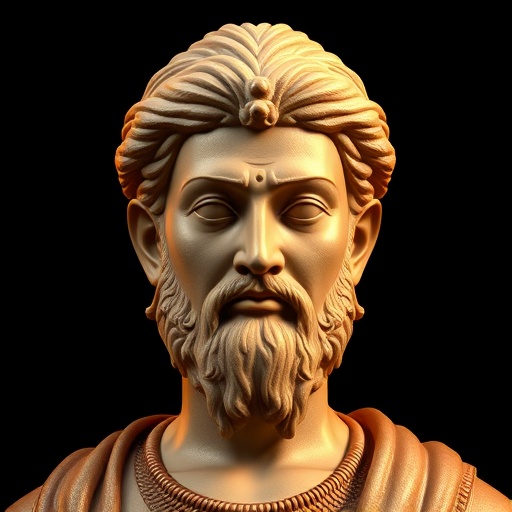
Mahavira — "Know thyself, and thou shalt know the universe and God."
Know thyself, and thou shalt know the universe and God.
Know thyself, and thou shalt know the universe and God.
Click any product to generate a realistic preview. Up to 3 at a time.
* Initial load can take up to 90 seconds — revising the preview in another color is nearly instant.
"All living beings desire happiness and despise misery."
"The senses are the enemies of the soul."
"The purpose of life is to realize one's true self."
"The greatest wisdom is to know oneself."
"The soul is its own friend and its own enemy."
24th and last Tirthankara of Jainism, whose teachings of strict ahimsa (non-violence), aparigraha (non-attachment), and karma reshaped ancient Indian religion. Closely associated with The Buddha (near-contemporary moral revolutionary, also reacting against Vedic ritualism). For an intellectual contrast, see Vedic Brahmanical ritual sacrifice, the animal-sacrifice-centered Vedic religion of his era — Mahavira's ahimsa demanded total non-violence, including not eating root vegetables that kill the plant — a maximum-distance ethical move from the Vedic priestly tradition that ritually sacrificed cattle and horses. The two cleanest poles of ancient Indian religious ethics.
Unknown, attributed to Mahavira, though similar to Socratic philosophy
Date: circa 5th-6th century BCE
BiblicalFound in 1 providers: grok
1 source checked
Self-knowledge is the gateway to understanding all reality. To truly know oneself—one's nature, impulses, limitations, and inner essence—is to perceive the same principles operating throughout the entire universe. The divine isn't found externally through ritual or doctrine but through turning awareness inward with complete honesty. Inner clarity reveals universal truth. Mastering the self and mastering existence are not two separate pursuits but one and the same journey.
Mahavira spent twelve years in silent meditation and severe asceticism, systematically examining every layer of his own consciousness. In Jainism, the soul is inherently omniscient—karma alone obscures it. Liberation comes by stripping away karmic layers through rigorous self-discipline. Mahavira's entire spiritual path was an act of radical self-study, and he achieved Kevala Jnana—total omniscience—purely through inner work, making this quote a direct expression of his foundational teaching.
Mahavira lived around 599–527 BCE in the Gangetic plains during the Axial Age, a period of simultaneous philosophical awakening across Greece, China, and India. Vedic religion dominated, privileging ritual and priestly authority over individual insight. Mahavira's Jainism directly challenged this orthodoxy, asserting liberation required no priest, no sacrifice—only rigorous self-examination. Claiming inner knowledge surpasses external religious authority was genuinely radical in a society structured entirely around ritualistic mediation between humans and the divine.
AI-generated insights based on extensive research and information for context. Factual errors? Email [email protected].
Your cart is empty