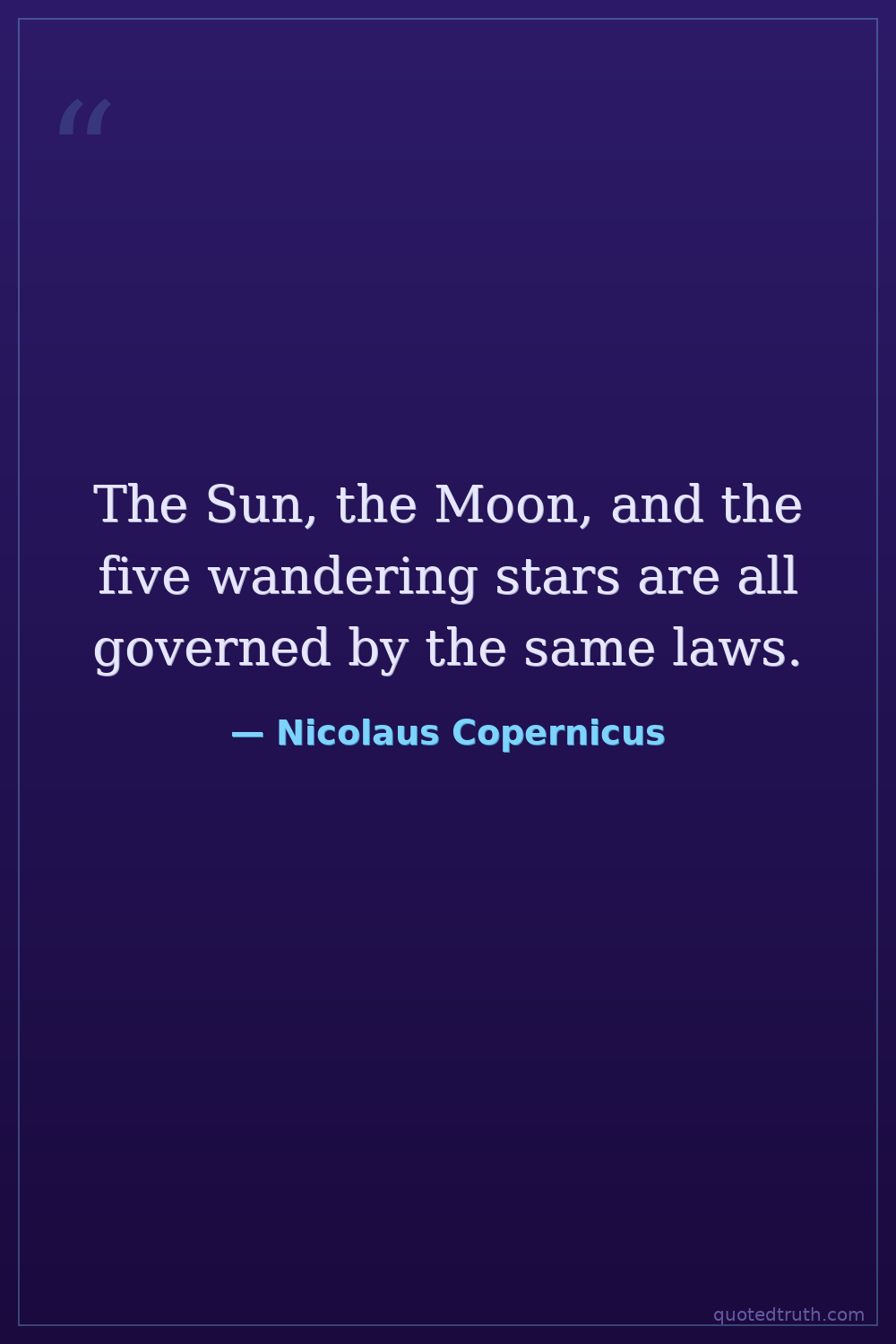
Nicolaus Copernicus — "The Sun, the Moon, and the five wandering stars are all governed by the same law…"
The Sun, the Moon, and the five wandering stars are all governed by the same laws.
The Sun, the Moon, and the five wandering stars are all governed by the same laws.
Click any product to generate a realistic preview. Up to 3 at a time.
* Initial load can take up to 90 seconds — revising the preview in another color is nearly instant.
"For the motion of the earth is of such a nature that it can account for all the apparent motions of the heavenly bodies."
"Yet because the novelty of the undertaking, which I knew to be contrary to the accepted views of the common people, might be regarded as absurd, I long hesitated."
"It is not the earth that is the center of the universe, but the sun."
"Therefore, let us not be afraid to follow truth wherever it may lead us, even if it contradicts our preconceived notions."
"So that we may not err, we should always follow the footsteps of the ancients."
Found in 1 providers: grok
1 source checked
All celestial bodies—the Sun, Moon, and five naked-eye planets (Mercury, Venus, Mars, Jupiter, Saturn)—operate under the same physical rules. Nothing in the sky is exempt from natural law or uniquely privileged. Motion and behavior across the entire cosmos can be understood and predicted through consistent mathematics. It is a declaration that the universe is unified and orderly, not a patchwork of special cases requiring separate explanations.
Copernicus spent roughly forty years developing the heliocentric model published in De Revolutionibus Orbium Coelestium (1543). His central ambition was a single, mathematically consistent framework that eliminated the messy, body-by-body epicycles of Ptolemaic astronomy. By placing the Sun at the center, he showed Mercury and Saturn obeyed the same orbital geometry. This quote captures his core scientific conviction: one set of laws, not custom rules per planet, must explain the sky.
In early 16th-century Europe, Ptolemaic geocentric cosmology still dominated, dividing the heavens into nested crystalline spheres each with its own movement rules. Medieval Christian theology taught that celestial matter was perfect and categorically different from earthly substance. Copernicus's claim that one law governed all bodies directly challenged this hierarchy and foreshadowed Newton's universal gravitation, arriving just as Renaissance humanism was encouraging scholars to question inherited classical authority.
AI-generated insights based on extensive research and information for context. Factual errors? Email [email protected].
Your cart is empty