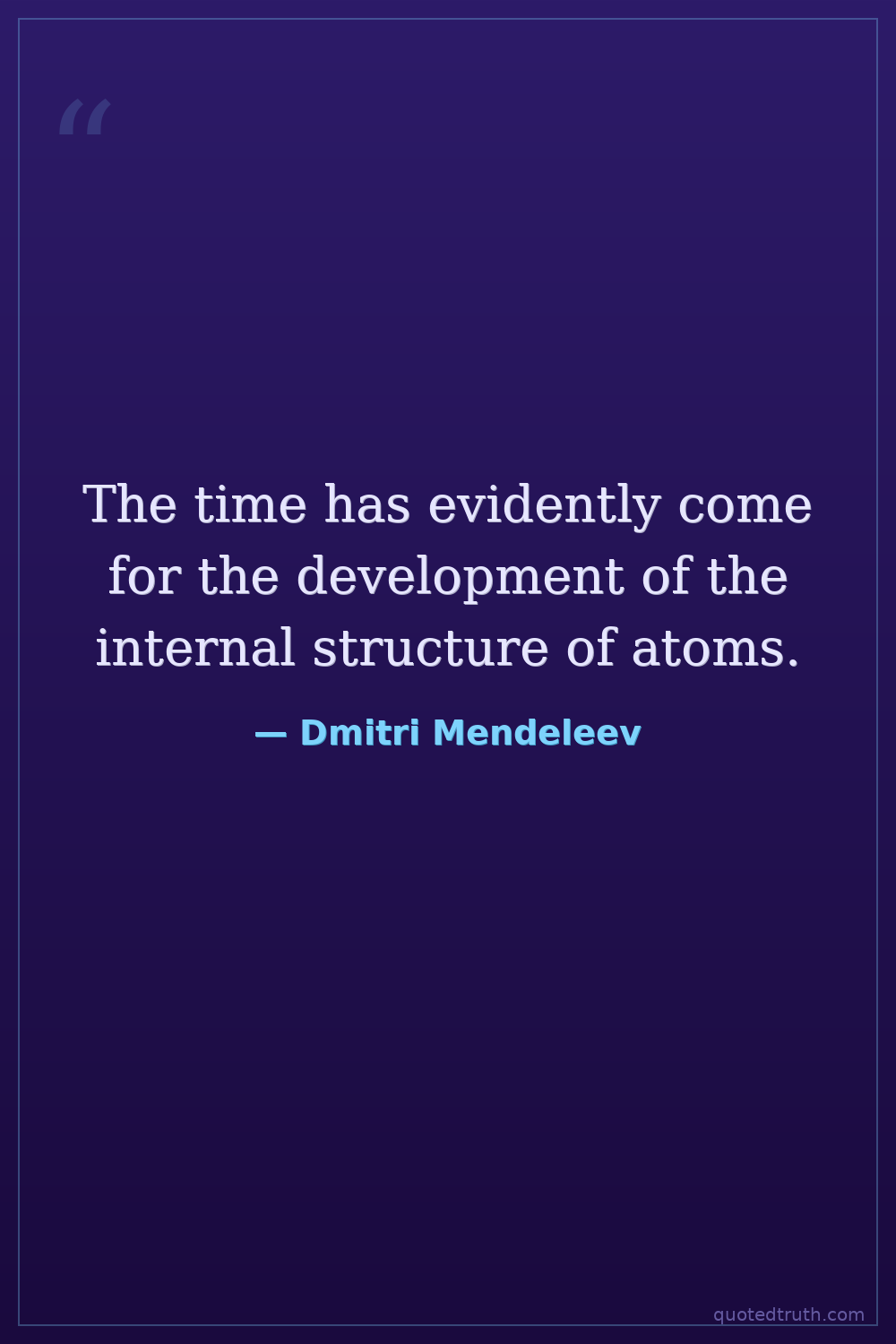
Dmitri Mendeleev — "The time has evidently come for the development of the internal structure of ato…"
The time has evidently come for the development of the internal structure of atoms.
The time has evidently come for the development of the internal structure of atoms.
Click any product to generate a realistic preview. Up to 3 at a time.
* Initial load can take up to 90 seconds — revising the preview in another color is nearly instant.
"It is easier to make a scientific discovery than to explain it to the common man."
"I have spent twenty-five years in the study of petroleum and have come to the conclusion that it is a product of the earth's interior, formed at great depths."
"Without order, our science is nothing but a miserable collection of facts."
"The essence of chemistry lies not in the pursuit of knowledge alone, but also in the pursuit of truth."
"The most all penetrating spirit before which will open the possibility of tilting not tables, but planets, is the spirit of free human inquiry. Believe only in that."
Found in 1 providers: grok
1 source checked
Mendeleev is saying that science has reached a turning point where researchers must stop treating atoms as simple, indivisible units and start investigating what lies inside them. He argues the groundwork is laid, the tools exist, and the questions are ripe, so the next frontier is cracking open the atom itself to understand its components, forces, and organization rather than only cataloging elements from the outside.
Mendeleev built the periodic table by ordering elements by atomic weight and properties, but he always suspected deeper patterns explained the regularities he exposed. As a chemist obsessed with underlying order, he spent his later years wrestling with radioactivity and the ether, pushing colleagues to probe atomic interiors. This quote captures his restless drive to move chemistry past classification toward fundamental structure, foreshadowing the subatomic physics he would not live to see completed.
Mendeleev spoke in the early 1900s, just as Becquerel, the Curies, and Thomson were shattering the belief that atoms were indivisible. Radioactivity, the electron, and X-rays had appeared within a decade, and Rutherford was about to expose the nucleus. European labs buzzed with the sense that matter itself was being reopened, and Mendeleev's periodic system suddenly looked like a map demanding a deeper explanation from the emerging atomic physics.
AI-generated insights based on extensive research and information for context. Factual errors? Email [email protected].
Your cart is empty