What it means
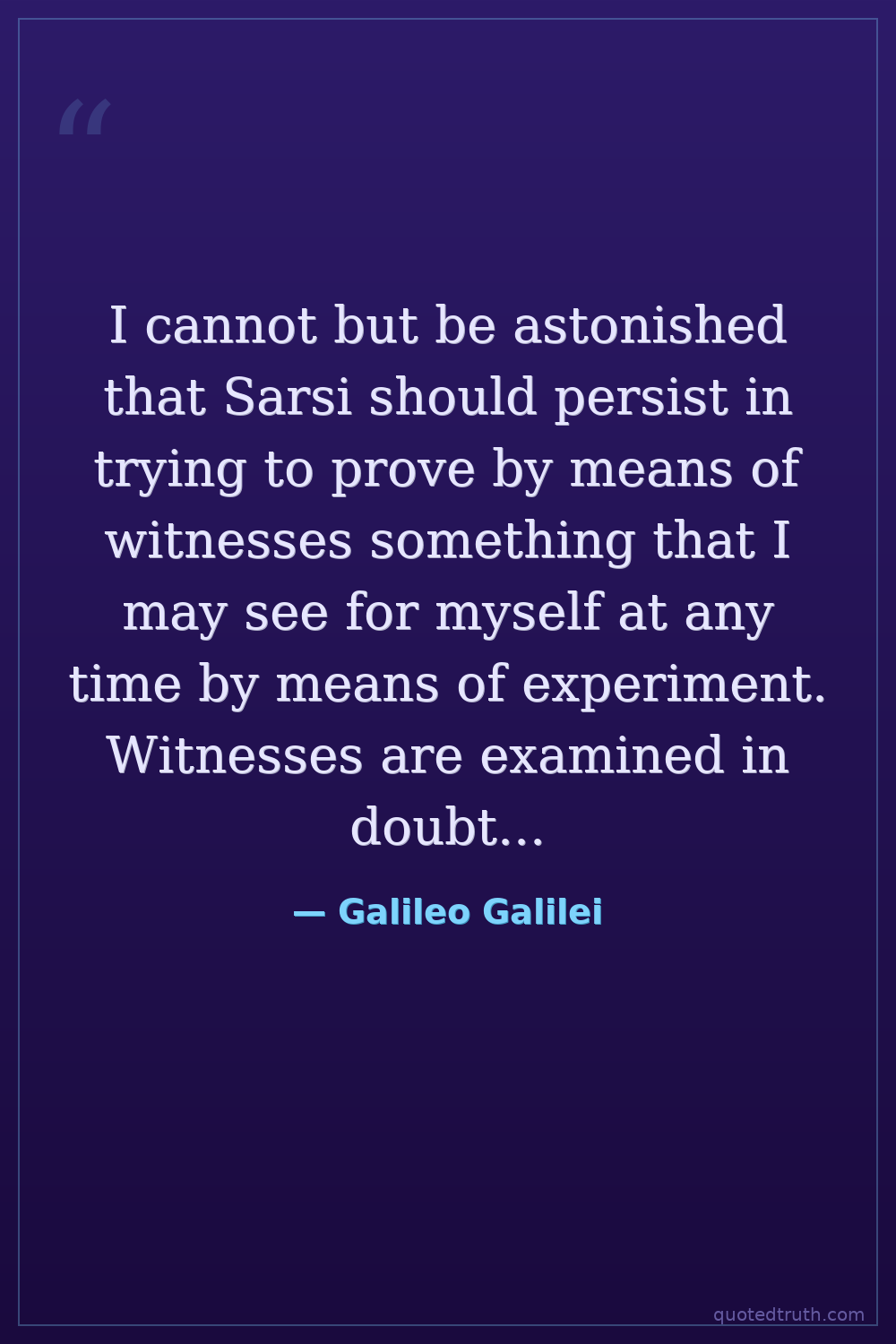
Direct observation and repeatable experiment outrank eyewitness testimony as sources of truth. If a phenomenon is physically present and testable right now, no number of verbal accounts can substitute for simply looking yourself. Credibility in science comes from what anyone can verify at any moment, not from who vouches for it — authority and tradition cannot override what eyes and instruments confirm.
Relevance to Galileo Galilei
Galileo built his career on systematic observation — telescopic discovery of Jupiter's moons, sunspots, and lunar craters overturned Aristotelian cosmology accepted for nearly two millennia. His trial by the Inquisition (1633) was essentially a contest of scriptural authority versus empirical evidence. This quote captures his foundational conviction: nature speaks louder than any witness, and personal verification is the only honest standard.
The era
In early modern Europe, scholastic tradition elevated ancient texts and clerical authority above direct inquiry. The Reformation had shaken institutional certainty, yet the Counter-Reformation Church tightened doctrinal control. Natural philosophers still debated by citing Aristotle or the Bible rather than running experiments. Galileo's insistence on repeatable, observable proof was genuinely radical — a direct challenge to a world where learned testimony and sacred tradition defined truth.
AI-generated insights based on extensive research and information for context. Factual errors? Email [email protected].