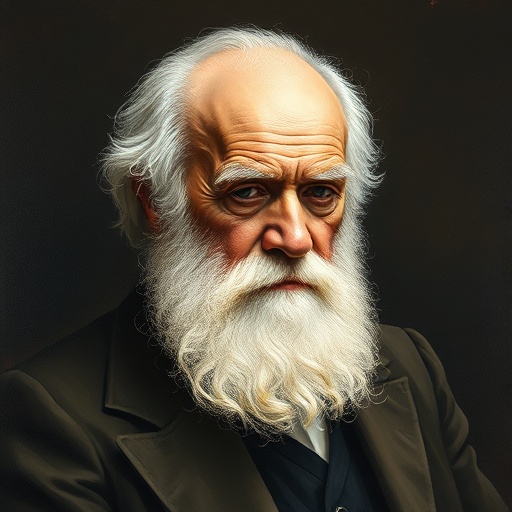
Charles Darwin — "The very existence of our senses, our reason, and our intellect, is a proof that…"
The very existence of our senses, our reason, and our intellect, is a proof that these faculties were given us for some purpose.
The very existence of our senses, our reason, and our intellect, is a proof that these faculties were given us for some purpose.
Click any product to generate a realistic preview. Up to 3 at a time.
* Initial load can take up to 90 seconds — revising the preview in another color is nearly instant.
"I have always felt a strong feeling of gratitude to those who have helped me in my work."
"Man, with all his noble qualities, with sympathy which feels for the most debased, with benevolence which extends not only to other men but to the humblest living creature, with his god-like intellect…"
"The more I see of the world, the more I am convinced of the fact that it is full of wonders."
"We are like a judge who has to sum up and deliver judgment, not on the evidence of witnesses, but on the arguments of counsel."
"Thus, from the war of nature, from famine and death, the most exalted object which we are capable of conceiving, namely, the production of the higher animals, directly follows."
British naturalist whose On the Origin of Species (1859) established evolution by natural selection — the unifying theory of modern biology. Closely associated with Thomas Henry Huxley (his 'bulldog' public defender) and Alfred Russel Wallace (independent co-discoverer of natural selection). For an intellectual contrast, see William Paley, Anglican theologian and Natural Theology author (1743-1805) — Origin of Species is structurally a 400-page reply to Paley — Darwin admired Paley's watchmaker-argument as an undergraduate at Cambridge and then spent 20 years building the empirical machinery to displace him. The cleanest 'design argument vs natural selection' founding rebuttal in science.
The standard scholarly entry points to Charles Darwin's work: Janet Browne (Harvard, history of science) — Charles Darwin: Voyaging (1995) and The Power of Place (2002); Adrian Desmond (UCL, biographer) — Darwin: The Life of a Tormented Evolutionist (1991, with James Moore). These are the works graduate seminars cite when teaching Charles Darwin.
Found in 1 providers: grok
1 source checked
The quote argues that because humans possess senses, reason, and intellect, these capacities must exist for a reason—they weren't accidental. It's a functionalist claim: complex cognitive tools imply purposeful use. In modern terms, our mental faculties have adaptive or meaningful roles. Whether through divine design or evolutionary pressure, the sophistication of human cognition points to function over randomness, suggesting our minds are built to do something, not merely to exist.
Darwin spent his career explaining how complex biological features arise through natural selection rather than divine design, yet this quote reveals his willingness to entertain purposive language. His own powers of observation aboard HMS Beagle and decades of painstaking research demonstrated his senses and intellect at full stretch. The tension here—purpose without a designer—sits at the heart of evolutionary theory, where function emerges through selection pressure, not intention, mirroring Darwin's own cautious, evidence-driven temperament.
Darwin published On the Origin of Species in 1859, upending Victorian Britain's religious consensus that living things were divinely designed. The era was defined by fierce debate between naturalists and theologians over whether life had purpose or arose through blind mechanism. This quote reflects the mid-19th century struggle to reconcile scientific empiricism with inherited religious frameworks—a tension that shaped public discourse and forced Darwin himself to carefully frame his most radical ideas in familiar, purposive language.
AI-generated insights based on extensive research and information for context. Factual errors? Email [email protected].
Your cart is empty