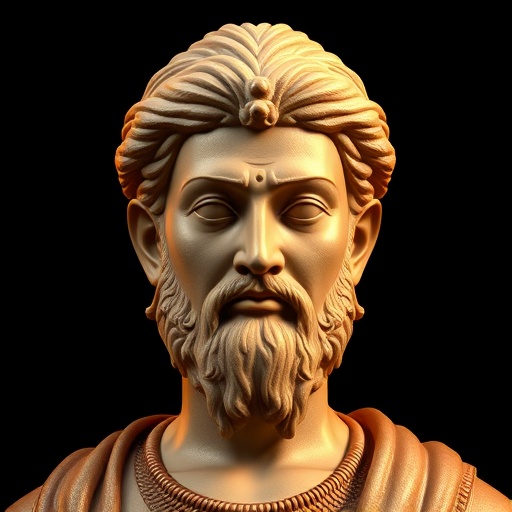
Mahavira — "The wise man is he who knows the truth."
The wise man is he who knows the truth.
The wise man is he who knows the truth.
Click any product to generate a realistic preview. Up to 3 at a time.
* Initial load can take up to 90 seconds — revising the preview in another color is nearly instant.
"Know then that the truth is eternal, pure, and unchanging."
"The soul is the perceiver, the knower, the agent, the enjoyer, and the sufferer."
"The soul is the only thing that is eternal; everything else is temporary."
"All living beings are endowed with consciousness."
"A man should wander about treating all creatures as he himself would be treated."
24th and last Tirthankara of Jainism, whose teachings of strict ahimsa (non-violence), aparigraha (non-attachment), and karma reshaped ancient Indian religion. Closely associated with The Buddha (near-contemporary moral revolutionary, also reacting against Vedic ritualism). For an intellectual contrast, see Vedic Brahmanical ritual sacrifice, the animal-sacrifice-centered Vedic religion of his era — Mahavira's ahimsa demanded total non-violence, including not eating root vegetables that kill the plant — a maximum-distance ethical move from the Vedic priestly tradition that ritually sacrificed cattle and horses. The two cleanest poles of ancient Indian religious ethics.
Found in 1 providers: grok
1 source checked
True wisdom isn't about credentials, status, or accumulated knowledge — it's about perceiving reality as it actually is. Genuine intelligence means cutting through illusion, desire, and bias to reach fundamental truth about existence. Wisdom and truth-perception are inseparable: you cannot claim to be wise while holding false beliefs, and you cannot know truth without the mental clarity and discipline that real wisdom demands.
Mahavira renounced his Kshatriya royal life at 30, spending twelve years in intense ascetic practice before achieving kevala jnana — total omniscience, the direct unobstructed perception of all truth. Jainism's three jewels place right knowledge (samyak jnana) at the center of liberation. His entire path rested on the premise that freedom from rebirth requires correctly perceiving reality, stripping away karmic distortion. This quote is essentially his life's work condensed to a single sentence.
Mahavira lived in 6th-century BCE northeastern India during the Axial Age, when Brahmanical ritual orthodoxy dictated that spiritual access depended on caste and hereditary privilege. The priestly class controlled sacred knowledge, and truth was defined by scripture and lineage rather than personal perception. Mahavira's insistence that wisdom belongs to anyone who perceives truth directly challenged this hierarchy, coinciding with Buddhism's emergence and Upanishadic inquiry into whether inner knowledge could supersede ritual authority.
AI-generated insights based on extensive research and information for context. Factual errors? Email [email protected].
Your cart is empty