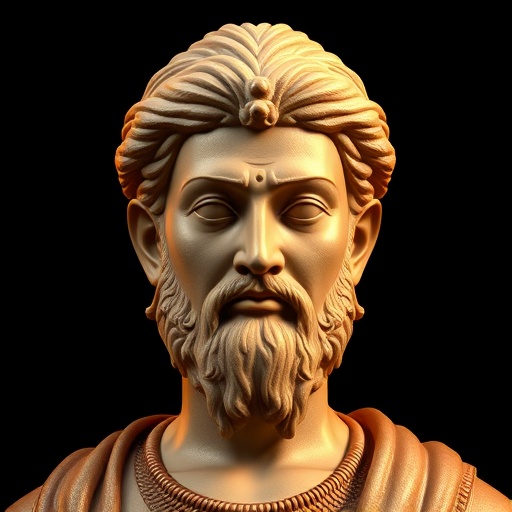
Mahavira — "Know then that the truth is eternal, pure, and unchanging."
Know then that the truth is eternal, pure, and unchanging.
Know then that the truth is eternal, pure, and unchanging.
Click any product to generate a realistic preview. Up to 3 at a time.
* Initial load can take up to 90 seconds — revising the preview in another color is nearly instant.
"One should always speak the truth, but not utter an unpleasant truth."
"One should always speak the truth."
"One should not steal."
"The senses are the enemies of the soul."
"Do not desire anything that is not yours."
24th and last Tirthankara of Jainism, whose teachings of strict ahimsa (non-violence), aparigraha (non-attachment), and karma reshaped ancient Indian religion. Closely associated with The Buddha (near-contemporary moral revolutionary, also reacting against Vedic ritualism). For an intellectual contrast, see Vedic Brahmanical ritual sacrifice, the animal-sacrifice-centered Vedic religion of his era — Mahavira's ahimsa demanded total non-violence, including not eating root vegetables that kill the plant — a maximum-distance ethical move from the Vedic priestly tradition that ritually sacrificed cattle and horses. The two cleanest poles of ancient Indian religious ethics.
Found in 1 providers: grok
1 source checked
Truth is not relative, subjective, or shaped by time and culture. It exists independently of what any person believes or when they live. Pure means uncontaminated by bias or self-interest; unchanging means no power — political, social, or personal — can alter it. The command 'know' makes this active: recognizing this kind of truth requires effort and inner clarity, not passive acceptance of whatever society or tradition currently declares.
Mahavira spent 12.5 years in extreme ascetic meditation before achieving omniscience (kevala jnana), the direct perception of all truth. As the 24th Tirthankara, he renounced a Kshatriya royal life to pursue liberation through perfect knowledge. His core doctrine anekantavada holds that reality is many-sided, yet ultimate truth is absolute. This quote reflects his conviction that beneath relative human perspectives lies an unchanging reality accessible only through rigorous self-purification and disciplined inner inquiry.
Mahavira lived in 6th–5th century BCE India during the Axial Age, when Vedic Brahminism with its ritual sacrifices and caste hierarchy dominated religious life. Rival schools — materialist Charvakas, fatalist Ajivikas, emerging Buddhism — each advanced competing claims about reality. Declaring truth eternal and unchanging was a direct philosophical challenge to relativism and to priestly religion that bent truth to ritual authority, positioning Jainism as a path grounded in permanent, perceivable cosmic law.
AI-generated insights based on extensive research and information for context. Factual errors? Email [email protected].
Your cart is empty