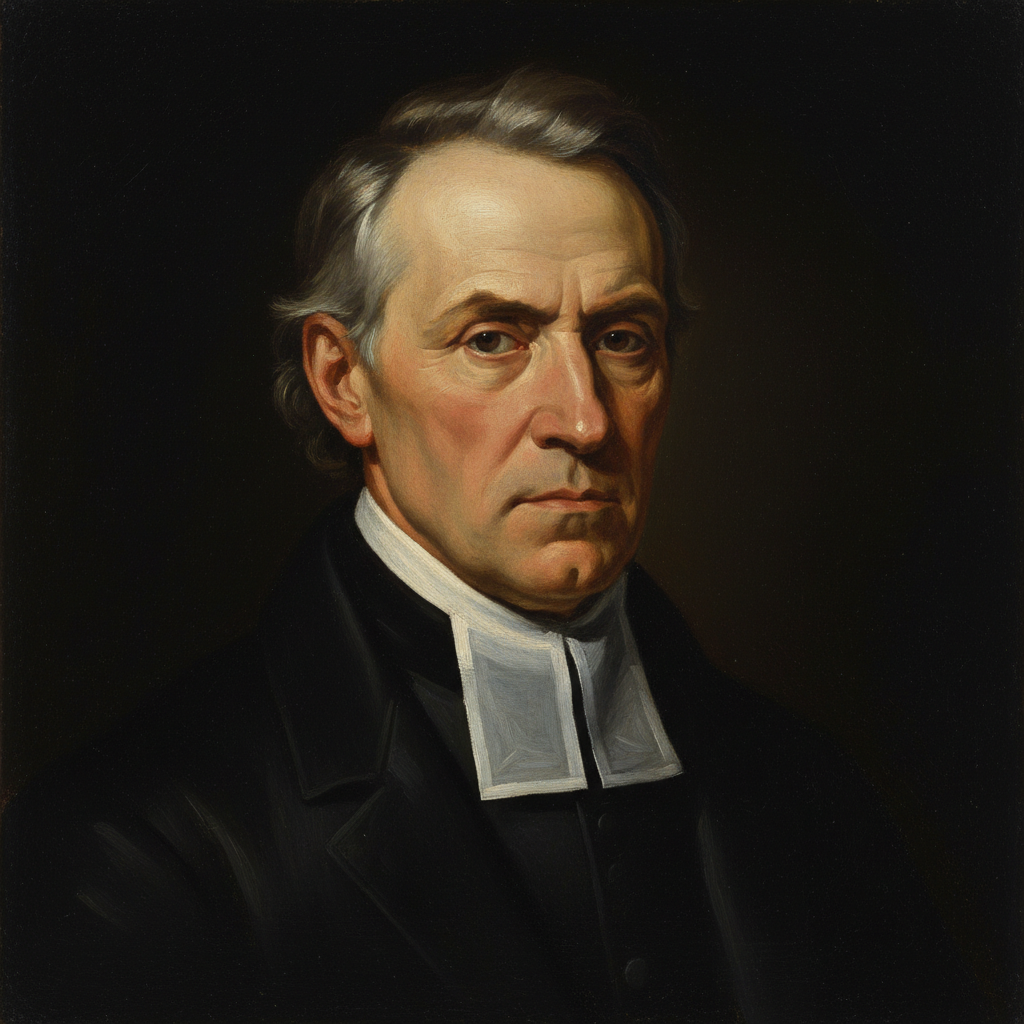
John Wesley — "The world is my parish."
The world is my parish.
The world is my parish.
Click any product to generate a realistic preview. Up to 3 at a time.
* Initial load can take up to 90 seconds — revising the preview in another color is nearly instant.
"I am a debtor to all the world, to do all the good I can, in every place, to every soul."
"I am not careful about my life or my death. I know that I am in the hands of God."
"I have not much time to spare for trifles."
"I have often thought, that if I were to choose a carriage to ride in, it should be a plain one."
"I have been writing a sermon on the use of money. Oh, what a flat, unprofitable subject it is!"
English Anglican cleric and founder of Methodism, whose open-air preaching and class-meeting structure created the largest 18th-century evangelical revival. Closely associated with Charles Wesley (his hymn-writing brother) and George Whitefield (early co-revivalist, later doctrinal opponent). For an intellectual contrast, see George Whitefield, Calvinist evangelical revivalist — Whitefield's predestinarian Calvinism vs Wesley's free-grace Arminian theology split the early Methodist movement permanently in the 1739-41 break. The founding evangelical Calvinist-Arminian schism — the two parallel evangelical traditions American Christianity descends from.
Found in 1 providers: grok
1 source checked
No single church building or geographic boundary limits where one can do good and spread faith. Wherever people exist, that is where meaningful work happens. This rejects institutional gatekeeping and embraces a universal calling — your responsibility extends to every human being you encounter, not just those who share your specific congregation, town, or denomination.
Wesley was literally barred from preaching in Church of England parishes after his evangelical awakening. Rather than accept exclusion, he began open-air preaching across Britain, traveling 250,000 miles on horseback over his lifetime. This phrase was his defiant response to clergy who accused him of trespassing in their parishes — he redefined parish as the entire world.
18th-century England had rigid parish systems where Anglican clergy held territorial monopolies over souls. The Industrial Revolution was displacing thousands into cities without pastoral care. Methodism emerged precisely to reach miners, factory workers, and the poor whom established churches ignored. Wesley's declaration challenged both ecclesiastical property rights and class-based assumptions about who deserved spiritual attention.
AI-generated insights based on extensive research and information for context. Factual errors? Email [email protected].
Your cart is empty