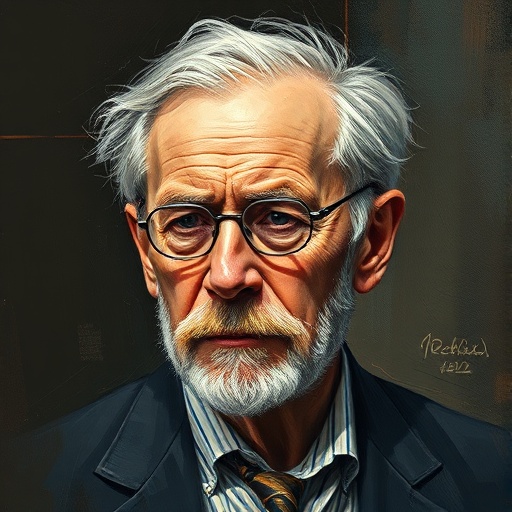
Erwin Schrodinger — "The world is not a machine. It is a living being."
The world is not a machine. It is a living being.
The world is not a machine. It is a living being.
Click any product to generate a realistic preview. Up to 3 at a time.
* Initial load can take up to 90 seconds — revising the preview in another color is nearly instant.
"The world is a mystery, and the more we learn, the more mysterious it becomes."
"If we were bees, ants, or Lacedaemonian warriors, to whom personal fear does not exist and cowardice is the most shameful thing in the world, warring would go on forever. But luckily we are only men —…"
"If we are to be honest, we must admit that the present state of physics offers no hope of a satisfactory picture of the world."
"There is no quantum jump. There is no such thing as a quantum jump. It is all balderdash."
"The true path to knowledge is to question everything."
Austrian physicist who shared the 1933 Nobel for the wave equation that bears his name and the famous cat thought-experiment. Closely associated with Werner Heisenberg (matrix-mechanics rival who reached the same physics by different math) and Albert Einstein (his pen-pal on quantum interpretation). For an intellectual contrast, see Niels Bohr, Danish physicist and architect of the Copenhagen interpretation — Schrödinger's cat thought-experiment was specifically designed to ridicule Bohr's 'observer-dependent reality' reading of quantum mechanics — Schrödinger thought the Copenhagen interpretation was absurd; the cat was meant as reductio ad absurdum.
Found in 1 providers: grok
1 source checked
Reality isn't a cold, deterministic clockwork system where everything follows fixed mechanical rules. Life, consciousness, and the universe have qualities that machines simply don't possess — unpredictability, organic complexity, self-organization, and something irreducible that pure mechanics cannot capture. The world behaves more like an organism than an engine, with interconnected processes that resist reduction to mere gears and levers.
Schrödinger spent his career revealing quantum mechanics' irreducibly probabilistic nature, undermining classical determinism. His 1944 book 'What Is Life?' pioneered biophysics, arguing living systems operate by quantum-level aperiodic crystal structures — genetics before DNA was understood. He rejected purely mechanistic biology, championing consciousness and organism as central to physics, notably through his unified field interests and Vedantic philosophical writings.
Mid-20th century physics had just shattered the Newtonian mechanical worldview through relativity and quantum theory. Simultaneously, cybernetics and early computing were tempting thinkers to model everything as information-processing machines. Schrödinger's era confronted industrialized warfare and dehumanizing mechanization, making the insistence that life transcends mechanism both scientifically urgent and deeply humanistic resistance against reductionism.
AI-generated insights based on extensive research and information for context. Factual errors? Email [email protected].
Your cart is empty