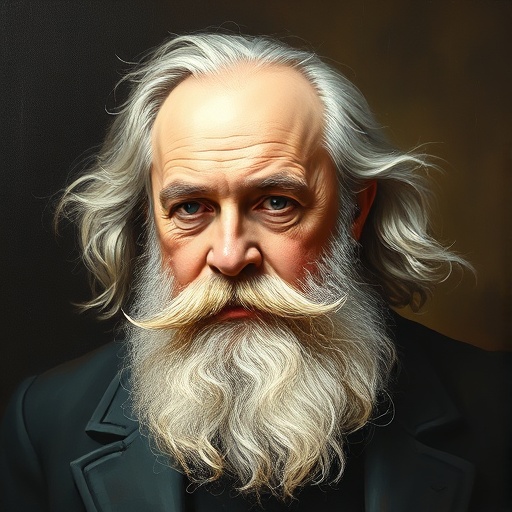
Dmitri Mendeleev — "There is nothing in science that cannot be explained to a barmaid."
There is nothing in science that cannot be explained to a barmaid.
There is nothing in science that cannot be explained to a barmaid.
Click any product to generate a realistic preview. Up to 3 at a time.
* Initial load can take up to 90 seconds — revising the preview in another color is nearly instant.
"One day, all elements will be discovered and their properties understood."
"I love only science, and my children, and my wife, and my work, and the motherland."
"There are no limits to the perfectibility of human knowledge, and it is in this spirit that the periodic system was conceived."
"I saw in a dream a table where all the elements fell into place as required. Awakening, I immediately wrote it down on a piece of paper."
"Why do they [Americans] quarrel, why do they hate Negroes, Indians, even Germans, why do they not have science and poetry commensurate with themselves, why are there so many frauds and so much nonsens…"
Found in 1 providers: deepseek
1 source checked
Any scientific idea, no matter how advanced, can be explained in ordinary language to someone without technical training. If a scientist cannot translate their work into plain speech for a regular person in a pub, the failure lies with the scientist, not the listener. Real understanding means being able to strip away jargon and communicate the core concept clearly to anyone willing to hear it.
Mendeleev built the periodic table by spotting plain patterns in element behavior, valuing clarity over mathematical obscurity. Born in Siberia as the youngest of many children, he taught working chemists, wrote accessible textbooks like Principles of Chemistry, and consulted on vodka standards and oil refining for ordinary Russian industry. He believed science served society, not elite circles, and personally lectured to broad audiences rather than hiding behind specialist vocabulary.
Late 19th-century Russia was industrializing rapidly under the tsars, with science seen as a tool for national modernization. European chemistry was exploding with new elements and competing theories, often locked in dense academic German and French. Public lectures, popular science writing, and technical schools were spreading knowledge to merchants, engineers, and workers. Mendeleev's insistence on plain explanation fit a reformist moment when educated Russians believed demystifying science was essential to lifting the country out of backwardness.
AI-generated insights based on extensive research and information for context. Factual errors? Email [email protected].
Your cart is empty