What it means
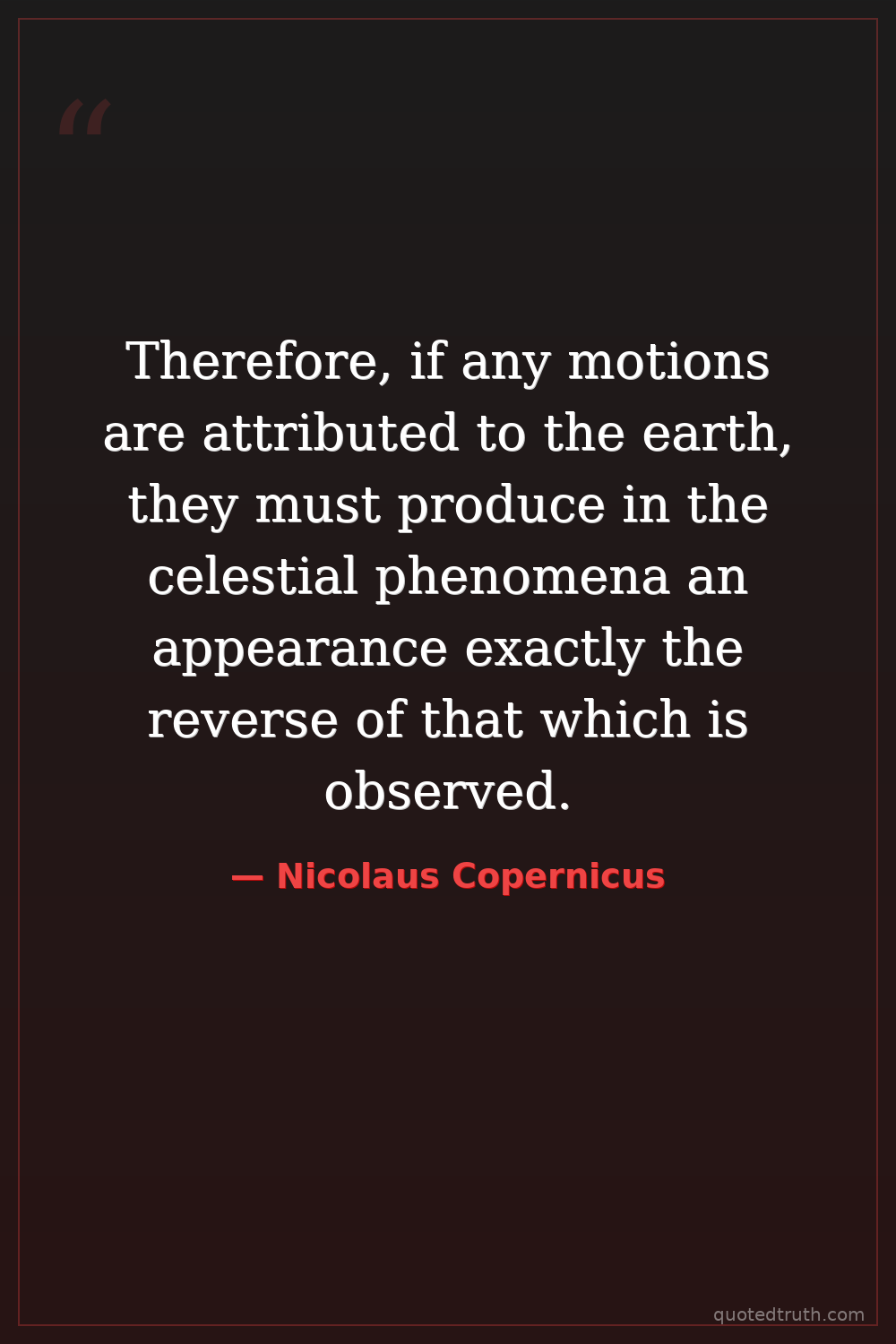
If Earth itself is moving, then what we observe in the sky will appear opposite to that motion — like watching scenery move backward from a moving train. Copernicus argues that apparent celestial movements can be explained by Earth's own motion rather than by the actual movement of stars and planets around us. Observed phenomena are relative to the observer's position and motion.
Relevance to Nicolaus Copernicus
Copernicus spent decades as a Polish canon and astronomer, meticulously reconciling observed planetary data with mathematical models. This statement is central to his heliocentric argument in De Revolutionibus — Earth's orbital and rotational motion creates the apparent retrograde motions of planets, replacing the need for Ptolemy's complex epicycles. It reflects his methodical, evidence-driven reasoning toward revolutionary conclusions.
The era
In early 16th-century Europe, Ptolemaic geocentrism was Church-sanctioned cosmological truth, embedded in university curricula and theological doctrine. Questioning Earth's central, stationary position risked accusations of heresy. Copernicus wrote carefully and delayed publication until his deathbed in 1543. His era also saw the Renaissance's renewed emphasis on direct observation and mathematical humanism challenging inherited Aristotelian authority.
AI-generated insights based on extensive research and information for context. Factual errors? Email [email protected].