What it means
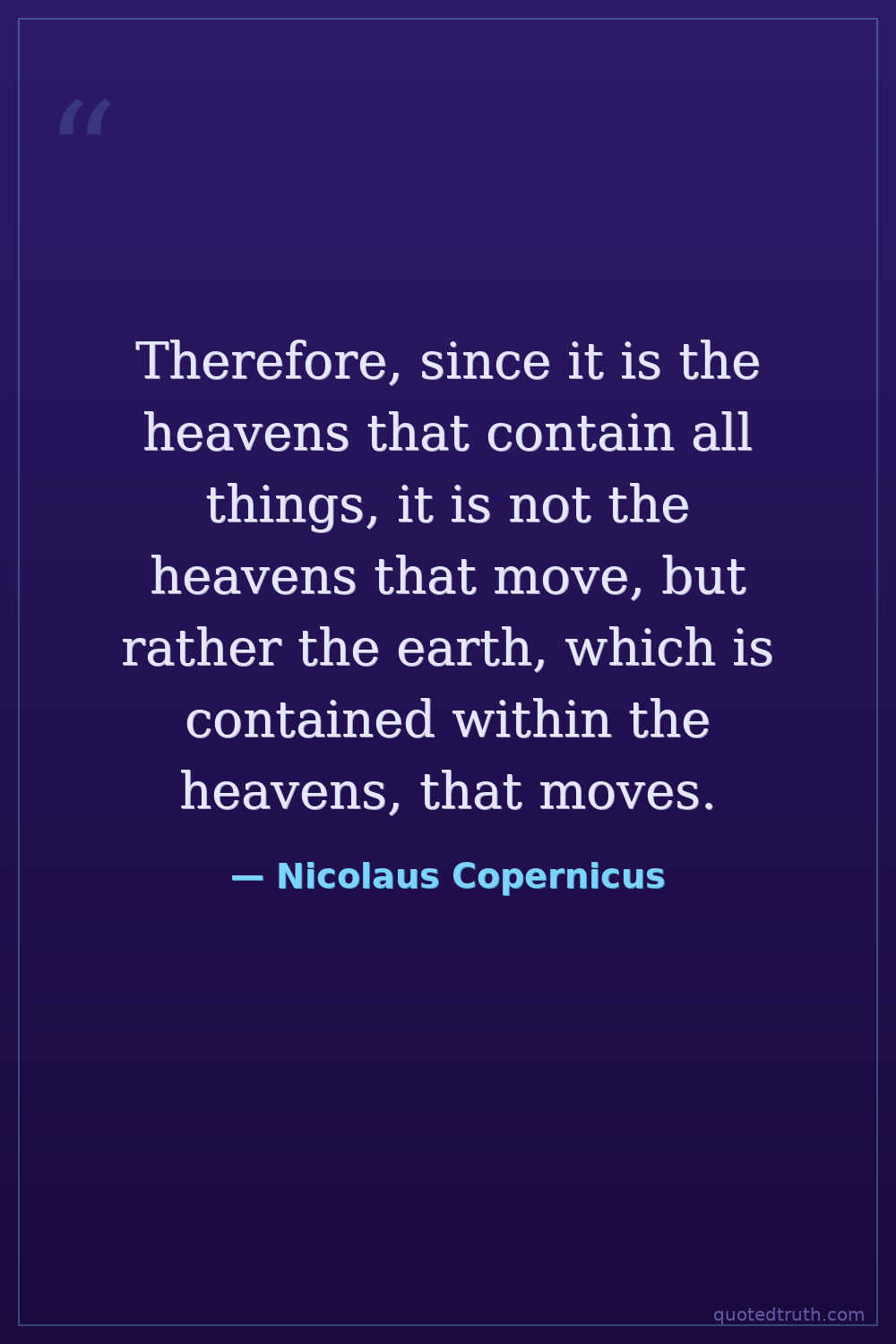
The quote flips conventional logic: if the heavens surround and contain everything, it is more reasonable that the smaller, enclosed Earth moves rather than the vast enclosing sky rotating around it. Copernicus uses a containment argument — the container holds still while what is inside it moves. This challenges the intuitive but mistaken assumption that because we feel stationary, the cosmos must be spinning around us. Motion, he argues, belongs to the smaller body within.
Relevance to Nicolaus Copernicus
Copernicus spent decades developing his heliocentric theory before publishing De Revolutionibus in 1543, the year he died. A canon of the Catholic Church and trained mathematician, he approached cosmology through geometry and logic, not just observation. This quote reflects his signature method: philosophical deduction before empirical proof. His caution — he withheld publication for years — shows awareness that claiming Earth moves was explosive. Yet his reasoning was precise, systematic, and ultimately launched the Scientific Revolution.
The era
In the early sixteenth century, European cosmology was anchored in Ptolemy's geocentric model, unchallenged for fourteen centuries and endorsed by Church doctrine. Aristotelian physics declared Earth the natural resting place of heavy matter — movement was the heavens' domain. Copernicus wrote amid the Renaissance's recovery of ancient texts, but also Luther's Reformation fracturing Christian authority. Proposing that Earth moves was not merely scientific heresy; it threatened the philosophical and theological architecture of an entire civilization.
AI-generated insights based on extensive research and information for context. Factual errors? Email [email protected].