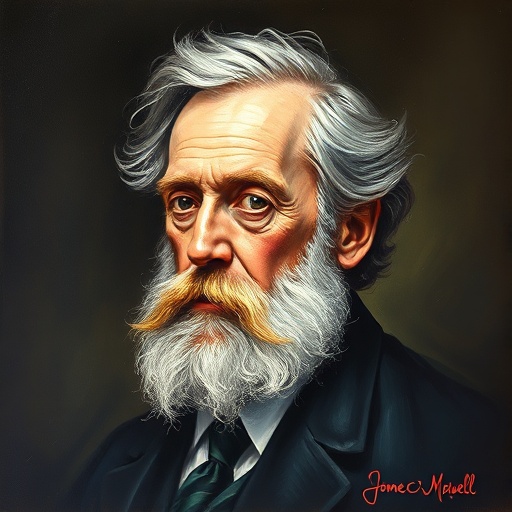
James Clerk Maxwell — "Thoroughly conscious ignorance is the prelude to every real advance in science."
Thoroughly conscious ignorance is the prelude to every real advance in science.
Thoroughly conscious ignorance is the prelude to every real advance in science.
Click any product to generate a realistic preview. Up to 3 at a time.
* Initial load can take up to 90 seconds — revising the preview in another color is nearly instant.
"The molecules of a gas are like angry bees in a jar, but far more mathematical."
"But I think that the results which each man arrives at in his attempts to harmonize his science with his Christianity ought not to be regarded as having any significance except to the man himself, and…"
"At quite uncertain times and places, The atoms left their heavenly path, And by fortuitous embraces, Engendered all that being hath. And though they seem to cling together, And form 'associations' her…"
"The present state of science is such that we cannot hope to explain all the phenomena of nature by means of a few simple laws."
"The only laws of matter are those which our minds must fabricate, and the only laws of mind are fabricated for it by matter."
General reflection on scientific progress.
Date: Undated, but a common philosophical stance in his writings.
GeneralFound in 1 providers: gemini
1 source checked
Real scientific progress begins when you clearly recognize exactly what you do not know. Vague awareness of gaps is not enough; you must map the boundaries of your ignorance in detail, understanding which questions are unanswered and why. Only this sharp, deliberate acknowledgment of what remains unexplained points researchers toward the problems worth solving and opens the door to genuine discovery rather than reshuffling old assumptions.
Maxwell embodied this approach. Before unifying electricity and magnetism into four equations, he carefully absorbed Faraday's experimental puzzles and identified precisely where existing theory failed. His kinetic theory of gases and work on Saturn's rings similarly began by pinpointing unresolved contradictions. A devout Presbyterian and rigorous mathematician, he valued humility before nature, treating unsolved problems not as embarrassments but as the starting coordinates for breakthrough physics.
Maxwell worked in Victorian Britain (1831-1879), amid the Industrial Revolution's faith in mechanical certainty and Newtonian completeness. Many believed physics was nearly finished. Yet anomalies in electromagnetism, thermodynamics, and spectroscopy hinted otherwise. Scientific societies, new universities, and journals like Philosophical Transactions were professionalizing research. Maxwell's insistence on catalogued ignorance pushed against the era's confident positivism, foreshadowing the relativistic and quantum revolutions that would overturn classical assumptions within decades of his death.
AI-generated insights based on extensive research and information for context. Factual errors? Email [email protected].
Your cart is empty