Martin Luther — "Those who despise these, or treat them with contempt, are worthy of purchasing, …"
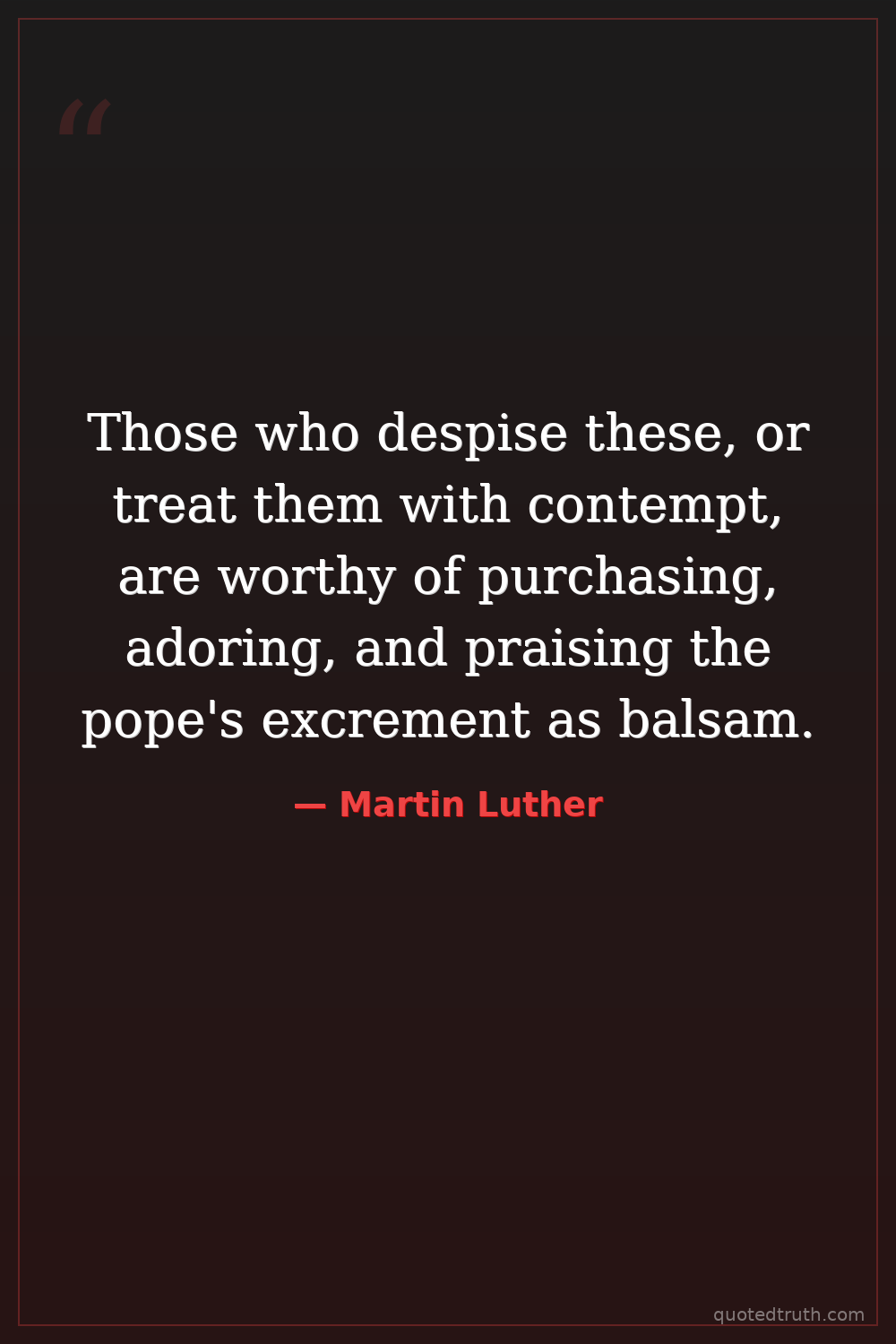
Those who despise these, or treat them with contempt, are worthy of purchasing, adoring, and praising the pope's excrement as balsam.
Those who despise these, or treat them with contempt, are worthy of purchasing, adoring, and praising the pope's excrement as balsam.
Click any product to generate a realistic preview. Up to 3 at a time.
* Initial load can take up to 90 seconds — revising the preview in another color is nearly instant.
"A man remains foolish until his 40th year, when he begins to recognize his foolishness; then life is soon over."
"The true treasure of the church is the most holy gospel of the glory and grace of God."
"I have held many things in my hands, and I have lost them all; but whatever I have placed in God’s hands, that I still possess."
"My conscience is captive to the Word of God. I cannot and I will not recant anything, for to go against conscience is neither right nor safe. Here I stand, I can do no other. God help me. Amen."
"You are an extraordinary creature, being neither God nor man. Perhaps you are the devil himself."
German theologian whose 95 Theses (1517) launched the Protestant Reformation and broke the Catholic Church's monopoly on Western Christianity. Closely associated with Philipp Melanchthon (Lutheran systematizer) and John Calvin (later Reformer who built on Luther's break). For an intellectual contrast, see Pope Leo X, Renaissance pope (1513-1521) — Leo X's indulgence sales triggered Luther's break and Leo excommunicated him in 1521 — Luther's entire Reformation is structured as a direct answer to the indulgence-funded Vatican Leo represented.
Found in 1 providers: gemini
1 source checked
Luther is saying that anyone who dismisses or looks down on certain things he values deserves instead to idolize the pope's filth as if it were precious perfume. It's a crude, sarcastic insult: he's turning the tables on his opponents by suggesting their contempt reveals misplaced devotion. Rejecting what is truly good, they prove themselves fit only to worship what is worthless or disgusting, packaged as holy.
Luther was notorious for scatological invective against the papacy, especially in late works like Against the Roman Papacy (1545). A former Augustinian monk turned reformer, he rejected papal authority after his 1521 excommunication and used shockingly coarse language as a deliberate rhetorical weapon. This quote captures his combative style: mocking Catholic veneration of relics and indulgences by comparing papal authority to excrement, reflecting his conviction that Rome had corrupted genuine Christian faith.
The early modern period (1500s) saw Christendom split by the Reformation Luther launched in 1517. Printing presses spread polemical pamphlets widely, and crude, bodily insults were standard theological combat across Europe. The papacy sold indulgences, venerated relics, and claimed supreme spiritual authority—all targets Luther attacked. Religious wars loomed, literacy rose, and vernacular Bibles challenged clerical monopoly. Coarse rhetoric wasn't scandalous but expected in the brutal pamphlet wars between Catholics and Protestants.
AI-generated insights based on extensive research and information for context. Factual errors? Email [email protected].
Your cart is empty