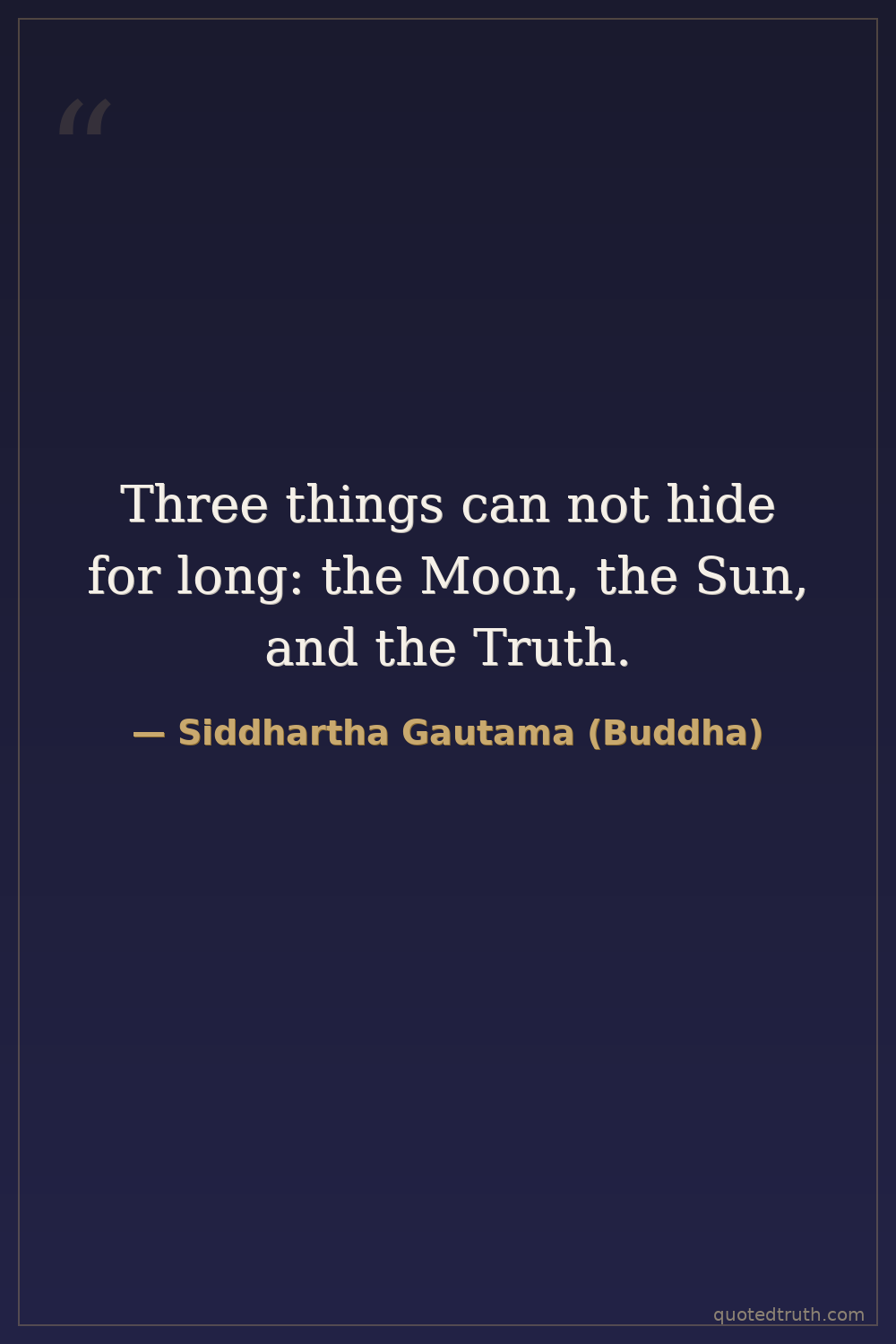
Siddhartha Gautama (Buddha) — "Three things can not hide for long: the Moon, the Sun, and the Truth."
Three things can not hide for long: the Moon, the Sun, and the Truth.
Three things can not hide for long: the Moon, the Sun, and the Truth.
Click any product to generate a realistic preview. Up to 3 at a time.
* Initial load can take up to 90 seconds — revising the preview in another color is nearly instant.
"Let them not do the slightest thing that the wise would later reprove."
"What you are is what you have been, and what you will be is what you do now."
"Irrigators channel waters, fletchers straighten arrows, carpenters bend wood, the wise master themselves."
"Peace comes from within. Do not seek it without."
"It is better to conquer yourself than to win a thousand battles."
Found in 1 providers: gemini
1 source checked
Certain realities are too powerful and visible to stay concealed. Just as the moon and sun always reappear in the sky regardless of clouds or night, truth eventually surfaces no matter how long it is suppressed, denied, or covered up. Lies, secrets, and deception may delay recognition, but time exposes what is real. The saying is a reminder that honesty wins out, and that attempts to bury facts are ultimately futile against the natural pull toward clarity.
As the Buddha, Siddhartha built his entire teaching around seeing reality clearly, piercing illusion, and awakening to truth through direct insight. After leaving his palace and confronting suffering, aging, and death he had been shielded from, he concluded that hidden realities must eventually be faced. His Four Noble Truths and emphasis on right view reflect this conviction: delusion is temporary, but truth, like celestial bodies, remains constant and inevitably reveals itself to the awakened mind.
In 5th-century BCE northern India, the Vedic Brahmin priesthood monopolized religious knowledge through ritual and Sanskrit scripture inaccessible to common people. The Buddha emerged alongside other shramana movements challenging this gatekeeping, teaching in vernacular Pali so truth could not be hoarded. Political kingdoms like Magadha and Kosala were consolidating power through propaganda and court intrigue. Against this backdrop of hidden esoteric doctrine and royal deception, insisting that truth cannot stay concealed was a radical democratizing claim.
AI-generated insights based on extensive research and information for context. Factual errors? Email [email protected].
Your cart is empty