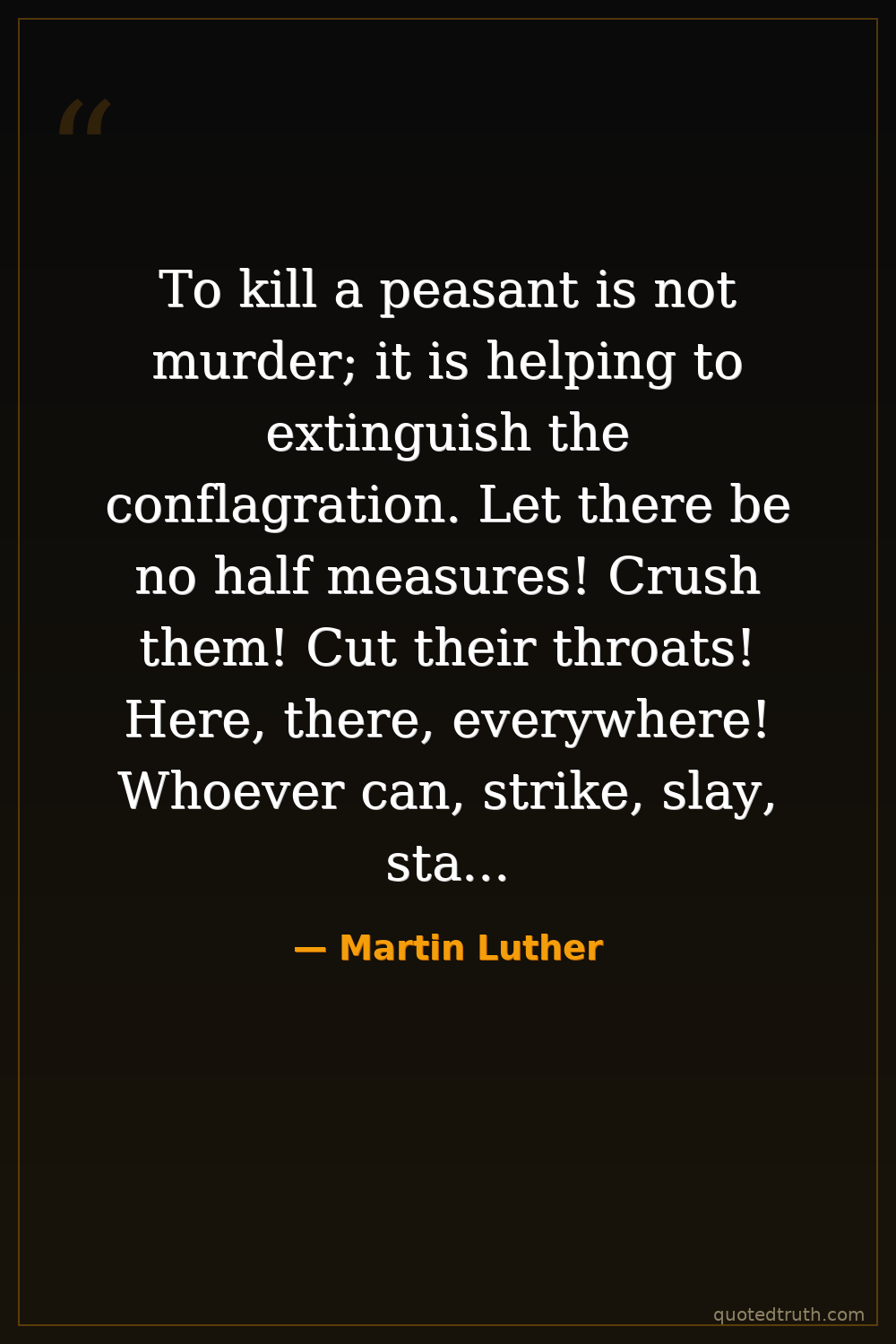
Martin Luther — "To kill a peasant is not murder; it is helping to extinguish the conflagration. …"

To kill a peasant is not murder; it is helping to extinguish the conflagration. Let there be no half measures! Crush them! Cut their throats! Here, there, everywhere! Whoever can, strike, slay, stab, secretly or openly, remembering that nothing can be more poisonous, hurtful, or devilish than a rebel.
Martin Luther — Martin Luther Early Modern · Leader of the Protestant Reformation

Get This Quote & Author's Image Illustrated On:

Click any product to generate a realistic preview. Up to 3 at a time.
* Initial load can take up to 90 seconds — revising the preview in another color is nearly instant.

Kitchen

Apparel

Other

About Martin Luther (1483-1546)

German theologian whose 95 Theses (1517) launched the Protestant Reformation and broke the Catholic Church's monopoly on Western Christianity. Closely associated with Philipp Melanchthon (Lutheran systematizer) and John Calvin (later Reformer who built on Luther's break). For an intellectual contrast, see Pope Leo X, Renaissance pope (1513-1521) — Leo X's indulgence sales triggered Luther's break and Leo excommunicated him in 1521 — Luther's entire Reformation is structured as a direct answer to the indulgence-funded Vatican Leo represented.

Details

Against the Murderous, Thieving Hordes of Peasants

Date: 1525

Shocking

Verification

Unverifiable

Found in 1 providers: grok

1 source checked

Understanding this quote

What it means

Luther is calling for merciless violence against rebelling peasants, insisting that killing them is not murder but a righteous act of stopping a fire. He rejects any leniency or compromise, urging rulers and citizens alike to stab, strike, and slay rebels wherever they find them, openly or in secret, framing armed revolt itself as the worst possible evil.

Relevance to Martin Luther

Luther wrote this in his 1525 tract 'Against the Murderous, Thieving Hordes of Peasants' after German peasants cited his reform ideas to justify revolt. Though he championed spiritual freedom, he believed in strict obedience to secular authority under his two-kingdoms doctrine. His brutal response shocked many followers, revealing his conviction that worldly rulers bore God-given swords to crush disorder.

The era

The 1524-1525 German Peasants' War was early modern Europe's largest popular uprising before the French Revolution, with up to 300,000 peasants demanding end of serfdom and feudal dues. The Reformation had destabilized traditional authority, and princes feared social collapse. Roughly 100,000 peasants were slaughtered. Luther's tract helped legitimize the massacre and cemented Protestantism's alliance with princely power rather than popular liberation.

AI-generated insights based on extensive research and information for context. Factual errors? Email [email protected].
Your Cart

Your cart is empty