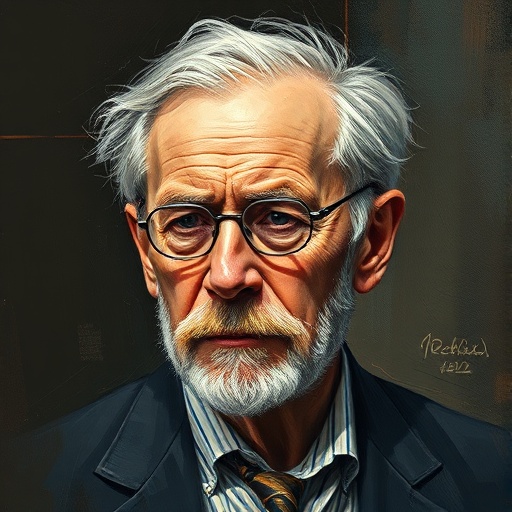
Erwin Schrodinger — "We are living in an age of specialization. This is a dangerous trend."
We are living in an age of specialization. This is a dangerous trend.
We are living in an age of specialization. This is a dangerous trend.
Click any product to generate a realistic preview. Up to 3 at a time.
* Initial load can take up to 90 seconds — revising the preview in another color is nearly instant.
"God's existence or non-existence, and the validity of moral laws, are not matters for scientific inquiry."
"The scientific picture of the world is very successful, but it is incomplete. It leaves out something essential, something that is very close to us, namely, our own consciousness."
"The problem of the 'thing in itself' is not a problem that can be solved by science. It is a philosophical problem."
"If you ask a theoretical physicist today, ‘What is an electron?’ he will probably say, ‘It is a symbol in the wave equation.’ We have got so far from the concrete picture of nature."
"The number of children born to a marriage ought to be limited, and that a man who has already had some children should be sterilized."
Austrian physicist who shared the 1933 Nobel for the wave equation that bears his name and the famous cat thought-experiment. Closely associated with Werner Heisenberg (matrix-mechanics rival who reached the same physics by different math) and Albert Einstein (his pen-pal on quantum interpretation). For an intellectual contrast, see Niels Bohr, Danish physicist and architect of the Copenhagen interpretation — Schrödinger's cat thought-experiment was specifically designed to ridicule Bohr's 'observer-dependent reality' reading of quantum mechanics — Schrödinger thought the Copenhagen interpretation was absurd; the cat was meant as reductio ad absurdum.
Attributed, reflecting his concerns about the fragmentation of knowledge.
Date: Unknown
GeneralFound in 1 providers: grok
1 source checked
Society increasingly demands people master one narrow field while ignoring everything else. This fragmentation is genuinely harmful — when experts know more and more about less and less, they lose the broad perspective needed to solve complex problems, make ethical judgments, or understand consequences beyond their specialty. Real wisdom requires connecting knowledge across domains, not siloing it.
Schrödinger embodied cross-disciplinary thinking: a physicist who founded wave mechanics yet wrote 'What is Life?' — a book that directly inspired Watson and Crick's DNA research. He read ancient Greek philosophy, studied Eastern mysticism, and taught himself biology. His greatest contributions came precisely from refusing to stay inside physics' boundaries.
Post-WWII science exploded into hyper-specialized government-funded research programs — nuclear, aerospace, biochemical. The Manhattan Project had revealed both the power and moral peril of technical experts working in isolation from humanistic concerns. Universities were restructuring around narrow departments, and Schrödinger watched generalist natural philosophy give way to siloed scientific bureaucracy.
AI-generated insights based on extensive research and information for context. Factual errors? Email [email protected].
Your cart is empty