What it means
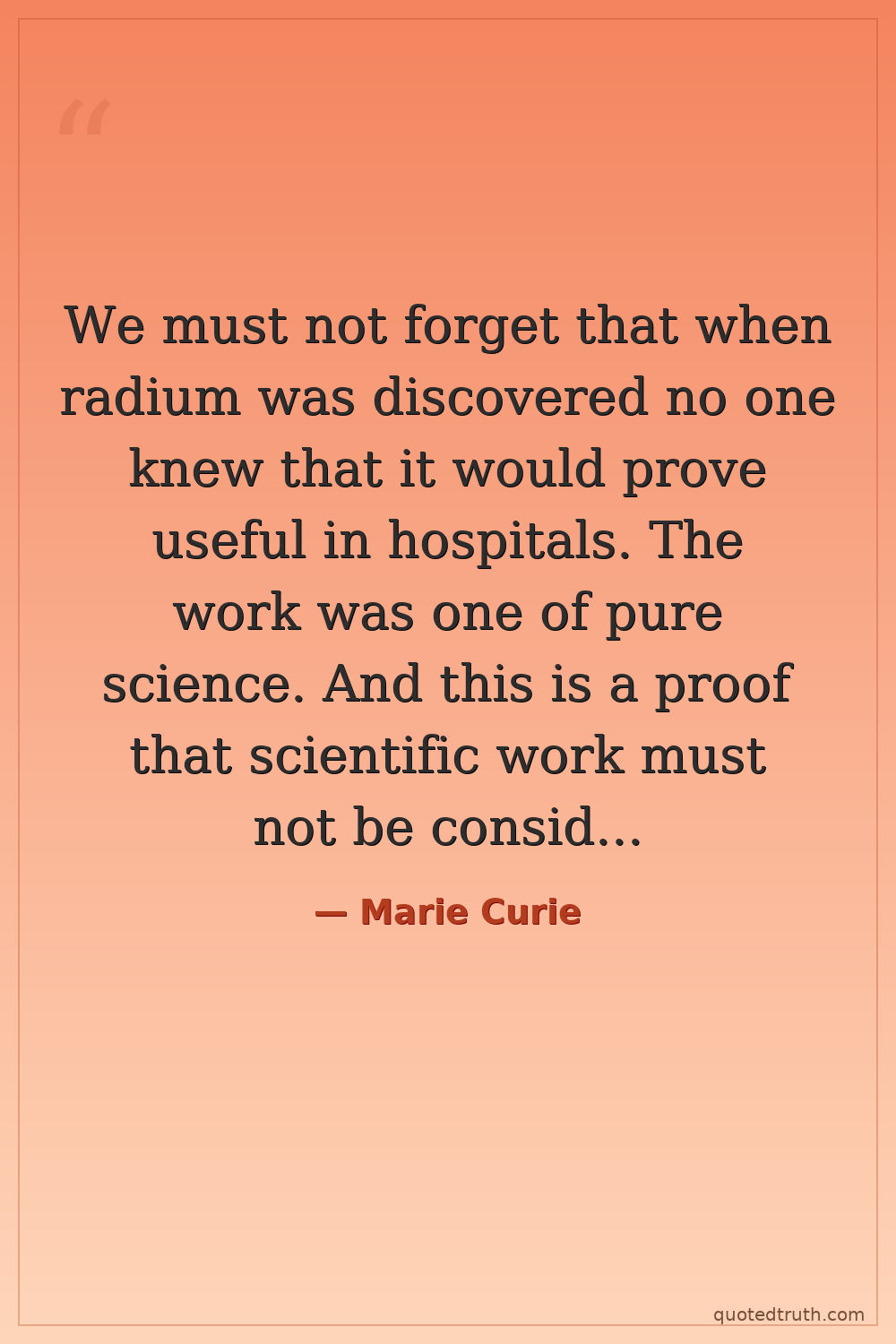
Curie argues that science should be pursued for its own sake, driven by curiosity and the pursuit of knowledge, not because researchers can predict practical payoffs. When she discovered radium, no one imagined it would treat cancer in hospitals. Demanding immediate usefulness from research is shortsighted because breakthroughs that transform human life often emerge from work done purely to understand nature. Fund curiosity, and application tends to follow.
Relevance to Marie Curie
Curie lived this principle. She and Pierre isolated radium through years of grueling work processing tons of pitchblende in a leaky shed, motivated by understanding radioactivity, not profit. She refused to patent the radium-isolation process, saying science belonged to humanity. Only later did radium therapy revolutionize cancer treatment. Her two Nobel Prizes (Physics 1903, Chemistry 1911) came from pure inquiry, yet her work founded oncology, radiography, and nuclear physics.
The era
Curie worked from the 1890s through the 1930s, when science was rapidly industrializing and governments increasingly expected research to yield weapons, medicines, or industry. Universities were pressured to justify budgets through applications. Meanwhile, World War I showcased science weaponized (gas, explosives), and Curie herself deployed mobile X-ray units to the front. Against this utilitarian tide, she defended basic research as European institutions debated whether pure science deserved public funding.
AI-generated insights based on extensive research and information for context. Factual errors? Email [email protected].