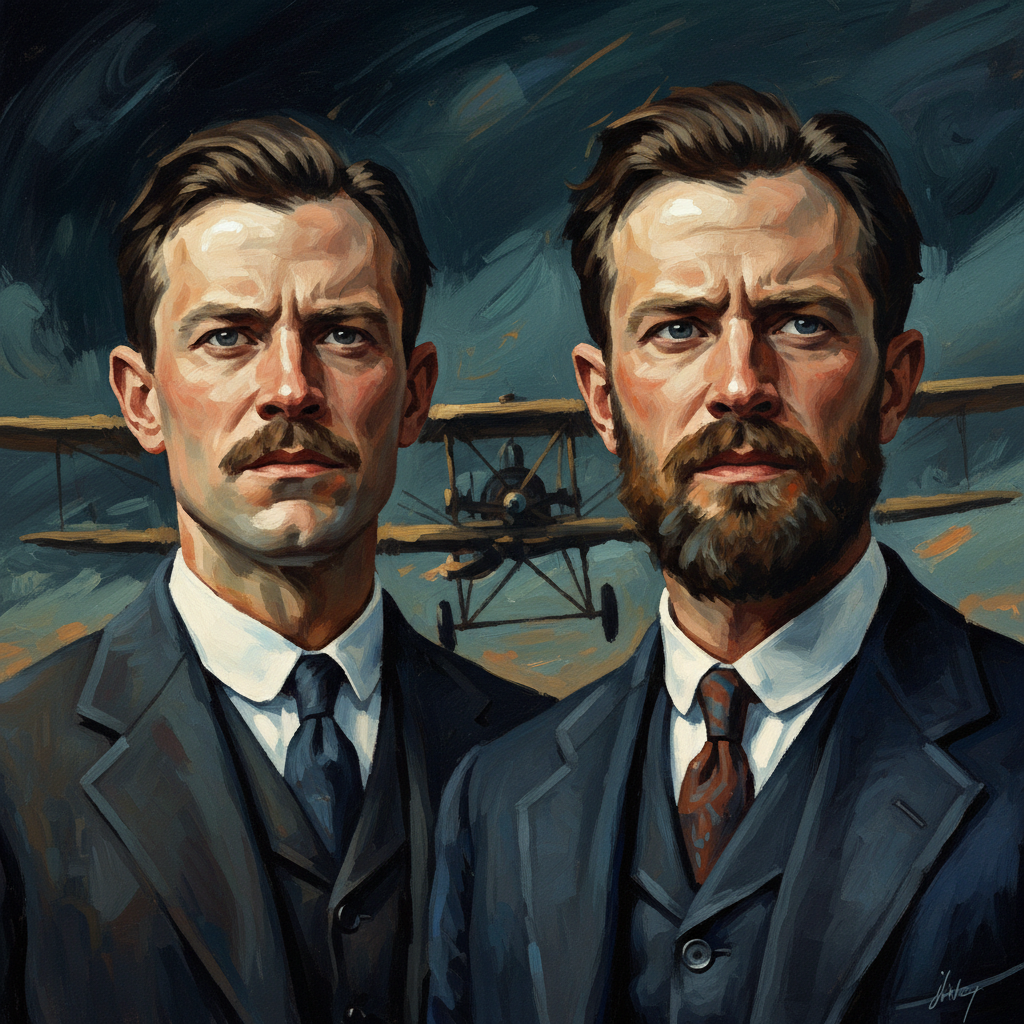
Wright Brothers (Orville & Wilbur) — "We were not seeking fame or fortune, but simply to solve a problem."
We were not seeking fame or fortune, but simply to solve a problem.
We were not seeking fame or fortune, but simply to solve a problem.
Click any product to generate a realistic preview. Up to 3 at a time.
* Initial load can take up to 90 seconds — revising the preview in another color is nearly instant.
"The air, like the sea, is an untamed element."
"The only way to learn to fly is to fly."
"We are trying to arrange a demonstration in Europe."
"The difficulties of the problem are so great that few have dared to attack it."
"The machine itself was a thing of beauty, a marvel of ingenuity and simplicity."
American aviation pioneers who achieved the first sustained powered controlled airplane flight at Kitty Hawk, NC, on December 17, 1903. Closely associated with Octave Chanute (their gliding mentor and aeronautical correspondent). For an intellectual contrast, see Samuel Pierpont Langley, Smithsonian Institution Secretary and government-funded aviation researcher — Langley's Aerodrome crashed twice into the Potomac in October-December 1903 with $50,000 of War Department funding; the Wright Brothers' bicycle-shop empiricism beat Langley's institutional Big Science by 9 days. The most-cited example in engineering history of empirical-tinkerer beating institution-funded credentialism.
Found in 1 providers: grok
1 source checked
The speaker rejects external rewards as motivation. They were not chasing recognition, wealth, or public approval. Instead, their drive came from the challenge itself, the intellectual puzzle of a difficult unsolved problem. Success, for them, meant cracking the problem, not cashing in on it. It is a statement about intrinsic motivation, prioritizing curiosity and mastery over applause, money, or status, and treating the work as its own reward.
The Wrights ran a modest bicycle shop in Dayton and poured their own savings into flight experiments without sponsors or university backing. Unlike rival Samuel Langley, who spent $50,000 in government funds, they worked quietly, built their own wind tunnel, and tested gliders at remote Kitty Hawk. Even after Kitty Hawk in 1903, they refused to publicly demonstrate until patents were secured. Their methodical, engineer-first approach embodied problem-solving over showmanship, exactly as this quote describes.
The early 1900s were dominated by well-funded inventors chasing glory, patents, and newspaper headlines. Edison, Marconi, and Langley were celebrity figures, and heavier-than-air flight was widely mocked as impossible after Langley's 1903 Potomac crash. The Industrial Revolution had created a culture where inventors pursued wealth and fame through press spectacle. Against that backdrop, two unknown bicycle mechanics quietly solving aerodynamics in isolation represented a counter-cultural, craftsman ethic rooted in disciplined experimentation rather than showmanship.
AI-generated insights based on extensive research and information for context. Factual errors? Email [email protected].
Your cart is empty