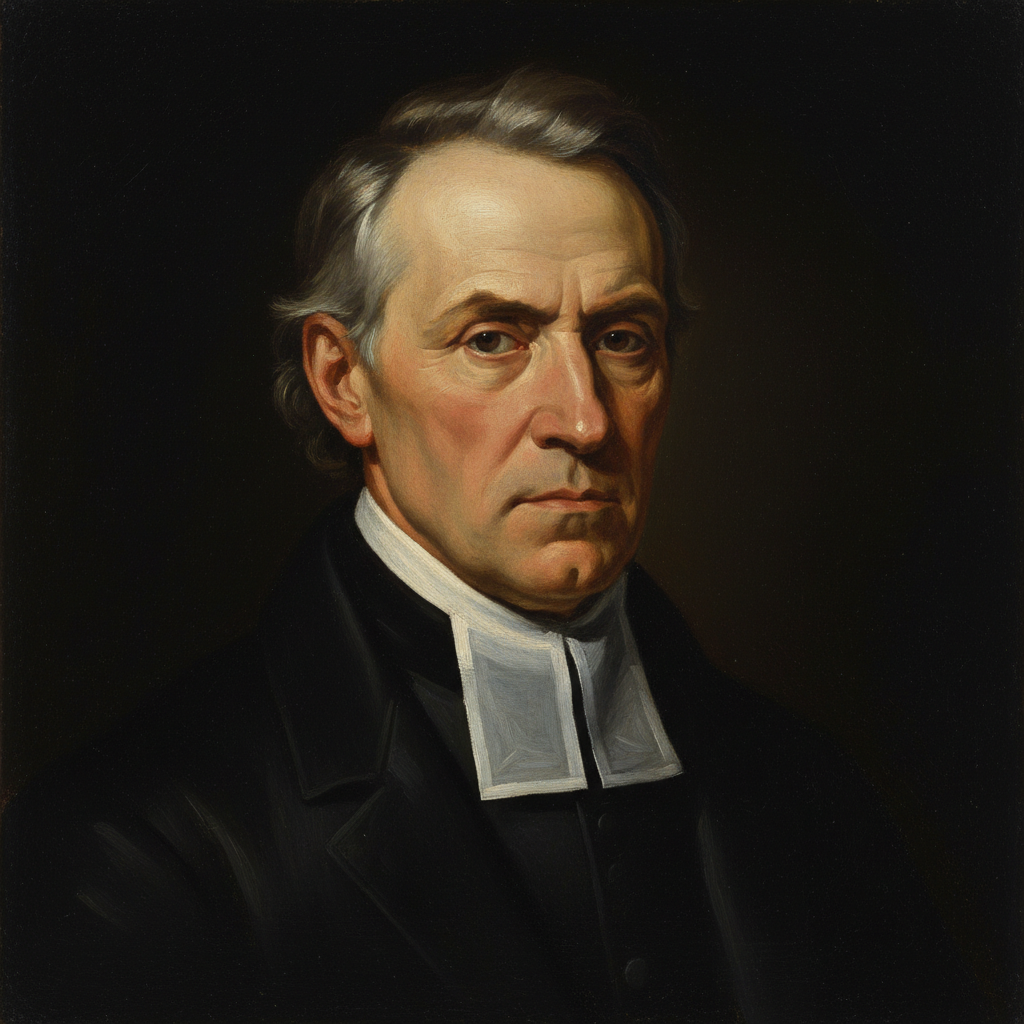
John Wesley — "What God has joined together, let no man put asunder."
What God has joined together, let no man put asunder.
What God has joined together, let no man put asunder.
Click any product to generate a realistic preview. Up to 3 at a time.
* Initial load can take up to 90 seconds — revising the preview in another color is nearly instant.
"God grant that I may never live to be useless!"
"I have not found one single man, among all those I have conversed with, who is able to give a rational account of the difference between an honest man and a rogue."
"I had rather have a thousand common people to hear me, than a thousand fine gentlemen."
"Reading the Scripture, I find there no other way to heaven than the way of holiness."
"I have often thought, that if I were to choose a companion to travel with, it should be one that would talk little."
English Anglican cleric and founder of Methodism, whose open-air preaching and class-meeting structure created the largest 18th-century evangelical revival. Closely associated with Charles Wesley (his hymn-writing brother) and George Whitefield (early co-revivalist, later doctrinal opponent). For an intellectual contrast, see George Whitefield, Calvinist evangelical revivalist — Whitefield's predestinarian Calvinism vs Wesley's free-grace Arminian theology split the early Methodist movement permanently in the 1739-41 break. The founding evangelical Calvinist-Arminian schism — the two parallel evangelical traditions American Christianity descends from.
Found in 1 providers: grok
1 source checked
Marriage is a sacred, permanent covenant ordained by God — not a contract humans can dissolve at will. Husband and wife are spiritually united by divine authority, a bond that transcends human law or personal desire. The phrase warns against any interference in that union, whether by courts, individuals, or social pressure. Once God has joined two people, no human power holds legitimate authority to break what the divine has bound together.
Wesley drew on this biblical text as foundational to Methodist theology's emphasis on disciplined, holy living within covenant relationships. Though his own marriage to Mary Vazeille in 1751 was notoriously unhappy — she eventually left him — Wesley consistently preached marriage as sacred duty. His Methodist societies promoted family stability and moral accountability, making covenantal marriage a cornerstone of the righteous household he believed Christians were called to build and sustain.
In 18th-century England, divorce required a private Act of Parliament, accessible only to the wealthy elite. The Marriage Act of 1753 placed marriage firmly under Church of England oversight. Meanwhile, Enlightenment philosophy increasingly challenged religious authority over personal life. Wesley's insistence on marital permanence pushed back against aristocratic casualness toward marriage and the secularizing trend eroding ecclesiastical control over matrimony, reinforcing the church's role in sanctifying domestic and family life.
AI-generated insights based on extensive research and information for context. Factual errors? Email [email protected].
Your cart is empty