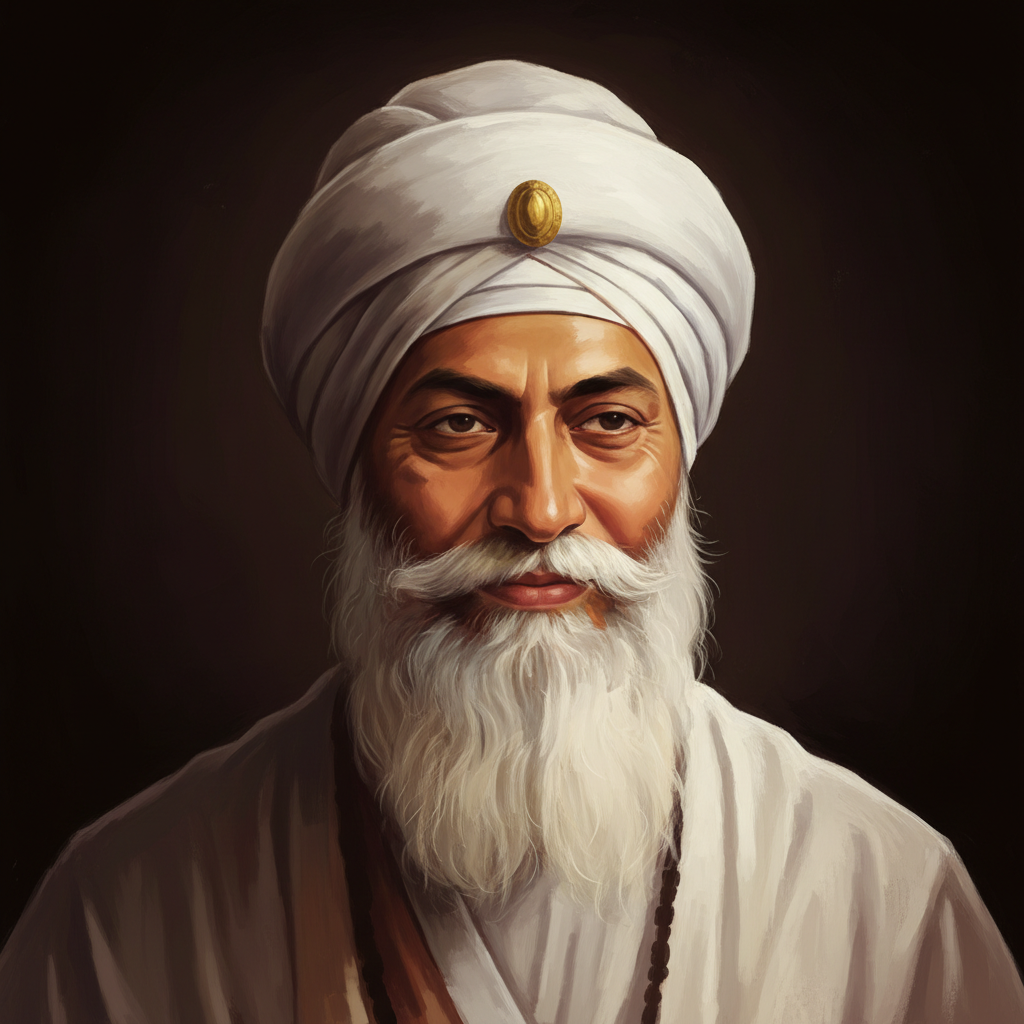
Guru Nanak — "Whatever is in the universe is in the body of the devotee."
Whatever is in the universe is in the body of the devotee.
Whatever is in the universe is in the body of the devotee.
Click any product to generate a realistic preview. Up to 3 at a time.
* Initial load can take up to 90 seconds — revising the preview in another color is nearly instant.
"Sing the songs of joy to the Lord, serve the Name of the Lord, and become the servant of His servants."
"Without fear, there is no love for God."
"The Guru is the ladder, the boat, the raft, the ferryman, the ship, and the captain."
"That one plant should be sown and another be produced cannot happen; whatever seed is sown, a plant of that kind even comes forth."
"With your hands carve out your own destiny."
Founder of Sikhism and the first of the Ten Sikh Gurus, whose teachings of one universal God and rejection of caste shaped Punjab. Closely associated with Kabir (mystical poet whose verses appear in the Sikh Guru Granth Sahib). For an intellectual contrast, see Brahmanical orthodoxy, the Hindu caste-and-ritual establishment of his era — Sikhism was founded as a deliberate alternative to both Hindu ritual hierarchy and Islamic exclusivism — Nanak's universalism was a structural rejection of caste and priestly mediation.
Found in 1 providers: grok
1 source checked
The entire cosmos exists within a sincere seeker. Every force, element, and divine spark found in creation is also present inside the human body and consciousness of one devoted to the truth. External pilgrimage and searching outward become unnecessary because the same reality pervading stars, rivers, and worlds already lives within. Self-inquiry and devotion unlock access to everything people ordinarily chase in temples, rituals, or distant holy sites.
Guru Nanak founded Sikhism on the conviction that one formless God (Ik Onkar) dwells equally in all beings, rejecting caste, idol worship, and ritual pilgrimage. He famously told Mecca's clerics that God faced every direction. This saying mirrors his core teaching that inner meditation on the Naam, honest labor, and sharing with others reveal the divine within, making the devotee's body itself the true shrine and pilgrimage site.
Guru Nanak lived 1469-1539 in Punjab under Lodi and early Mughal rule, an era of sharp Hindu-Muslim friction, rigid Brahminical caste hierarchy, and formalistic ritualism on both sides. Bhakti and Sufi movements were challenging orthodoxy by emphasizing direct, interior devotion over priests and pilgrimage. Nanak's message that the universe lives inside the devotee dismantled temple gatekeeping and Mecca-bound piety alike, offering a radical equality that resonated with peasants, merchants, and disenfranchised communities across a volatile frontier.
AI-generated insights based on extensive research and information for context. Factual errors? Email [email protected].
Your cart is empty