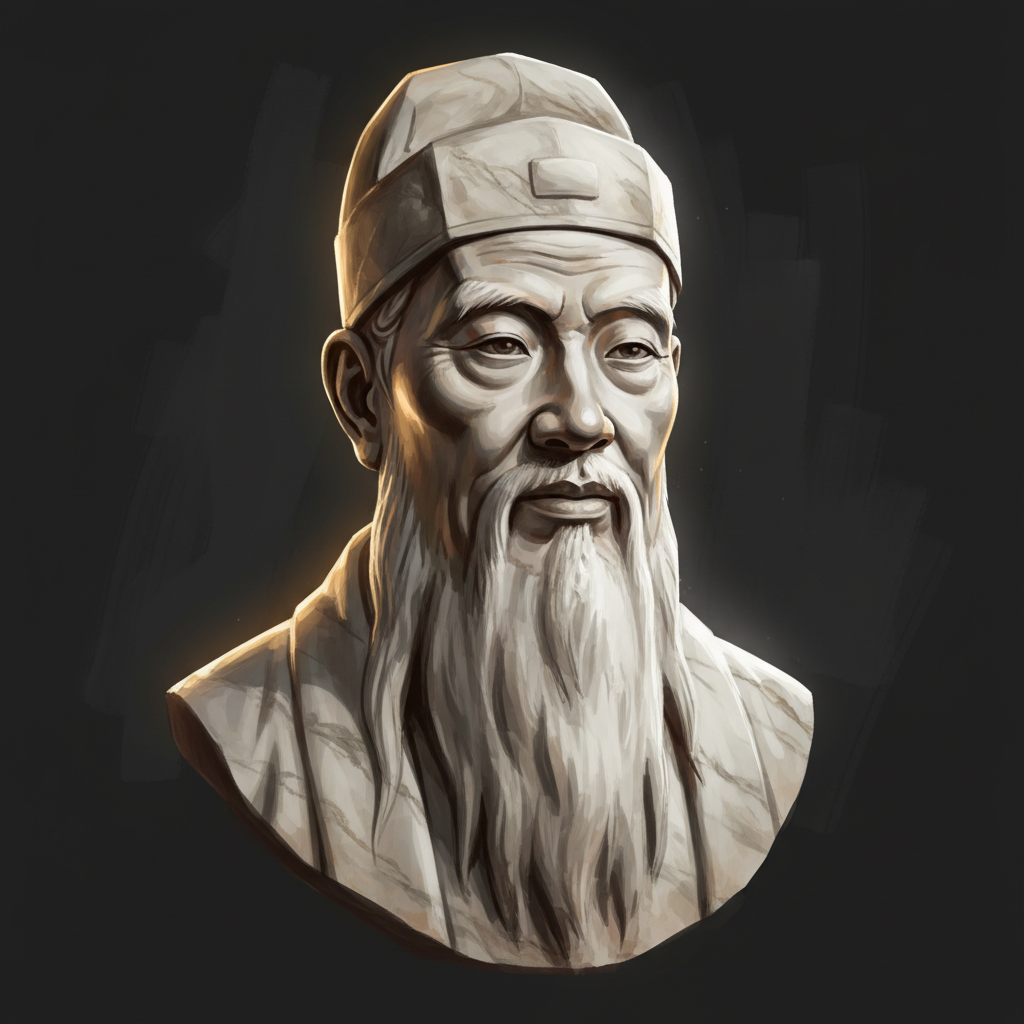
Confucius — "When you see a good man, try to emulate his example, and when you see a bad man,…"
When you see a good man, try to emulate his example, and when you see a bad man, search yourself for his faults.
When you see a good man, try to emulate his example, and when you see a bad man, search yourself for his faults.
Click any product to generate a realistic preview. Up to 3 at a time.
* Initial load can take up to 90 seconds — revising the preview in another color is nearly instant.
"The Master said, 'The superior man is anxious lest he should not get the truth; he is not anxious lest poverty should come upon him.'"
"The superior man is watchful over himself when alone."
"Is it not a pleasure, having learned something, to try it out at due intervals?"
"The gentleman considers righteousness to be essential. He performs it according to the rules of propriety. He brings it forth in humility. He completes it with sincerity. This is indeed a gentleman."
"The Master said, 'To see what is right, and not to do it, is want of courage.'"
Chinese philosopher and teacher whose teachings (compiled by his students in the Analects) became the foundational ethical framework of East Asian civilization for 2,500 years. Closely associated with Mencius (his most-influential follower a century later). For an intellectual contrast, see Laozi, near-contemporary Chinese sage and Tao Te Ching author — Confucius systematized social order through ritual and family hierarchy; Laozi's Taoist effortless-action philosophy argued such systems were the disease, not the cure. The two founding poles of Chinese moral philosophy — every East Asian moral tradition since has positioned itself between them.
The standard scholarly entry points to Confucius's work: Philip J. Ivanhoe (Georgetown, Chinese philosophy) — Confucian Moral Self Cultivation (2000); Edward Slingerland (UBC, Asian Studies) — Effortless Action: Wu-wei as Conceptual Metaphor (2003); Tu Weiming (Harvard, Confucian scholar) — Confucian Thought: Selfhood as Creative Transformation (1985). These are the works graduate seminars cite when teaching Confucius.
Found in 1 providers: grok
1 source checked
Treat everyone you encounter as a mirror for self-improvement. When someone acts admirably, study what they do and try to copy it. When someone behaves badly, don't just criticize them—check whether you carry the same flaw, even in smaller form. Growth comes from constant honest self-examination, not from judging others. Both virtuous and flawed people become teachers if you pay attention and stay humble enough to learn from the comparison.
Confucius built his entire teaching around self-cultivation and moral refinement as the foundation of a good society. He worked as a teacher and minor official, training students to become virtuous leaders through daily reflection. This saying captures his signature method: using others as mirrors rather than targets. His Analects repeatedly urge disciples to examine themselves three times a day and treat every interaction as a chance to sharpen character rather than assign blame.
Confucius lived during the late Spring and Autumn period (around 551–479 BCE), an era of collapsing Zhou authority, warring states, and moral chaos. Rulers were corrupt, rituals decayed, and violence spread. In that climate, blaming others was easy and common. Confucius offered a radical alternative: rebuild society one character at a time by having each person take responsibility for their own conduct. His emphasis on introspection was a direct response to a world obsessed with power and blame.
AI-generated insights based on extensive research and information for context. Factual errors? Email [email protected].
Your cart is empty