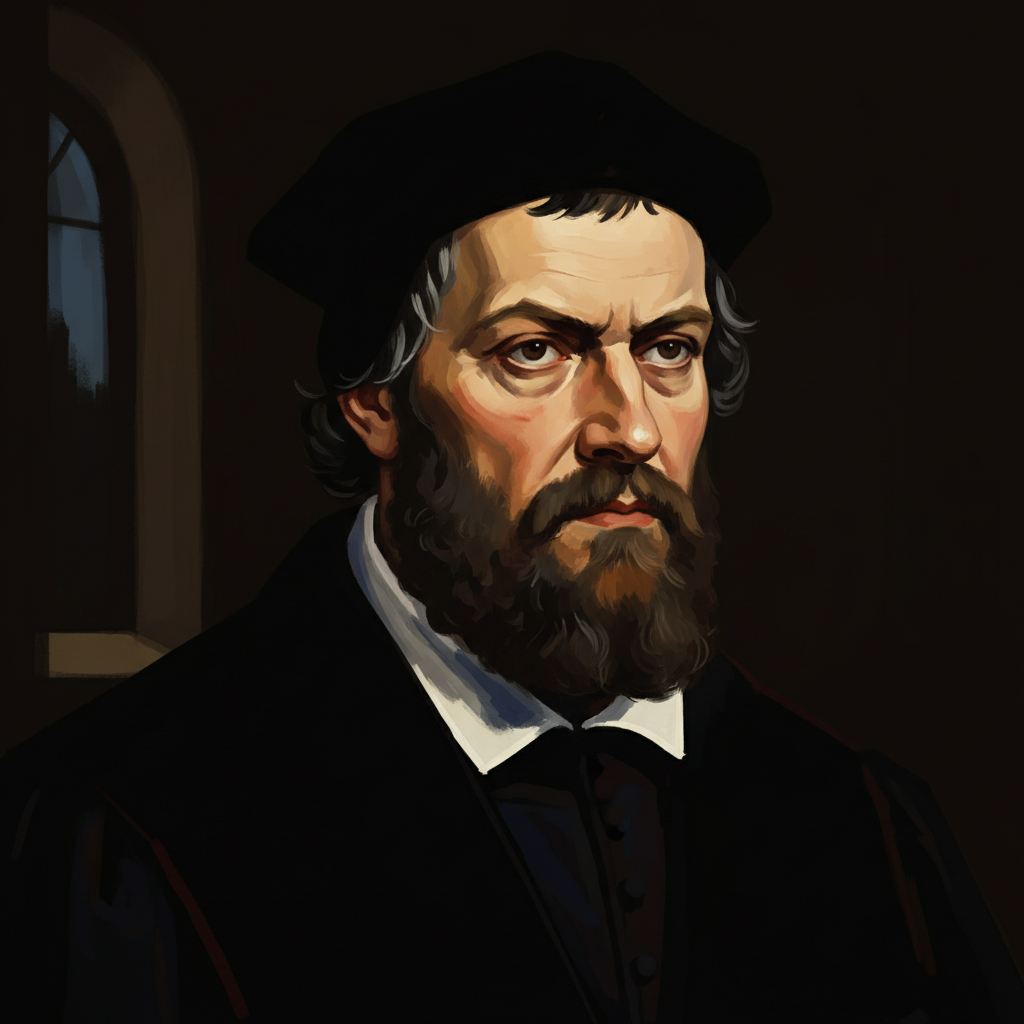
Martin Luther — "Whoever does not know God hidden in suffering does not know God at all."
Whoever does not know God hidden in suffering does not know God at all.
Whoever does not know God hidden in suffering does not know God at all.
Click any product to generate a realistic preview. Up to 3 at a time.
* Initial load can take up to 90 seconds — revising the preview in another color is nearly instant.
"If God has no sense of humor, I don't want to go to Heaven."
"The book of Esther I toss into the Elbe. I am such an enemy to the book of Esther that I wish it did not exist, for it Judaizes too much and has in it a great deal of heathenish foolishness."
"Whoever drinks beer, he is quick to sleep; whoever sleeps long, does not sin; whoever does not sin, enters Heaven! Thus, let us drink beer!"
"If a woman grows weary and at last dies from childbearing, it matters not. Let her die in childbearing—she is there to do it."
"The greatest vice is pride."
German theologian whose 95 Theses (1517) launched the Protestant Reformation and broke the Catholic Church's monopoly on Western Christianity. Closely associated with Philipp Melanchthon (Lutheran systematizer) and John Calvin (later Reformer who built on Luther's break). For an intellectual contrast, see Pope Leo X, Renaissance pope (1513-1521) — Leo X's indulgence sales triggered Luther's break and Leo excommunicated him in 1521 — Luther's entire Reformation is structured as a direct answer to the indulgence-funded Vatican Leo represented.
Found in 1 providers: gemini
1 source checked
Real knowledge of God comes through pain, weakness, and hardship rather than through displays of power, glory, or human reasoning. Anyone who only recognizes God in success, prosperity, or intellectual achievement has missed the point entirely. To genuinely understand the divine, a person must encounter God in the messy, painful, humiliating places of life, because that is precisely where God chooses to reveal himself.
Luther built his entire theology around this idea, calling it the theology of the cross versus the theology of glory. Excommunicated, hunted as an outlaw after the Diet of Worms, and tormented by spiritual anguish he called Anfechtungen, he found assurance not in religious achievement but in Christ crucified. His own suffering convinced him that hidden, broken-looking faith outweighed the visible grandeur of Rome.
In early sixteenth-century Europe, the Roman Church projected God through glory: indulgences, relics, towering cathedrals, papal power, and scholastic philosophy. Plague, peasant poverty, and war left ordinary people crushed while clergy displayed wealth. Luther's 1517 Ninety-Five Theses ignited the Reformation precisely by attacking this glory-based religion. Printing presses spread his message that a suffering God met suffering people, reshaping European Christianity, politics, and eventually the modern conscience.
AI-generated insights based on extensive research and information for context. Factual errors? Email [email protected].
Your cart is empty