What it means
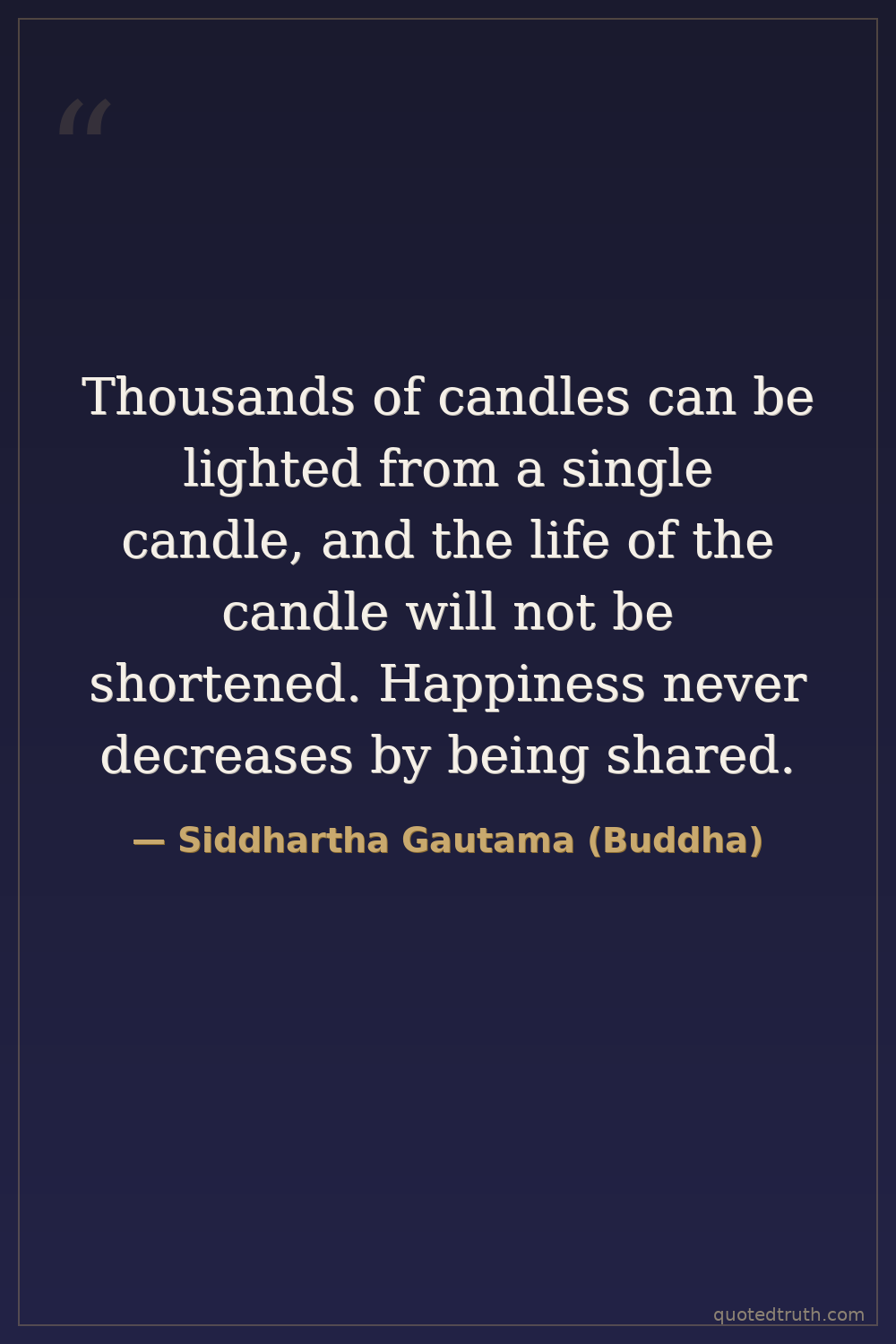
Sharing happiness with others does not diminish your own. Just as one candle can light countless others without losing its flame, giving joy, kindness, or good fortune to those around you leaves your own supply intact. Generosity is not a zero-sum transaction where helping others costs you something. Instead, spreading positive feelings multiplies them in the world while your personal well-being remains fully preserved and often grows through the act itself.
Relevance to Siddhartha Gautama (Buddha)
This reflects the Buddha's core teaching of metta, or loving-kindness, which he placed at the heart of his path after leaving his royal life in Kapilavastu. Having renounced his princely wealth at twenty-nine to seek liberation from suffering, he spent forty-five years teaching that compassion and generosity, dana, were foundational virtues. His sangha of monks survived on shared alms, embodying the principle that giving sustains rather than depletes both giver and receiver.
The era
The Buddha lived roughly 563 to 483 BCE in northern India during the Axial Age, when new philosophies challenged rigid Vedic ritualism and the caste hierarchy controlled by Brahmin priests. Competing shramana movements, including Jainism and the Ajivikas, questioned sacrifice-based religion. Candles and oil lamps were central to evening life and religious ceremony, making the flame metaphor instantly vivid. His emphasis on shared happiness countered a culture where spiritual merit was often hoarded through exclusive ritual access.
AI-generated insights based on extensive research and information for context. Factual errors? Email [email protected].