What it means
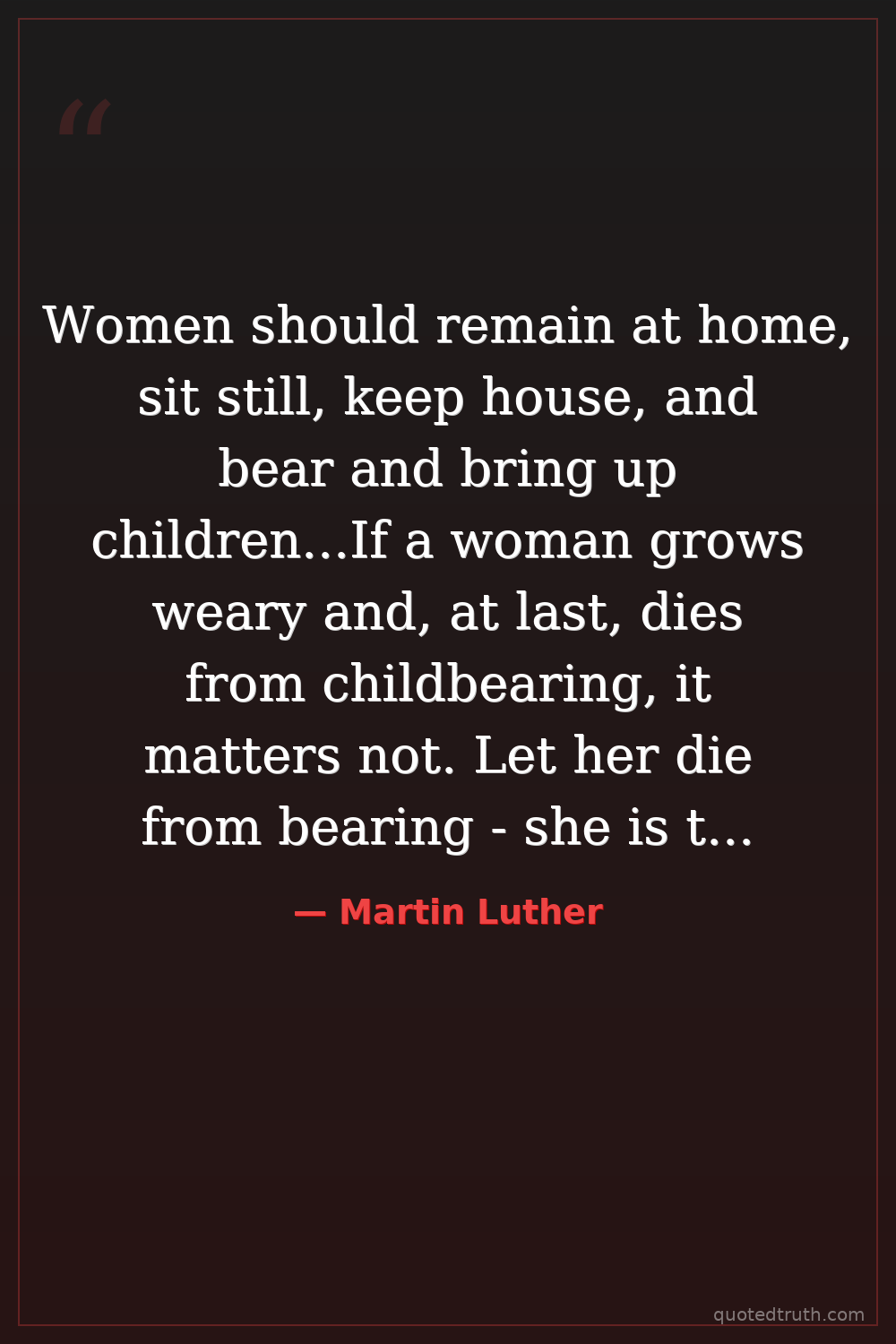
Luther states that a woman's proper role is confined to the household: managing the home and producing children. He goes further, declaring that if childbirth kills her, that outcome is acceptable because bearing children is literally her purpose. The quote frames women as instruments of reproduction whose lives are expendable in service of that function, denying them value beyond domestic and maternal duty.
Relevance to Martin Luther
Luther, an Augustinian monk who married former nun Katharina von Bora in 1525 and fathered six children, preached extensively on marriage and household order. While he elevated marriage over celibacy—a radical break from Catholic monasticism—he anchored it in rigid patriarchal hierarchy drawn from his reading of Genesis and Paul. His "table talk" and sermons repeatedly cast wifely submission and fertility as divine mandates, shaping Protestant domestic theology for centuries.
The era
In early-modern Europe, childbirth killed roughly one in forty mothers per delivery, and women averaged seven or more pregnancies. The Reformation dissolved convents, eliminating the main alternative to marriage for women and funneling them into household roles. Legal codes treated wives as husbands' property, and theological debates over Eve's guilt reinforced female subordination. Luther's words reflected—and helped cement—a Protestant social order built on compulsory marriage, large families, and women's civic invisibility.
AI-generated insights based on extensive research and information for context. Factual errors? Email [email protected].