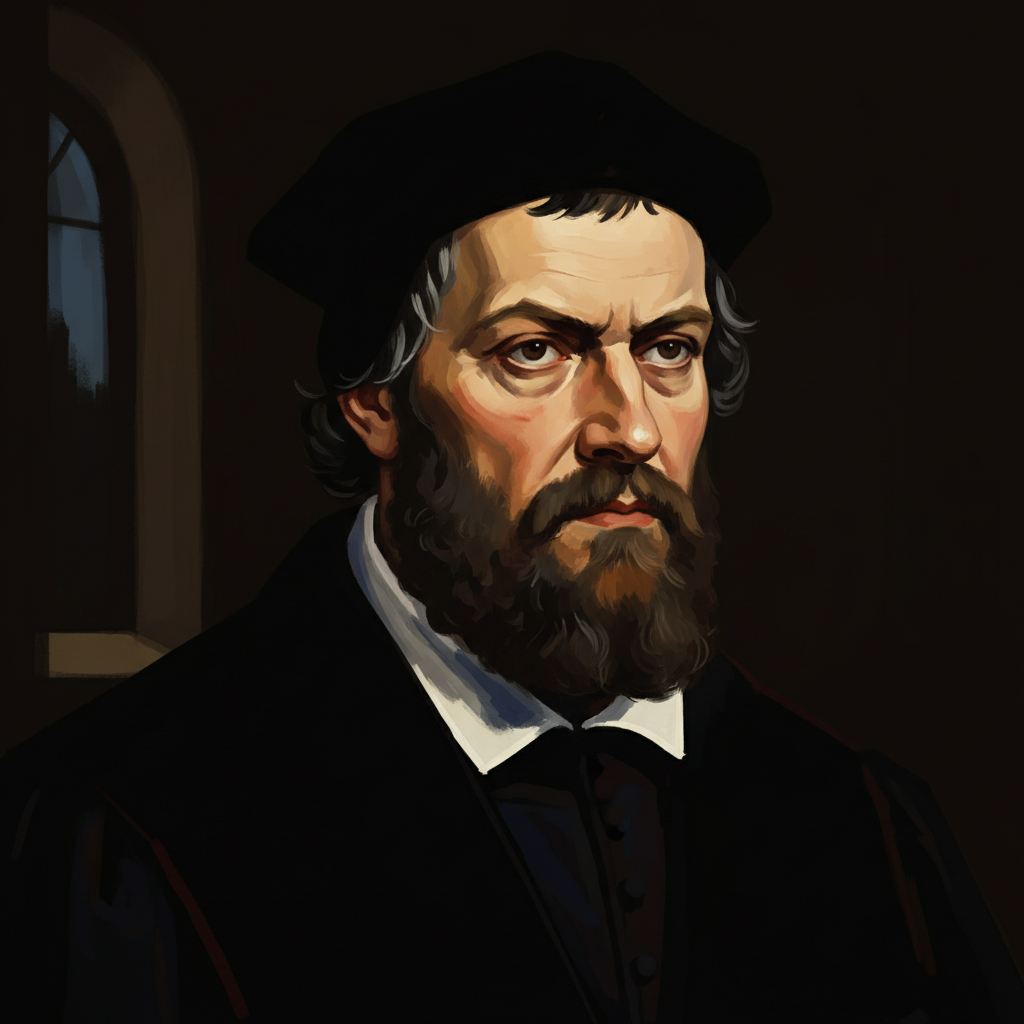
Martin Luther — "You abominable abomination."
You abominable abomination.
You abominable abomination.
Click any product to generate a realistic preview. Up to 3 at a time.
* Initial load can take up to 90 seconds — revising the preview in another color is nearly instant.
"Heretics are not to be disputed with, but to be condemned unheard, and whilst they perish by fire, the faithful ought to pursue the evil to its source, and bathe their heads in the blood of the Cathol…"
"Fourthly, their rabbis must be forbidden under threat of death to teach any more."
"A man must have a good digestion to be a good preacher."
"Your Hellishness."
"The more a man is skilled in the Scriptures, the more he is tempted."
German theologian whose 95 Theses (1517) launched the Protestant Reformation and broke the Catholic Church's monopoly on Western Christianity. Closely associated with Philipp Melanchthon (Lutheran systematizer) and John Calvin (later Reformer who built on Luther's break). For an intellectual contrast, see Pope Leo X, Renaissance pope (1513-1521) — Leo X's indulgence sales triggered Luther's break and Leo excommunicated him in 1521 — Luther's entire Reformation is structured as a direct answer to the indulgence-funded Vatican Leo represented.
Found in 1 providers: gemini
1 source checked
This is a blunt expression of disgust or condemnation, calling something so repulsive it doubles down on itself. The speaker is not merely saying the target is bad or offensive but insisting it represents a profound, layered form of wrongness. In modern terms, it is the equivalent of saying something is utterly detestable, a vile thing piled on top of vileness, beyond ordinary criticism or polite disagreement.
Luther was famous for ferocious, scatological, and theatrical invective against popes, theologians, Jews, peasants, and rival reformers. His writings brim with doubled insults and biblical curses, reflecting a personality that fused deep piety with volcanic rage. Trained as an Augustinian monk and biblical scholar, he wielded Scripture-laced condemnation as a weapon, and phrases stacking a noun on its own adjective echo his habit of amplifying denunciations until opponents seemed cosmically corrupt.
In early-modern Europe, the Reformation unleashed polemical warfare fought through pamphlets, sermons, and woodcuts. Printing presses spread insults across Christendom within weeks, and reformers competed to brand opponents as satanic, heretical, or monstrous. Religious disputes were existential, tied to salvation, princes, and peasant revolts. Calling something an abomination carried Old Testament weight, invoking idolatry and divine wrath, and heaping the word on itself fit an age when rhetorical violence preceded, and often justified, actual bloodshed.
AI-generated insights based on extensive research and information for context. Factual errors? Email [email protected].
Your cart is empty