Alexander Fleming — "A good many people think that I deserve some credit for the discovery of penicil…"
A good many people think that I deserve some credit for the discovery of penicillin. They are wrong. It was discovered by nature.
A good many people think that I deserve some credit for the discovery of penicillin. They are wrong. It was discovered by nature.
Click any product to generate a realistic preview. Up to 3 at a time.
* Initial load can take up to 90 seconds — revising the preview in another color is nearly instant.
"My work was not a flash of genius, but a gradual unfolding of facts."
"I did not invent penicillin. Nature did that. I only discovered it by accident."
"It was not easy to convince people of the importance of penicillin in the early days."
"I have always been interested in the fight against disease."
"It has been said that I am a lucky man. I agree. I have been very lucky."
Found in 1 providers: grok
1 source checked
Fleming argues that penicillin wasn't invented — it existed in nature long before humans arrived. His contribution was simply noticing that a Penicillium mold was killing surrounding bacteria and recognizing the significance of that observation. The quote redefines discovery as witnessing rather than creating, and deflects personal glory entirely. It is a reminder that nature's complexity vastly predates human intelligence, and scientists are observers, not originators, of its phenomena.
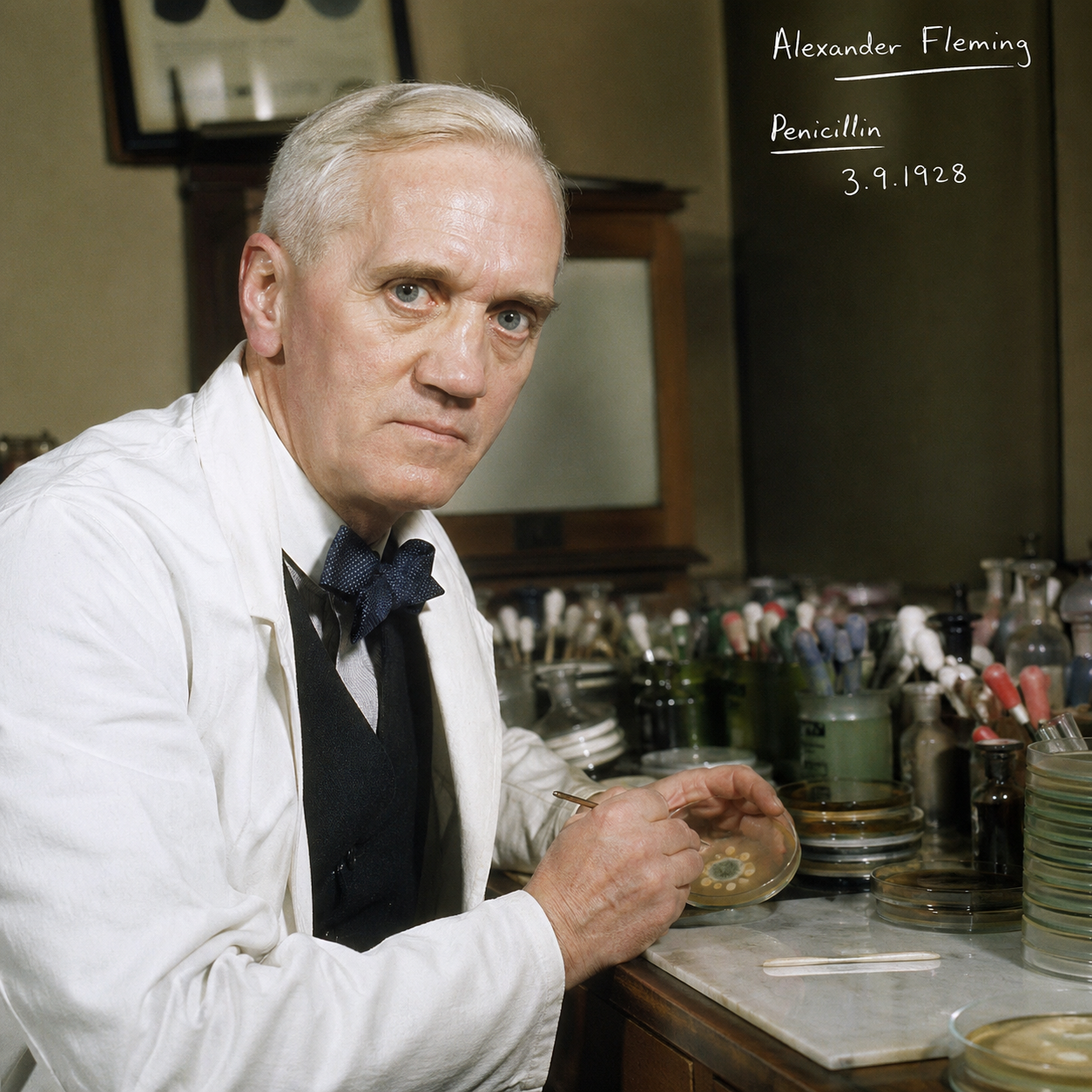
Fleming's 1928 discovery was famously accidental: a contaminated petri dish he nearly discarded revealed that Penicillium mold was lysing bacteria. He didn't engineer this — he recognized it. Throughout his life Fleming remained modest, crediting chance over intellect. He won the 1945 Nobel Prize yet consistently reminded audiences that the bacteria-killing mold had existed for millennia; his only act was paying attention when another scientist might have simply cleaned the bench.
Fleming worked in the interwar period when bacterial infections — pneumonia, sepsis, syphilis — were leading causes of death and medicine lacked effective treatments. Culture celebrated heroic individual inventors. Fleming's quote quietly resisted that framing. By the 1940s, penicillin mass production saved hundreds of thousands of WWII soldiers, cementing his legend — making his insistence that nature deserved the credit a striking act of intellectual honesty against enormous public pressure to accept hero status.
AI-generated insights based on extensive research and information for context. Factual errors? Email [email protected].
Your cart is empty