Alexander Fleming — "The bacteriologist is a detective. He must follow every clue, however small."
The bacteriologist is a detective. He must follow every clue, however small.
The bacteriologist is a detective. He must follow every clue, however small.
Click any product to generate a realistic preview. Up to 3 at a time.
* Initial load can take up to 90 seconds — revising the preview in another color is nearly instant.
"A good many people think that I deserve some credit for the discovery of penicillin. They are wrong. It was discovered by nature."
"It is not the man who first sees a thing who is the discoverer, but he who sees into a thing."
"Some people have been very enthusiastic about penicillin, others less so."
"It is not wise to be too dogmatic in science. One must always be prepared to change one's mind."
"I never thought of myself as a genius. I just kept looking."
Found in 1 providers: grok
1 source checked
The quote draws a direct parallel between scientific bacteriology and detective investigation. A scientist must maintain relentless attention to anomalies—even seemingly trivial observations demand pursuit. Small, unexpected findings often contain the most consequential discoveries. Science advances not through grand theorizing alone but through patient, methodical observation of every irregularity. The instinct to investigate rather than dismiss the unusual is what separates breakthrough science from routine research.
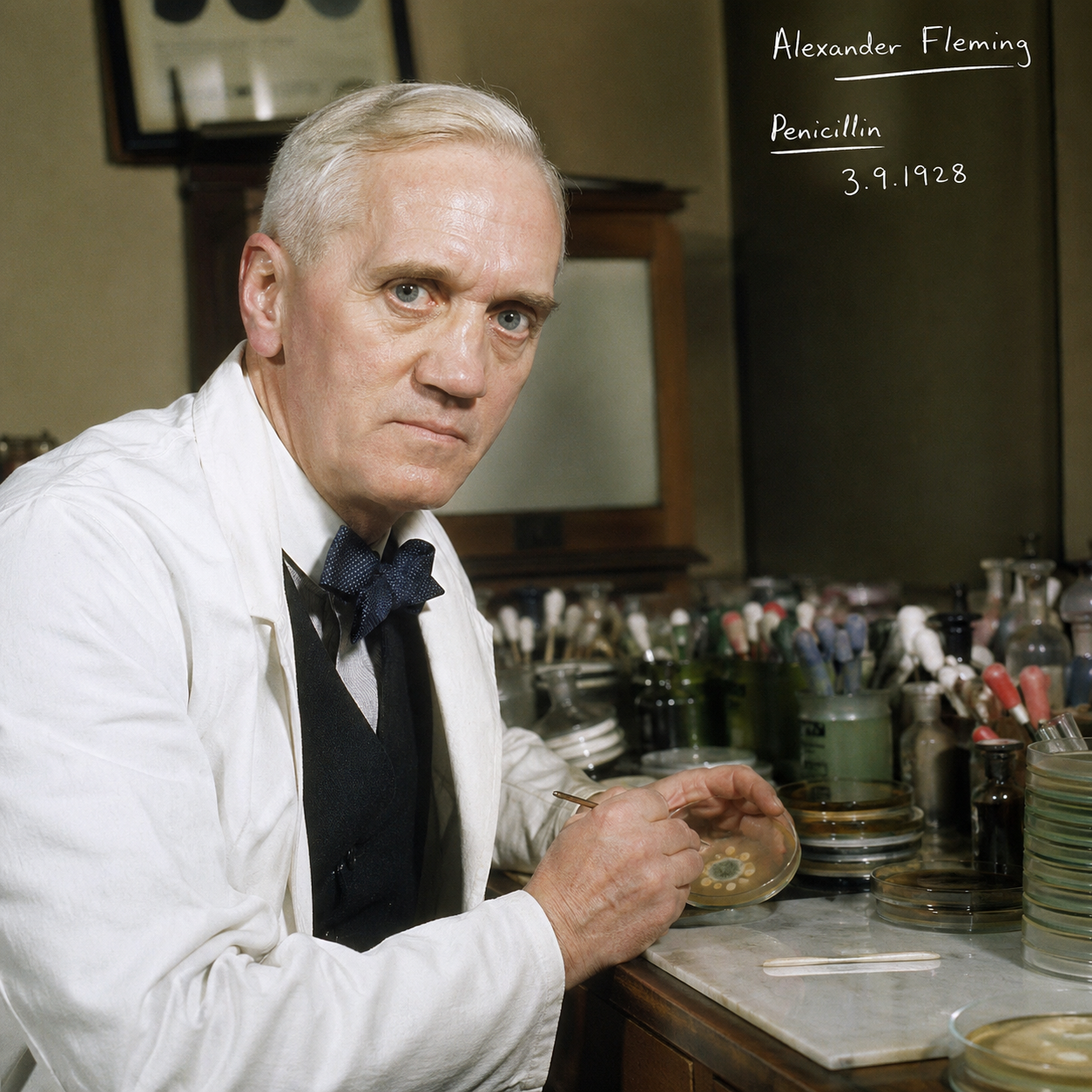
Fleming's career is the definition of following small clues. In 1928, he noticed a mold contaminating a petri dish had created a bacteria-free zone around it—most researchers would have discarded it as spoilage. Fleming investigated instead, identifying Penicillium notatum's antibacterial properties. His earlier work detecting lysozyme in tears followed identical logic. His entire scientific legacy rests on refusing to dismiss minor unexpected observations.
Fleming worked in the early 20th century when bacterial infections—pneumonia, tuberculosis, infected wounds—killed millions and had no reliable treatments. World War I had demonstrated devastating losses to infected injuries. Bacteriology was simultaneously urgent and primitive. Germ theory was barely decades old, yet pathogens responsible for epidemics remained poorly understood. Every careful laboratory observation carried genuine life-or-death stakes, making the detective metaphor not mere flourish but practical urgency.
AI-generated insights based on extensive research and information for context. Factual errors? Email [email protected].
Your cart is empty