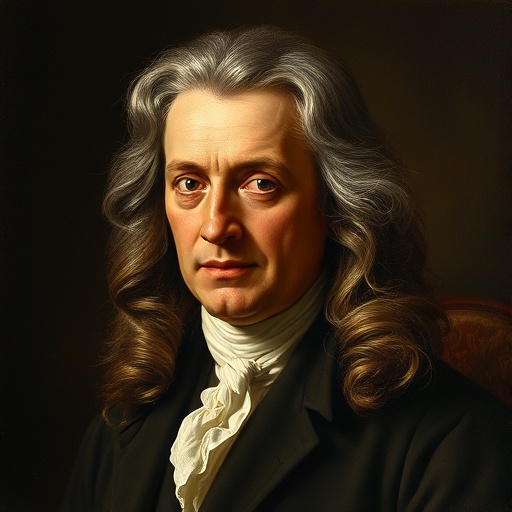
Isaac Newton — "Oh, Diamond! Diamond! thou little knowest what mischief thou hast done!"
Oh, Diamond! Diamond! thou little knowest what mischief thou hast done!
Oh, Diamond! Diamond! thou little knowest what mischief thou hast done!
Click any product to generate a realistic preview. Up to 3 at a time.
* Initial load can take up to 90 seconds — revising the preview in another color is nearly instant.
"I do not know what I may appear to the world, but to myself I seem to have been only like a boy playing on the seashore, and diverting myself in now and then finding a smoother pebble or a prettier sh…"
"The best and safest method of philosophizing seems to be, first to inquire diligently into the properties of things, and to establish those properties by experiments, and then to proceed more slowly t…"
"He who thinks half-heartedly will not believe in God; but he who thinks seriously will believe in God, and will not doubt that God is the author of the world."
"I have studied these things – you have not."
"Truth is ever to be found in simplicity, and not in the multiplicity and confusion of things."
Anecdote about his dog Diamond overturning a candle and burning his papers.
Date: c. 1690
WisdomFound in 1 providers: gemini
1 source checked
The quote expresses helpless grief after an irreversible accident destroys something precious. Newton addresses his dog directly—a creature innocent of the consequences—lamenting the loss of reportedly years of scientific manuscripts. It captures the specific sorrow of watching irreplaceable intellectual labor vanish while being unable to assign blame to a guileless animal. It's a cry of resignation in the face of accidental, catastrophic loss with no path to recovery.
Newton was legendarily obsessive, spending years in solitary focus on singular problems. This anecdote—his dog Diamond allegedly knocking over a candle and burning manuscripts—fits his documented intensity. His Principia Mathematica emerged from decades of private labor. Whether historically accurate or apocryphal, it captures his character: someone for whom lost research represented genuine devastation. His private correspondence reveals a man who tied his identity tightly to his intellectual work and suffered deeply over setbacks.
In late 17th-century England, scientific manuscripts were hand-written and entirely irreplaceable—no copies, no printed drafts, no backups. Newton worked during the Scientific Revolution when individual scholars were the sole custodians of their discoveries. The Royal Society, founded 1660, was still establishing how knowledge should be preserved. Losing years of research notes meant permanent, total loss in ways modern researchers with digital storage cannot fully appreciate, making this kind of accident a genuine intellectual catastrophe.
AI-generated insights based on extensive research and information for context. Factual errors? Email [email protected].
Your cart is empty