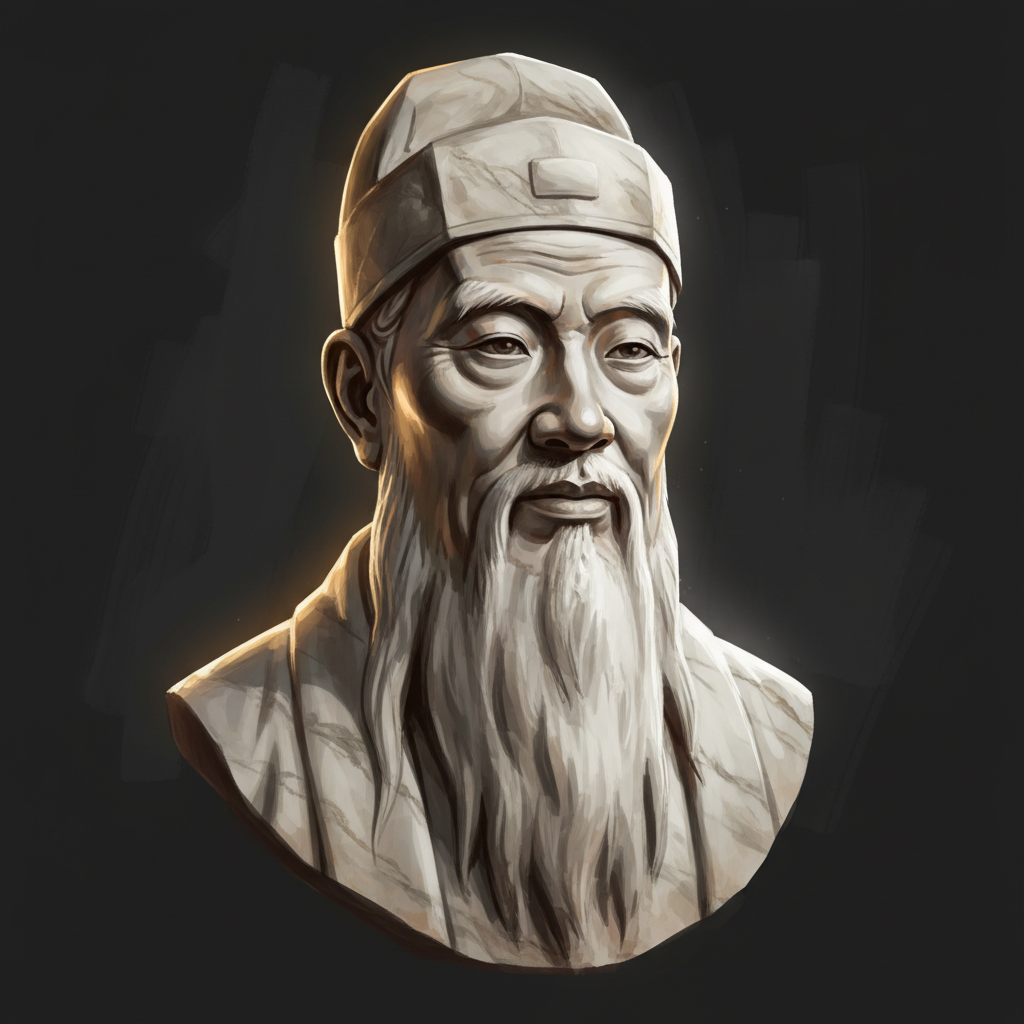
Confucius — "The student of virtue has no time for idleness."
The student of virtue has no time for idleness.
The student of virtue has no time for idleness.
Click any product to generate a realistic preview. Up to 3 at a time.
* Initial load can take up to 90 seconds — revising the preview in another color is nearly instant.
"The gentleman is calm and at ease; the small man is fretful and ill at ease."
"The Master said, 'The superior man is firm in the right way, and not merely firm.'"
"The Master said, 'When I walk along with two others, they may serve me as my teachers. I will select their good qualities and follow them, their bad qualities and avoid them.'"
"The gentleman understands integrity; the petty person knows about profit."
"The Master said, 'The superior man is dignified, but not proud. The mean man is proud, but not dignified.'"
Chinese philosopher and teacher whose teachings (compiled by his students in the Analects) became the foundational ethical framework of East Asian civilization for 2,500 years. Closely associated with Mencius (his most-influential follower a century later). For an intellectual contrast, see Laozi, near-contemporary Chinese sage and Tao Te Ching author — Confucius systematized social order through ritual and family hierarchy; Laozi's Taoist effortless-action philosophy argued such systems were the disease, not the cure. The two founding poles of Chinese moral philosophy — every East Asian moral tradition since has positioned itself between them.
The standard scholarly entry points to Confucius's work: Philip J. Ivanhoe (Georgetown, Chinese philosophy) — Confucian Moral Self Cultivation (2000); Edward Slingerland (UBC, Asian Studies) — Effortless Action: Wu-wei as Conceptual Metaphor (2003); Tu Weiming (Harvard, Confucian scholar) — Confucian Thought: Selfhood as Creative Transformation (1985). These are the works graduate seminars cite when teaching Confucius.
Found in 1 providers: grok
1 source checked
Anyone seriously pursuing moral growth and good character will find their days full. Becoming a better person requires constant practice, study, reflection, and disciplined action, leaving no gaps for laziness or wasted hours. Idleness is incompatible with genuine self-improvement because virtue is not a static achievement but a continuous effort. If you are truly committed to bettering yourself ethically, you simply do not have spare time to squander on nothing.
Confucius built his entire philosophy around self-cultivation, ren (humaneness), and lifelong learning. He traveled for years seeking rulers who would apply his ethics and taught roughly three thousand students, emphasizing constant study, ritual practice, and moral refinement. He famously said he never tired of learning or teaching. For him, becoming a junzi, or exemplary person, demanded relentless daily effort, making idleness the opposite of the disciplined, purposeful life he modeled and preached.
Confucius lived during the Spring and Autumn period of the late Zhou dynasty, around 551 to 479 BCE, an age of political fragmentation, warring feudal states, and collapsing social order. Traditional rituals and hereditary virtue were eroding, and rulers prized military cunning over moral character. Against this chaos, Confucius urged a return to disciplined self-cultivation and civic duty as the foundation for restoring harmony, making the call to reject idleness a direct answer to his turbulent, morally adrift era.
AI-generated insights based on extensive research and information for context. Factual errors? Email [email protected].
Your cart is empty