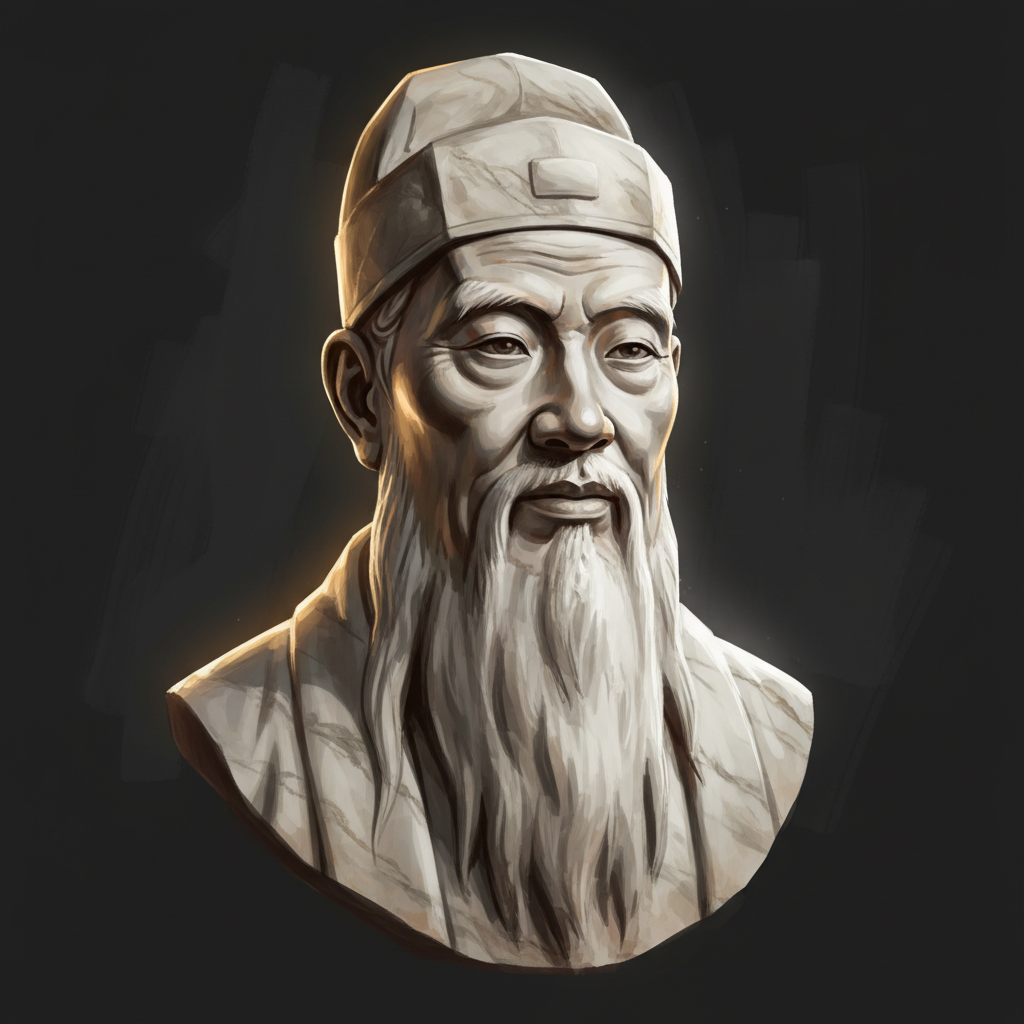
Confucius — "A youth is to be regarded with respect. How do we know that his future will not …"
A youth is to be regarded with respect. How do we know that his future will not be equal to our present?
A youth is to be regarded with respect. How do we know that his future will not be equal to our present?
Click any product to generate a realistic preview. Up to 3 at a time.
* Initial load can take up to 90 seconds — revising the preview in another color is nearly instant.
"The Master said, 'The superior man, extensively studying all learning, and keeping himself under the restraint of the rules of propriety, may thus likewise not overstep what is right.'"
"The Master said, 'A youth is to be regarded with respect. How do we know that his future will not be equal to our present? If he reach the age of forty or fifty, and has made no name for himself, then…"
"The Master said, 'He who is not concerned about the distant future will find trouble right at hand.'"
"The superior man is satisfied with himself; the inferior man seeks to please others."
"The faults of a man are characteristic of his class. It is by observing a man's faults that one may know his virtue."
Chinese philosopher and teacher whose teachings (compiled by his students in the Analects) became the foundational ethical framework of East Asian civilization for 2,500 years. Closely associated with Mencius (his most-influential follower a century later). For an intellectual contrast, see Laozi, near-contemporary Chinese sage and Tao Te Ching author — Confucius systematized social order through ritual and family hierarchy; Laozi's Taoist effortless-action philosophy argued such systems were the disease, not the cure. The two founding poles of Chinese moral philosophy — every East Asian moral tradition since has positioned itself between them.
The standard scholarly entry points to Confucius's work: Philip J. Ivanhoe (Georgetown, Chinese philosophy) — Confucian Moral Self Cultivation (2000); Edward Slingerland (UBC, Asian Studies) — Effortless Action: Wu-wei as Conceptual Metaphor (2003); Tu Weiming (Harvard, Confucian scholar) — Confucian Thought: Selfhood as Creative Transformation (1985). These are the works graduate seminars cite when teaching Confucius.
Found in 1 providers: grok
1 source checked
Young people deserve genuine respect because you cannot predict what they will accomplish. The person who seems inexperienced today may surpass everything you have achieved. Dismissing someone based on age is a mistake, since their potential is genuinely unknown. Treat the next generation with the same seriousness you would want for yourself, because the future belongs to them and they may eclipse the current generation.
Confucius built his life around teaching students, running a school open to anyone regardless of social rank, which was radical for his time. He valued continuous self-cultivation and believed virtue, not birth, determined worth. This saying reflects his pedagogy: students were not lesser beings but future sages in formation. His most famous disciples, like Yan Hui, earned his deep admiration, showing he practiced this humility toward youth genuinely.
During the late Spring and Autumn period around 500 BCE, Chinese society was rigidly hierarchical, with age and lineage determining status absolutely. Elders commanded automatic deference, and youth were expected to remain silent before superiors. The Zhou dynasty was fragmenting into warring states, and traditional aristocratic authority was crumbling. Confucius's suggestion that young people might surpass their elders challenged ingrained assumptions, opening the door to meritocratic thinking that would later influence the imperial examination system.
AI-generated insights based on extensive research and information for context. Factual errors? Email [email protected].
Your cart is empty