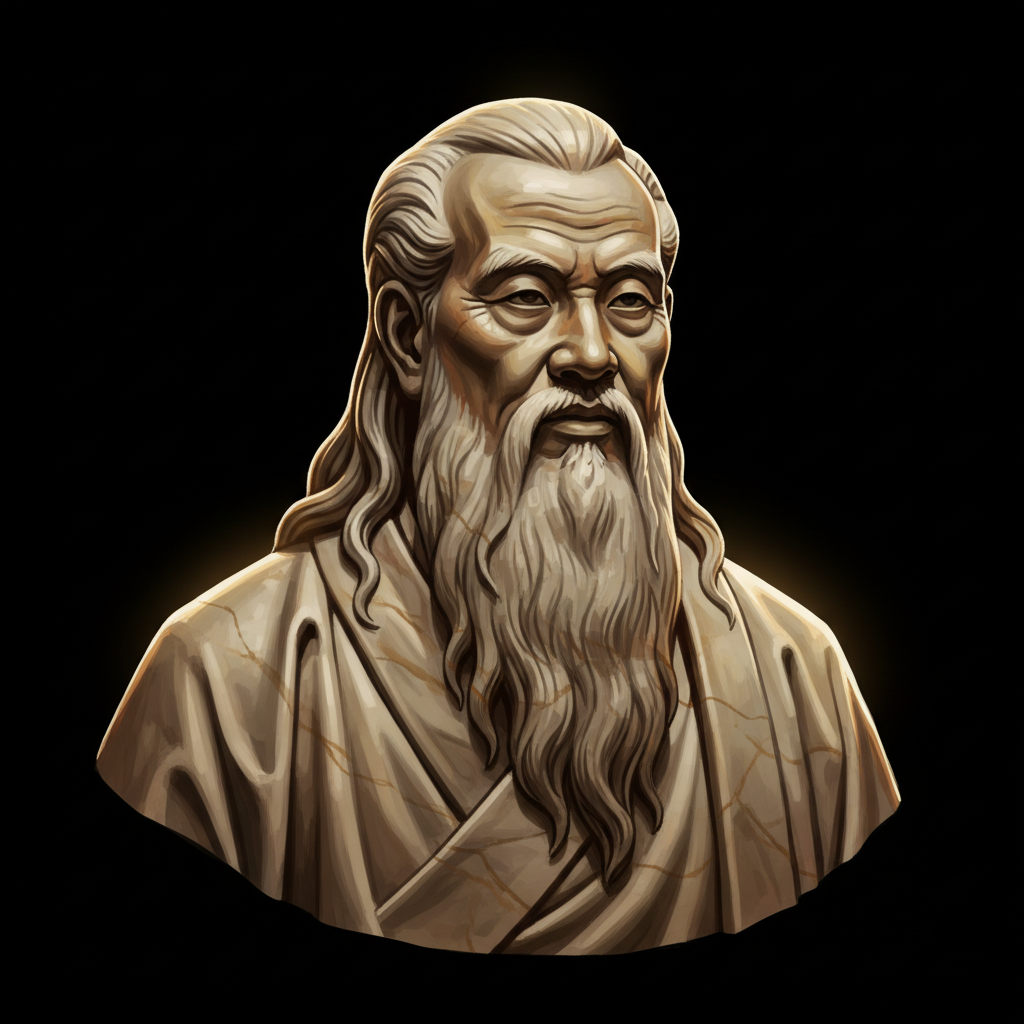
Laozi — "He who talks much is soon exhausted."
He who talks much is soon exhausted.
He who talks much is soon exhausted.
Click any product to generate a realistic preview. Up to 3 at a time.
* Initial load can take up to 90 seconds — revising the preview in another color is nearly instant.
"The sage is like water, which flows to the lowest places and yet is the strongest."
"The highest good is like water. It nourishes all things without trying to."
"The greatest villain is the one who tries to do good."
"The sage is sharp but not cutting, pointed but not piercing, straightforward but not unrestrained, brilliant but not dazzling."
"To attain knowledge, add things everyday. To attain wisdom, remove things every day."
Reputed founder of Taoism and author of the Tao Te Ching, whose wu wei (effortless action) shaped East Asian philosophy. Closely associated with Zhuangzi (later Taoist who extended Laozi's framework). For an intellectual contrast, see Confucius, near-contemporary Chinese sage of social ritual and duty — Confucius systematized social order through ritual and hierarchy; Laozi argued that all such systems were the disease, not the cure — the two founding poles of Chinese moral philosophy.
Found in 1 providers: grok
1 source checked
Constant talking drains energy and rarely achieves much. Words spent freely lose their weight, while the talker wears themselves out explaining, arguing, and persuading. Silence preserves strength and forces others to listen when you do speak. The more you say, the less each statement matters, and the quicker you empty yourself of both ideas and vitality. Restraint keeps you sharper, calmer, and more effective than endless chatter ever could.
Laozi championed wu wei, effortless action, and distrusted excessive speech, famously writing that those who know do not speak. As the legendary keeper of Zhou dynasty archives, he observed officials and scholars debating endlessly while accomplishing little. His Tao Te Ching repeatedly praises silence, humility, and conserving one's inner energy. This saying captures his conviction that wisdom flows from stillness, and that noisy self-assertion reveals emptiness rather than strength or genuine understanding.
Laozi lived during the late Zhou dynasty, around the 6th century BCE, amid political decay leading into the Warring States period. Rival courts employed persuaders, diplomats, and rhetoricians who talked ceaselessly to gain influence, while philosophical schools competed loudly for patronage. Against this backdrop of verbal combat and scheming ministers, Laozi's praise of quiet restraint was radical. His teaching offered an alternative to the exhausting rhetorical arms race consuming the educated class of ancient China.
AI-generated insights based on extensive research and information for context. Factual errors? Email [email protected].
Your cart is empty