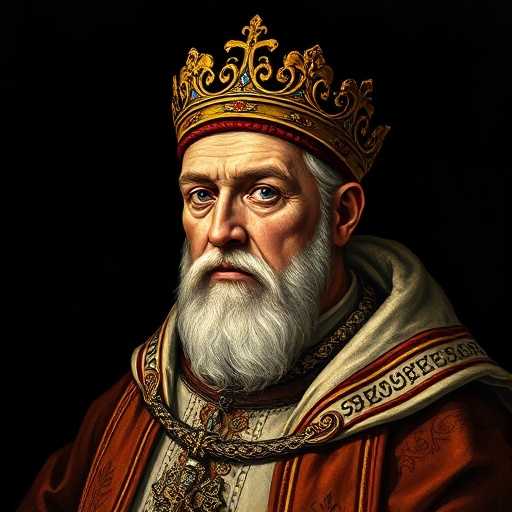
Pope Urban II — "The holy city of Jerusalem is now held captive by the enemies of God."
The holy city of Jerusalem is now held captive by the enemies of God.
The holy city of Jerusalem is now held captive by the enemies of God.
Click any product to generate a realistic preview. Up to 3 at a time.
* Initial load can take up to 90 seconds — revising the preview in another color is nearly instant.
"The land of promise, which the Lord gave to the children of Israel, is now occupied by the enemies of Christ."
"Go forth, therefore, and cleanse the Holy Sepulchre from the wicked race."
"Let no delay postpone the journey."
"We absolve all who undertake this journey from all penance for their sins."
"Oh, how admirable is that salting! Truly, you must strive by the salt of wisdom to correct these foolish people, hastening open-mouthed after the pleasures of this world, lest putrefied by sins and un…"
Pope (1088-1099) whose Council of Clermont speech (November 1095) launched the First Crusade — the founding event of nine centuries of Christian-Muslim military conflict. Closely associated with Pope Gregory VII (his predecessor on papal-imperial reform). For an intellectual contrast, see Saladin, Kurdish-Muslim Sultan of Egypt and Syria (1138-1193) — Saladin recaptured Jerusalem in 1187, undoing the First Crusade Urban II launched 92 years earlier. Saladin's chivalrous treatment of Christian prisoners became the canonical Muslim counter-image to Crusader brutality. The cleanest before/after pairing of the Crusades' moral arc.
Found in 1 providers: grok
1 source checked
Jerusalem is declared a prisoner of God's enemies, framing Muslim control as a spiritual emergency rather than a political fact. The word 'captive' evokes chains and suffering, demanding liberation. By labeling those in power 'enemies of God,' the statement strips away diplomatic nuance and recasts armed conflict as sacred obligation. Any Christian hearing it understands: inaction equals complicity in a divine wrong that must be answered by force.
Urban II delivered this framing at the Council of Clermont in 1095, igniting the First Crusade. His papacy centered on Church reform and asserting papal supremacy over secular rulers—this rhetoric embodied that vision perfectly. By declaring Jerusalem captive, he exercised spiritual authority to mobilize feudal armies under divine sanction, bypassing kings and positioning the pope as commander of all Christendom. Jerusalem's fate became inseparable from his project of unified papal leadership.
In 1095, Seljuk Turks controlled Jerusalem and had restricted Christian pilgrimage access, alarming Byzantine Emperor Alexios I, who appealed to Rome for military aid. Western Europe was steeped in pilgrimage culture and holy war theology; knights needed religious legitimacy for violence. The 1054 East-West schism also left Rome eager to reassert influence over Eastern Christianity. Reclaiming Jerusalem offered Urban a singular opportunity to unite fractured Christendom under one papal cause.
AI-generated insights based on extensive research and information for context. Factual errors? Email [email protected].
Your cart is empty