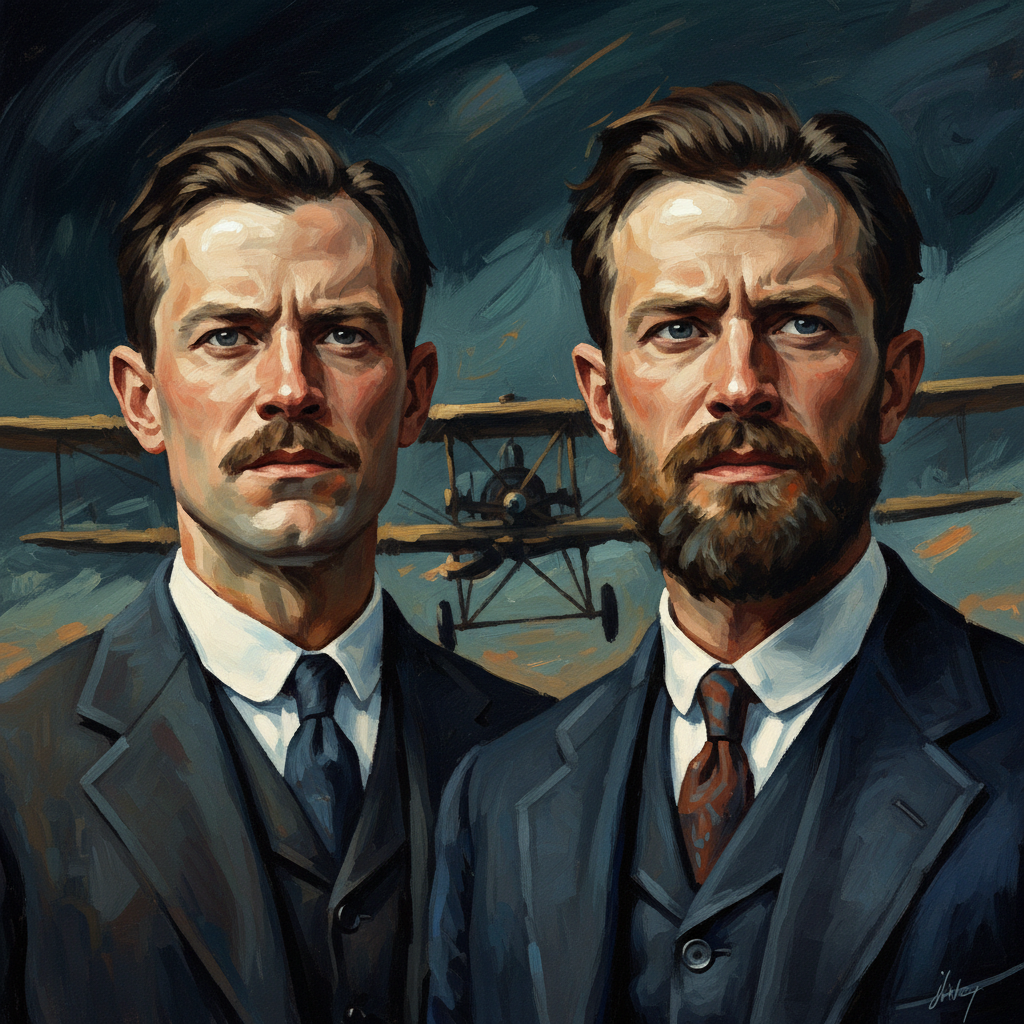
Wright Brothers (Orville & Wilbur) — "It is a pleasure to be able to inform you that the machine has been a success."
It is a pleasure to be able to inform you that the machine has been a success.
It is a pleasure to be able to inform you that the machine has been a success.
Click any product to generate a realistic preview. Up to 3 at a time.
* Initial load can take up to 90 seconds — revising the preview in another color is nearly instant.
"We kept at it, and we kept on learning."
"We have at last succeeded in making a machine that will fly."
"The air, like the sea, is an untamed element."
"Our confidence in the ability of men to fly has not been shaken."
"The machine was kept in the air for 59 seconds and traveled 852 feet."
American aviation pioneers who achieved the first sustained powered controlled airplane flight at Kitty Hawk, NC, on December 17, 1903. Closely associated with Octave Chanute (their gliding mentor and aeronautical correspondent). For an intellectual contrast, see Samuel Pierpont Langley, Smithsonian Institution Secretary and government-funded aviation researcher — Langley's Aerodrome crashed twice into the Potomac in October-December 1903 with $50,000 of War Department funding; the Wright Brothers' bicycle-shop empiricism beat Langley's institutional Big Science by 9 days. The most-cited example in engineering history of empirical-tinkerer beating institution-funded credentialism.
Telegram from Orville Wright to his father, Bishop Milton Wright, announcing first flight
Date: 1903
GeneralFound in 1 providers: grok
1 source checked
A measured, understated announcement that something attempted has worked. It avoids triumph or boasting, framing world-altering success in polite, practical language. "The machine" does the heavy lifting — no name, no fanfare — just confirmation it performed as intended. It communicates the satisfaction of a craftsman whose careful work produced the expected result, rather than a visionary celebrating a historic breakthrough. Restraint itself becomes the statement.
These words come from Orville's telegram to their father Milton after four successful flights at Kitty Hawk on December 17, 1903. The brothers were Dayton bicycle mechanics — self-taught, methodical, unsponsored — who treated aeronautics as an engineering problem to solve systematically. Their approach was always practical over romantic. That this telegram, announcing the first powered flight in human history, reads like a routine progress report perfectly captures their disciplined character.
In 1903, powered flight was widely considered impossible. The Smithsonian Institution had just funded Samuel Langley's publicized Aerodrome, which crashed twice into the Potomac. Newspapers openly mocked the idea. The Wright brothers, working without government funding or academic credentials, succeeded nine days after Langley's final failure. The industrial revolution had delivered precision manufacturing and internal combustion engines — the raw materials of flight — but no institution had yet assembled them correctly.
AI-generated insights based on extensive research and information for context. Factual errors? Email [email protected].
Your cart is empty