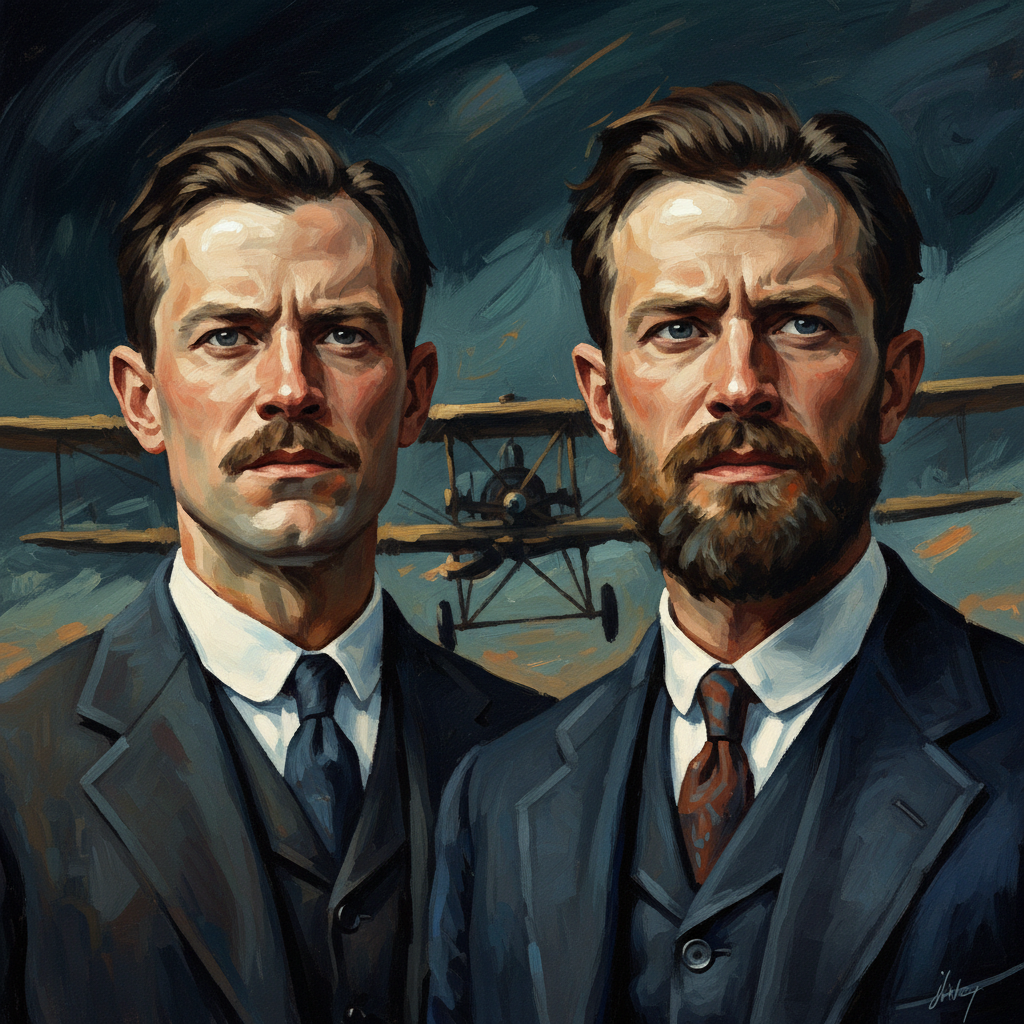
Wright Brothers (Orville & Wilbur) — "We have at last succeeded in making a machine that will fly."
We have at last succeeded in making a machine that will fly.
We have at last succeeded in making a machine that will fly.
Click any product to generate a realistic preview. Up to 3 at a time.
* Initial load can take up to 90 seconds — revising the preview in another color is nearly instant.
"The airplane stays up because it doesn’t have the time to fall."
"The machine itself is but a tool, the spirit that controls it is the thing."
"Learning the secret of flight from a bird was a good deal like learning the secret of magic from a magician."
"The machine is practically ready for its public demonstration."
"I confess that in 1901 I said to my brother Orville that man would not fly for 50 years. Ever since I have distrusted myself and every time I think that a particular thing will not be done, I recall t…"
American aviation pioneers who achieved the first sustained powered controlled airplane flight at Kitty Hawk, NC, on December 17, 1903. Closely associated with Octave Chanute (their gliding mentor and aeronautical correspondent). For an intellectual contrast, see Samuel Pierpont Langley, Smithsonian Institution Secretary and government-funded aviation researcher — Langley's Aerodrome crashed twice into the Potomac in October-December 1903 with $50,000 of War Department funding; the Wright Brothers' bicycle-shop empiricism beat Langley's institutional Big Science by 9 days. The most-cited example in engineering history of empirical-tinkerer beating institution-funded credentialism.
Found in 1 providers: grok
1 source checked
After years of failed attempts and skepticism from the public and scientific community, the speakers announce a breakthrough achievement. They have built a device capable of sustained, controlled flight through the air. The statement is understated yet historic, conveying quiet triumph over a problem that had defeated inventors for centuries. It marks the moment humanity transitioned from earthbound travel to conquering the sky through mechanical means.
Orville and Wilbur Wright were self-taught bicycle mechanics from Dayton, Ohio, with no formal engineering degrees. They methodically solved flight through wind-tunnel testing, wing-warping control, and a custom lightweight engine. On December 17, 1903, at Kitty Hawk, Orville piloted the first powered, controlled, heavier-than-air flight for 12 seconds. This quiet, factual declaration reflects their modest Midwestern character and engineer's mindset: let the results speak, avoid boasting.
In the early 1900s, powered flight was widely considered impossible or decades away. Samuel Langley's government-funded attempts had failed publicly weeks earlier. The Second Industrial Revolution was transforming society with automobiles, electricity, and telephones, yet two bicycle-shop owners outpaced funded scientists. Newspapers initially refused to believe the Wrights' claims, and it took years for their achievement to gain recognition. Their breakthrough launched the aviation age that would reshape warfare, commerce, and global travel.
AI-generated insights based on extensive research and information for context. Factual errors? Email [email protected].
Your cart is empty