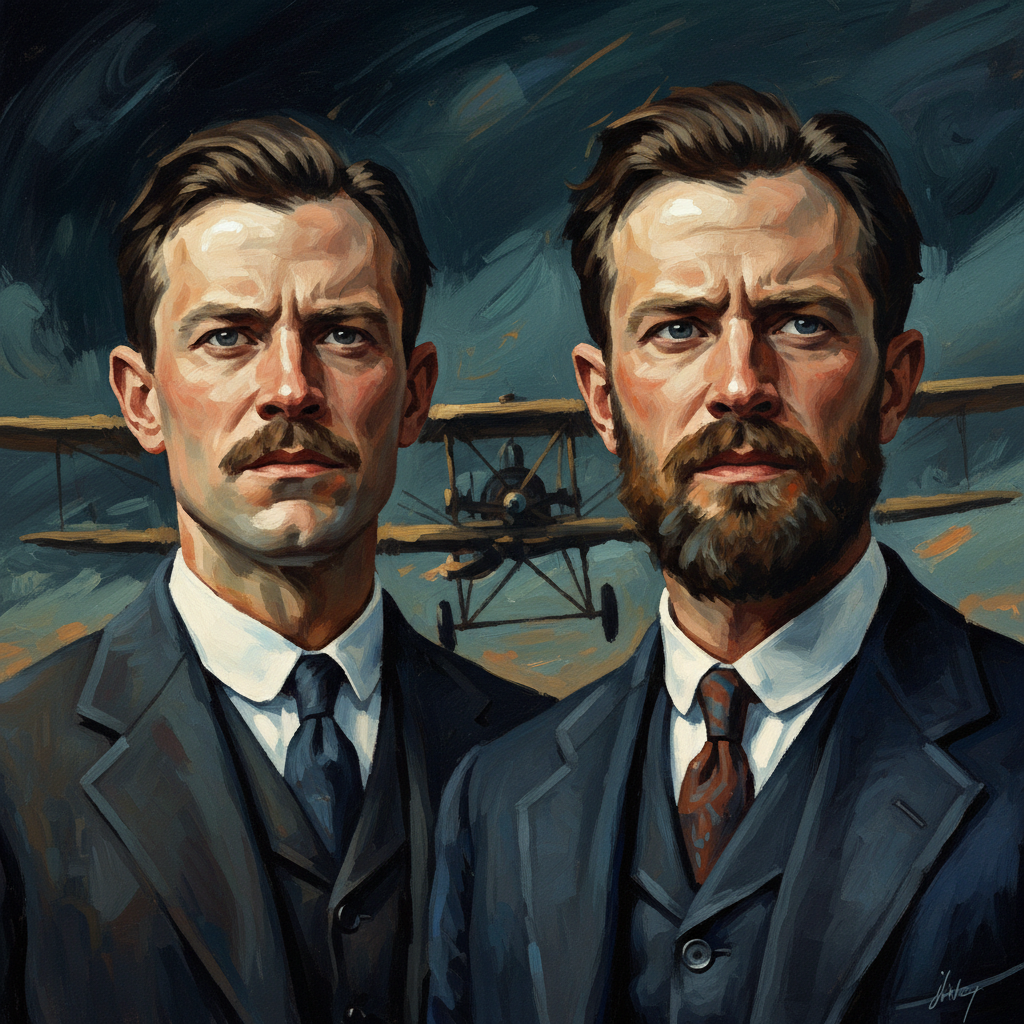
Wright Brothers (Orville & Wilbur) — "Our confidence in the ability of men to fly has not been shaken."
Our confidence in the ability of men to fly has not been shaken.
Our confidence in the ability of men to fly has not been shaken.
Click any product to generate a realistic preview. Up to 3 at a time.
* Initial load can take up to 90 seconds — revising the preview in another color is nearly instant.
"The airplane stays up because it doesn’t have the time to fall."
"We have been making flights at an altitude of about 50 feet."
"The course of the experiment was not always smooth. The machine would start all right, but the propelling power was not sufficient to overcome the resistance of the air."
"We have been trying to make a machine that will fly, and we have succeeded."
"It is difficult to understand how anyone could have been so blind to the truth."
American aviation pioneers who achieved the first sustained powered controlled airplane flight at Kitty Hawk, NC, on December 17, 1903. Closely associated with Octave Chanute (their gliding mentor and aeronautical correspondent). For an intellectual contrast, see Samuel Pierpont Langley, Smithsonian Institution Secretary and government-funded aviation researcher — Langley's Aerodrome crashed twice into the Potomac in October-December 1903 with $50,000 of War Department funding; the Wright Brothers' bicycle-shop empiricism beat Langley's institutional Big Science by 9 days. The most-cited example in engineering history of empirical-tinkerer beating institution-funded credentialism.
Found in 1 providers: grok
1 source checked
Even after setbacks, doubts, or failures, belief in human flight remains firm. The speakers refuse to let obstacles, critics, or unsuccessful attempts erode their certainty that people can and will fly. It is a declaration of steady conviction in the face of discouragement, signaling that progress may stumble but the underlying goal is still achievable and worth pursuing relentlessly.
The Wrights faced years of crashes, failed glider designs, and public skepticism before their 1903 Kitty Hawk success. Bicycle mechanics without formal engineering training, they pushed through Lilienthal's fatal glider crash, their own 1901 setbacks, and ridicule from scientists who declared heavier-than-air flight impossible. This quote captures their stubborn, methodical faith that disciplined experimentation would eventually conquer the air.
In the late 1890s and early 1900s, powered flight was widely mocked as a fool's errand. Samuel Langley's publicly funded Aerodrome had just crashed into the Potomac in 1903, and The New York Times declared flying machines would take a million years. Industrial optimism collided with entrenched scientific doubt, making the Wrights' quiet persistence a radical stance during an age otherwise obsessed with railroads, steamships, and electrification.
AI-generated insights based on extensive research and information for context. Factual errors? Email [email protected].
Your cart is empty