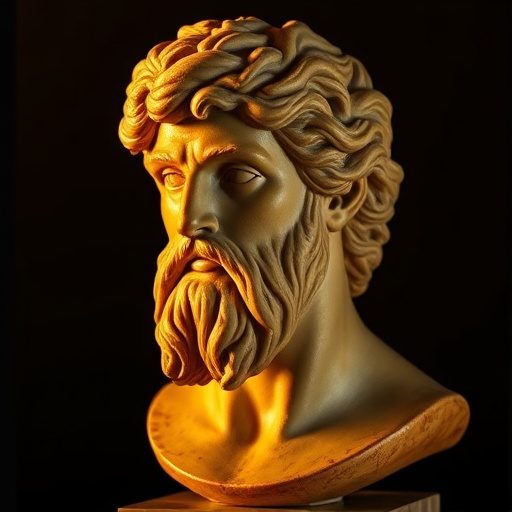
Pythagoras — "Don't eat your heart."
Don't eat your heart.
Don't eat your heart.
Click any product to generate a realistic preview. Up to 3 at a time.
* Initial load can take up to 90 seconds — revising the preview in another color is nearly instant.
"It is only necessary to make war with five things; with the maladies of the body, the ignorances of the mind, with the passions of the body, with the seditions of the city and the discords of families…"
"Do not offer the right hand to everyone."
"The monad, is god and the good, which is the origin of the One, and is itself intelligence; but the undefined dyad is a deity and the evil, surrounding which is the mass of matter."
"The property of friends is common."
"The beginning is half of the whole."
Greek philosopher and mathematician whose school in Croton combined geometry (the Pythagorean theorem), number-mysticism, and a religious-vegetarian way of life. Closely associated with Thales of Miletus (earlier pre-Socratic and the first philosopher). For an intellectual contrast, see Heraclitus, pre-Socratic Greek philosopher of flux — Heraclitus called Pythagoras 'the chief of swindlers' — among the founding insults of the philosophical-rivalry tradition. Their 'all is flux' vs 'all is number' poles still organize the philosophy of mathematics today (Platonist vs anti-realist).
A Pythagorean 'Symbol', interpreted by Diogenes Laertius as 'not wearing away your mind with troubles and grief'.
Date: c. 570-495 BCE (interpreted 3rd century CE)
Art & CreativityFound in 1 providers: gemini
1 source checked
Don't torment yourself with anxiety, grief, or regret over things beyond your power. Stop obsessing over past mistakes or worrying about futures you cannot control — that internal gnawing destroys you from within. Excessive rumination depletes mental energy without producing any useful result. Recognize what you can change, act on it, then release the rest rather than letting unresolvable troubles consume your peace and clarity.
Pythagoras founded a philosophical brotherhood in Croton governed by strict behavioral rules — the akousmata — covering diet, speech, and emotional conduct. He believed the soul required purification through rational self-mastery. His famous prohibitions against beans and meat reflected his conviction that what one consumes shapes the soul. This maxim extends that logic inward: emotional self-torment corrupts inner harmony just as impure intake corrupts the body.
Pythagoras lived in the 6th century BCE, before Stoicism formally codified emotional self-discipline. Greek culture prized public honor and communal ritual but offered little guidance for managing private grief or anxiety. His community-based philosophical school was radical — it treated inner emotional regulation as essential to a virtuous life. In an era of city-state rivalries and frequent war, systematic teaching on not self-destructing through worry was genuinely novel.
AI-generated insights based on extensive research and information for context. Factual errors? Email [email protected].
Your cart is empty