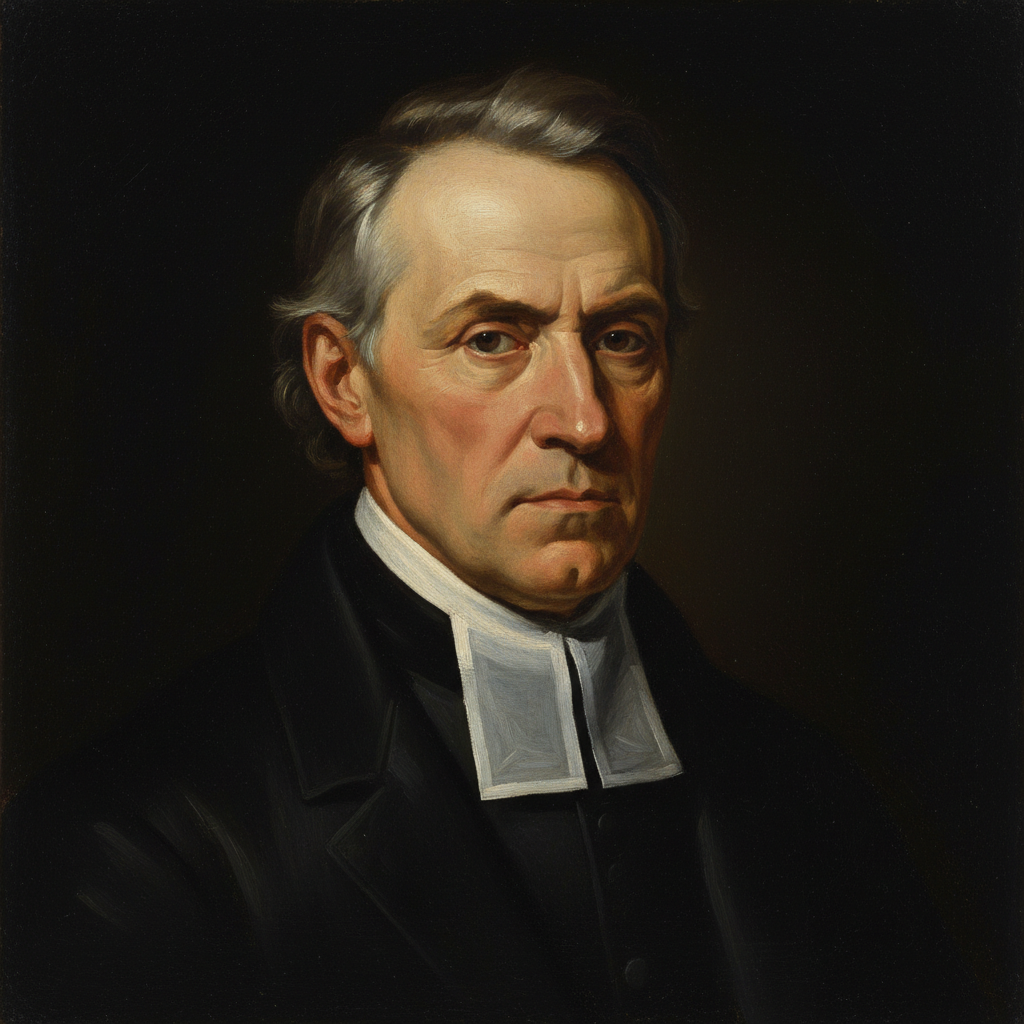
John Wesley — "I conceive slavery to be such a thing as is odious to the God of love."
I conceive slavery to be such a thing as is odious to the God of love.
I conceive slavery to be such a thing as is odious to the God of love.
Click any product to generate a realistic preview. Up to 3 at a time.
* Initial load can take up to 90 seconds — revising the preview in another color is nearly instant.
"I have often thought, that if I were to choose a food to eat, it should be bread and water."
"I am not afraid of being accounted an enthusiast. I am afraid of nothing but sin."
"I continue to dream and pray about a revival of holiness in our day that moves forth in power and reaches to the ends of the earth."
"What is the Lord’s Supper? It is a feast upon a sacrifice."
"Women's preaching is flatly contrary to the Bible."
English Anglican cleric and founder of Methodism, whose open-air preaching and class-meeting structure created the largest 18th-century evangelical revival. Closely associated with Charles Wesley (his hymn-writing brother) and George Whitefield (early co-revivalist, later doctrinal opponent). For an intellectual contrast, see George Whitefield, Calvinist evangelical revivalist — Whitefield's predestinarian Calvinism vs Wesley's free-grace Arminian theology split the early Methodist movement permanently in the 1739-41 break. The founding evangelical Calvinist-Arminian schism — the two parallel evangelical traditions American Christianity descends from.
Found in 1 providers: deepseek
1 source checked
Slavery is deeply offensive to God precisely because God's defining nature is love. Wesley argues theologically: a deity whose essence is love cannot sanction an institution that strips human beings of freedom, dignity, and personhood. This isn't merely a social critique — it's a spiritual verdict. Owning another person as property is incompatible with divine love, making opposition to slavery not just a moral preference but a religious obligation.
Wesley's theology of universal grace — that Christ redeemed all souls equally — made slavery theologically untenable in his framework. He published 'Thoughts Upon Slavery' in 1774, one of the era's most forceful abolitionist pamphlets. His final letter, written days before his 1791 death, urged William Wilberforce to continue fighting the slave trade. Wesley's conviction that every person holds inherent worth before God made him a natural abolitionist decades before the movement reached parliament.
The Atlantic slave trade reached peak volume in the 18th century, with Britain transporting hundreds of thousands of Africans to colonial plantations annually. Abolitionism was barely organized — the Society for Effecting the Abolition of the Slave Trade formed only in 1787. Wesley's condemnation in the 1770s was among the earliest influential challenges, framing the debate in moral-theological terms at a time when economic justifications dominated and slave-owning among Christians faced almost no institutional opposition.
AI-generated insights based on extensive research and information for context. Factual errors? Email [email protected].
Your cart is empty