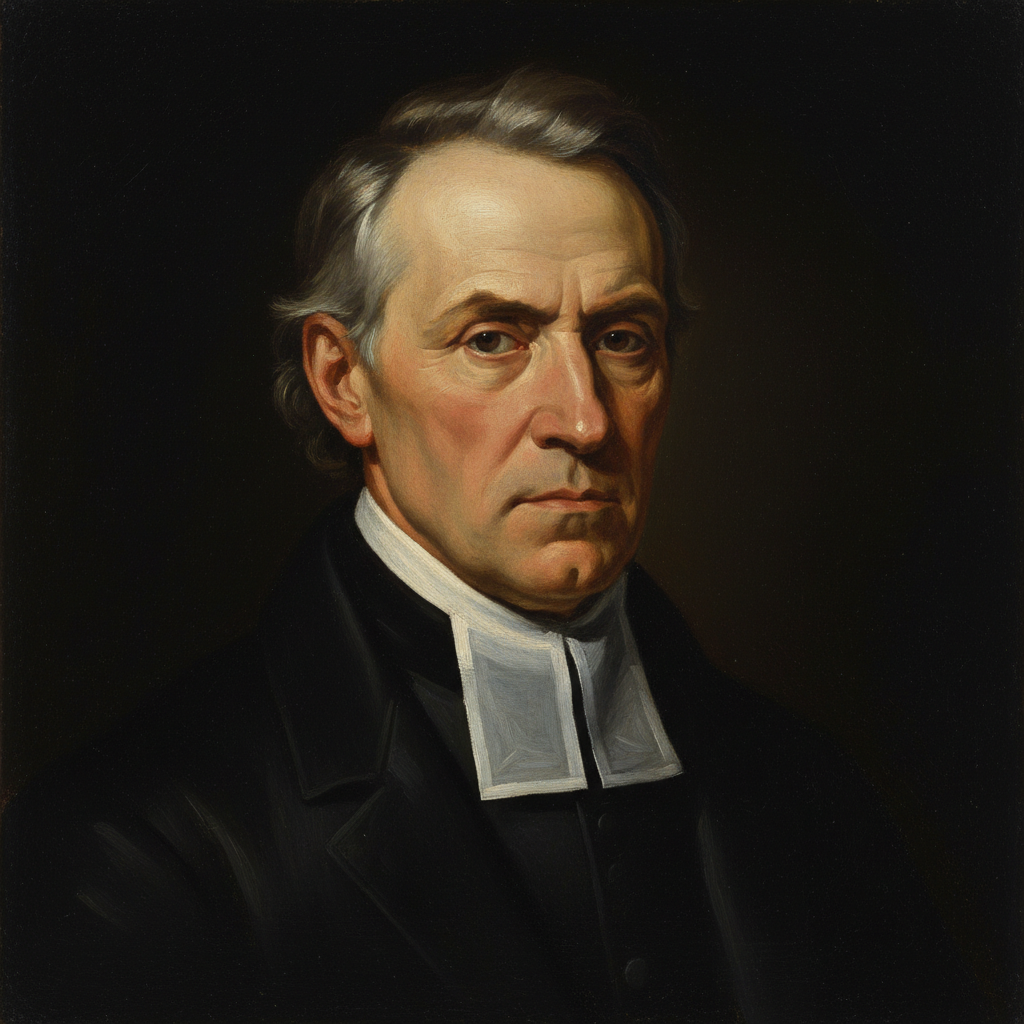
John Wesley — "I am not afraid of being accounted an enthusiast. I am afraid of nothing but sin…"
I am not afraid of being accounted an enthusiast. I am afraid of nothing but sin.
I am not afraid of being accounted an enthusiast. I am afraid of nothing but sin.
Click any product to generate a realistic preview. Up to 3 at a time.
* Initial load can take up to 90 seconds — revising the preview in another color is nearly instant.
"Satan has no objection to our being religious, provided we are not too religious."
"It is a poor religion that consists in negatives only."
"The greatest enemy to human happiness is the love of money."
"I have often thought, that the best way to do good, is to do it as if you were doing it for yourself."
"It is not the being in a place, but the being in a state, that makes us happy."
English Anglican cleric and founder of Methodism, whose open-air preaching and class-meeting structure created the largest 18th-century evangelical revival. Closely associated with Charles Wesley (his hymn-writing brother) and George Whitefield (early co-revivalist, later doctrinal opponent). For an intellectual contrast, see George Whitefield, Calvinist evangelical revivalist — Whitefield's predestinarian Calvinism vs Wesley's free-grace Arminian theology split the early Methodist movement permanently in the 1739-41 break. The founding evangelical Calvinist-Arminian schism — the two parallel evangelical traditions American Christianity descends from.
Found in 1 providers: grok
1 source checked
The speaker declares fearlessness about being labeled a religious fanatic or excessive zealot. Their only genuine fear is moral wrongdoing. This is a statement of radical prioritization: social reputation and others' judgments matter far less than maintaining personal integrity and avoiding actions that violate one's conscience and God's commands.
Wesley was routinely mocked as an 'enthusiast' — the 18th-century term for dangerously irrational religious fervor — by Anglican clergy and educated society. He preached in fields, organized working-class converts, and pursued intense personal holiness through his Methodist discipline. His entire ministry defied respectable opinion while centering on the pursuit of sanctification and freedom from sin.
In Georgian England, 'enthusiasm' in religion was considered socially dangerous and mentally unhinged, associated with disruptive dissent. The established Church of England prized rational, orderly worship. Wesley's outdoor preaching to miners and laborers scandalized polite society. Meanwhile, widespread poverty, gin epidemic, and moral decay made sin a visible societal crisis, lending his fear of sin urgent practical meaning.
AI-generated insights based on extensive research and information for context. Factual errors? Email [email protected].
Your cart is empty